Hey everyone, it’s Ugu!
I’ve spent a lot of time thinking about our future on Mars and the Moon. We usually talk about rockets, oxygen scrubbers, and radiation shielding, but there is one “human” question we often shy away from: Can we actually have families in space? If we want to become a multi-planetary species, we have to be able to reproduce. For a long time, the biological impact of microgravity and cosmic radiation on pregnancy was a giant, scary question mark. But thanks to four very brave (and very tiny) “astronaut” mice from China’s Tiangong space station, I think we finally have a reason to be incredibly optimistic.
One of these mice just returned to Earth and gave birth to nine healthy pups. Honestly, reading this report made me feel like the dream of a Martian colony just got a whole lot more real. Let’s dive into why this “mouse-sized” step is actually a giant leap for us.
Not Just “Random” Mice: The Astronaut Selection
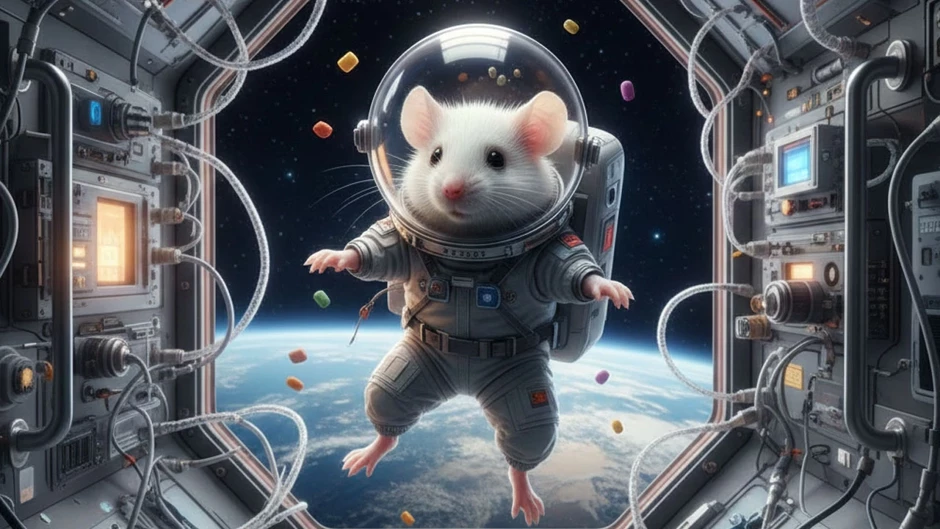
When I first heard about this, I thought they just grabbed some lab mice and sent them up. I was wrong. The Chinese Academy of Sciences (CAS) treated these mice like elite athletes.
To make sure the data was solid, the mice went through a rigorous selection process that sounds surprisingly like what human astronauts go through:
- Balance Tests: Can they handle the disorientation?
- Motion Sickness Resistance: No one wants a nauseous mouse in a multi-billion dollar station.
- Determination: They were tested on how they handle obstacles and stress.
Only the four most “zen” and physically fit mice made the cut for the Shenzhou-21 mission. It’s funny to think about, but these little guys are effectively the “Chuck Yeagers” of the rodent world.

Survival Mode: The Great Soy Milk Rescue
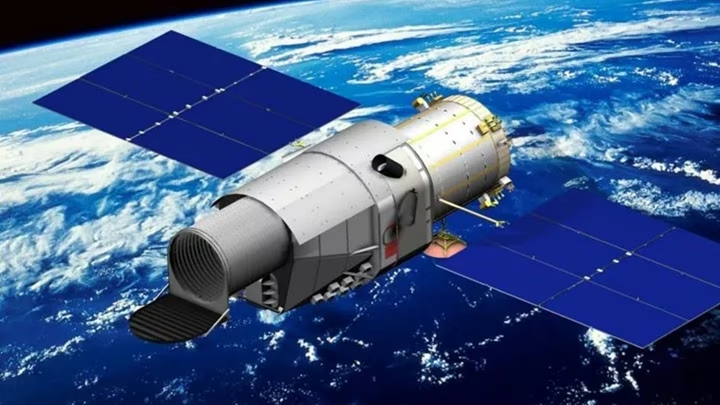
Here is a detail that I found absolutely wild while researching this: the mission almost ended in a disaster due to space debris.
Because of a delay caused by debris risks, the mice had to stay up there longer than planned. Their food stocks started running low. In a move that feels like a scene from a sci-fi movie, the taikonauts (Chinese astronauts) actually shared their own soy milk stocks with the mice to keep them nourished.
Imagine being an astronaut on a high-stakes mission and hand-feeding soy milk to a mouse so that the future of human reproduction research doesn’t fail. I love this—it shows the bond between humans and our “co-pilots” in the stars. Despite this “food crisis” and the stress of the delay, the mice stayed healthy. That tells me a lot about their resilience.
Why Two Weeks is a Big Deal

You might think, “Ugu, it was only two weeks. That’s nothing.” But here is the kicker: A mouse’s life cycle is much faster than ours.
Biologically speaking, two weeks for a mouse is roughly equivalent to over a year for a human. If a mouse can spend the equivalent of a year in microgravity, return to Earth, and immediately have a successful, healthy pregnancy, it suggests that short-to-medium-term space travel doesn’t “break” our reproductive systems permanently.
The Physics of the “Nursery”
CAS scientists didn’t just let the mice float around. They designed special cages that used airflow systems to manage waste and hair. In zero-G, things like “ticking off” waste can become a health hazard for both the mice and the station’s air filters. Seeing the engineering that went into a “mouse hotel” in space makes me realize how close we are to building larger-scale habitats.
Are “Space Babies” Different?

Now, the big question: Are the pups okay?
Out of the nine babies, most are developing perfectly. Professor Wang Hongmei, who led the study, pointed out that this gives us “invaluable data” on the early stages of mammalian development.
However, I have to be the “realistic Ugu” for a second. These mice stayed within the protection of the Earth’s magnetic field (mostly). They didn’t cross the Van Allen radiation belts, which is what we’ll face on the way to Mars. So, while we’ve conquered the “microgravity” part of the puzzle, the “deep space radiation” part is the next boss level we need to beat.
My Perspective: The Biological Boundary is Moving
I used to think our biology would be the thing that kept us trapped on Earth. I thought we were too “fragile” for the stars. But these mice—with their symbolic names about “reaching the moon” and “chasing clouds”—are proving that life is much tougher than we give it credit for.
If we can protect the early stages of life from radiation, it seems our bodies (and those of our furry friends) are ready to adapt. This experiment isn’t just about mice; it’s a proof of concept for the first nursery on the Moon.
I personally find it poetic that the path to Mars is being paved by tiny paws and a little bit of shared soy milk. It reminds me that exploration is always a team effort between all living things.
But I want to know what you think: If you were offered a spot in the first lunar colony, would you be worried about the long-term health effects, or would you trust the science and go for it? Let’s talk about it in the comments!
Stay curious, Ugu | Metaverse Planet
You Might Also Like;