The Matrix Reality: Is Instant Skill Downloading the Future of Humanity?


You remember that iconic scene from the 1999 movie The Matrix: Neo gets plugged into a computer program, and within seconds, he opens his eyes and delivers that legendary line: “I know Kung Fu.”
Compressing years of disciplined training into a few seconds, just like downloading a computer file… Is this merely a science fiction fantasy, or is it the inevitable future where neurotechnology is leading us?
Today, as Brain-Computer Interface (BCI) technologies like Neuralink dominate the headlines, the answer to this question is evolving from “impossible” to “closer than we think.”
Is This the End of the 10,000-Hour Rule?

According to author Malcolm Gladwell’s famous theory, mastering a skill truly requires approximately 10,000 hours of practice. To become a concert pianist, a master surgeon, or an airline pilot, you must sacrifice your years, your youth, and your energy.
This is because the human brain is biologically “slow” at learning. Acquiring a new skill means establishing new synaptic connections between billions of neurons and strengthening these pathways through endless repetition. It is a physical process that demands patience.
However, future technology promises to bypass this biological bottleneck. If learning is simply about sending electrical signals between neurons, why not trigger these signals artificially?
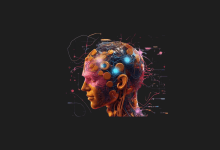

“Reading” the Brain vs. “Writing” to the Brain

Current BCI technologies (including Elon Musk’s Neuralink) are predominantly focused on “reading” the brain. Allowing a paralyzed patient to move a robotic arm or control a mouse cursor with their thoughts relies on “listening” to signals from the motor cortex and converting them into digital commands.
A Matrix-style “skill download” requires the exact opposite: “Writing” data to the brain.
In this scenario, a brain chip isn’t just a passive listener; it is an active stimulator. For example, when you download an “Advanced Japanese Data Pack,” the chip would stimulate specific neuron groups in your brain’s language centers (Broca’s and Wernicke’s areas) to fire as if you already knew the language. It would instantly restructure your neural networks as if you had been speaking Japanese for years.
This is just like downloading an app to your phone and using it immediately. The biological “installation time” is eliminated.
The Future of Schools and Careers

If this technology becomes reality, our social structure will change radically:
- The End of Education? In a world where possessing knowledge—not just accessing it—is instantaneous, what will be the function of traditional schools and universities? Education might transform into a space solely for socialization and teaching ethical values.
- The Business World: Imagine walking into a job interview. You don’t need to spend years studying for the “C++ Programming” skill on your CV. Five minutes before the interview, you could upload this skill to your brain as an “update” in the restroom. In this case, what will employers value? The answer: Things that cannot be downloaded. Human traits like creativity, emotional intelligence, strategic thinking, and empathy will become worth their weight in gold.
- The Inequality Gap: Will only the wealthy have access to this “Super Human” technology? Could we see the birth of a new class divide where those with money become instant geniuses, while others are condemned to “old-school” learning?
Reality Check: We Are Not There Yet

While exciting, there are massive scientific hurdles we must overcome before switching to Matrix mode.
The biggest problem is that we haven’t fully decoded the brain’s “language” yet. The brain doesn’t work with binary code (0 and 1) like computers. Every piece of information is hidden within the complex and chaotic firing patterns of billions of neurons. Finding where and how “piano skills” are stored is harder than finding a needle in a haystack.
Furthermore, writing data to the brain from the outside could have terrifying side effects: Dystopian scenarios like implanting false memories, altering personalities, or “brain hacking” are the most critical ethical issues that must be discussed as technology advances.
Conclusion: A Step Towards Transhumanism
Matrix-style instant learning is still a speculative vision of the future. However, looking at the history of science, we see yesterday’s “impossibilities” becoming today’s “ordinary” realities.
Brain chips won’t just cure diseases; they will push the boundaries of human potential to points we can’t even imagine. Perhaps in the future, “learning” won’t be a struggle, but simply a matter of “file transfer.”
And when that day comes, humanity will have to ask itself: Have we crossed our biological limits to become “Homo Deus” (Human God)?
You Might Also Like;