
NASA has lost connection with the MAVEN spacecraft in Mars orbit. While it was announced that signal loss occurred after the satellite passed behind the planet, engineers are working on solutions.
NASA confirmed that it has lost contact with one of its most important satellites around the Red Planet. Communication with the orbiter named MAVEN (Mars Atmosphere and Volatile EvolutioN) was cut off during routine operations on December 6 as it was passing behind Mars. Under normal conditions, NASA’s Deep Space Network (DSN) system automatically re-establishes the connection once the signal line, blocked by the planet, opens up again. However, this time, no signal was received as MAVEN emerged from the expected point, and DSN’s attempts to regain access failed.
In a statement made on December 9, NASA noted that satellite and operations teams are investigating the “anomaly.” The agency emphasized that data received from MAVEN just prior to the loss of contact showed there was no deviation in its orbit and that all subsystems were operating normally. This situation indicates that the problem could stem from the satellite’s hardware, software, or communication antennas. However, the exact cause is not yet known.
It Was on Duty for 10 Years
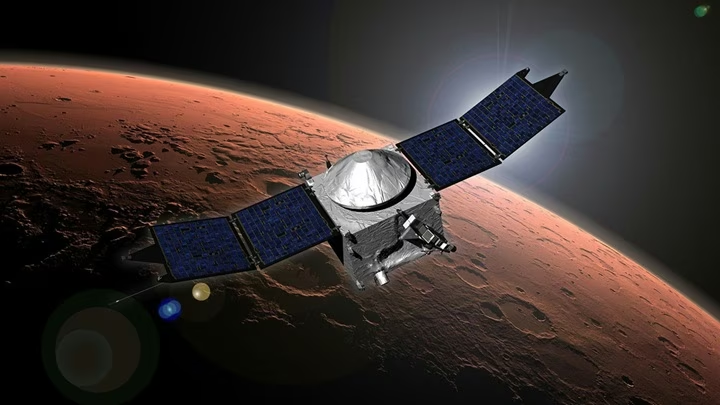
Launched in November 2013 aboard a ULA Atlas V rocket, MAVEN was designed to study the effects of Solar winds on the Mars atmosphere. After a journey lasting approximately 10 months, the vehicle settled into Mars orbit and has been conducting uninterrupted scientific observations for over a decade.
However, MAVEN is not just a scientific platform; it is also a critical communications bridge for missions operating on the surface. Playing a major role in connecting the Perseverance and Curiosity rovers with Earth, MAVEN undertakes this task alongside NASA’s MRO and Odyssey satellites, as well as ESA’s Mars Express (MEX) and ExoMars Trace Gas Orbiter (TGO) vehicles. This quintet ensures that missions on the Martian surface have coverage across the planet.
NASA engineers state that, assuming MAVEN’s orbit has not changed, the DSN is continuing attempts to pick up a signal from the satellite at regular intervals along its predicted flight path. If the satellite is still proceeding on its expected route, receiving a response—even a weak one—may be possible. NASA announced that work is ongoing and new information will be shared as MAVEN’s situation becomes clearer.


You Might Also Like;