The Facts Are Scary: How Will Mars Change the Human Body?


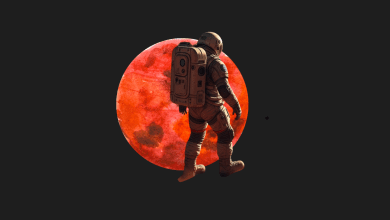
Humanity’s dream for Mars is not just an engineering, but a biological challenge. In space, the heart shrinks, bones atrophy, and DNA is damaged. But is the human body truly ready for this?
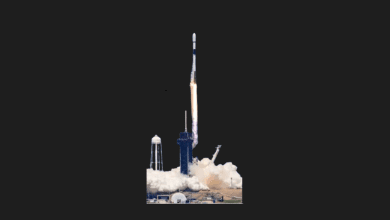
For over half a century, humanity has not progressed beyond those first steps taken on the Moon. The “small steps” of that era were a great turning point, but a “giant leap” has yet to materialize. Today, billionaires like Elon Musk and companies like SpaceX aim to send humans to Mars, but the biggest hurdle is not rockets or fuel technology. The real danger does not end with reaching Mars; on the contrary, it begins upon arrival.
Muscles and Bones Atrophy
A one-way trip to Mars will take between 6 to 9 months under the best conditions. Throughout this time, astronauts will remain in a hostile vacuum for life. In space, not only gravity but also the biological conditions the human body is accustomed to disappear.
- In a weightless environment, muscles rapidly weaken, and bones lose about 1 percent of their density each month — equivalent to the annual rate seen in patients with osteoporosis (bone loss) on Earth.
- The lack of gravity also confuses the inner ear and muscle sensors that maintain the body’s balance. This condition leads to what NASA calls “space adaptation syndrome.” Astronauts struggle with nausea, dizziness, headaches, and fatigue in the first days. Although the brain eventually adapts to the new conditions, muscle and bone loss continues.
- Since the spine is also free in space, astronauts can grow a few centimeters taller, but this causes severe back pain.
Fluid Abnormalities

On Earth, gravity pulls fluids toward the lower part of the body. Without gravity, this effect on blood and other fluids disappears, leading to a tendency to spread throughout the body. This results in facial puffiness and thinning of the legs. But the effects are deeper:
- In a weightless environment, intracranial pressure increases, putting pressure on the optic nerve and potentially leading to permanent vision loss.
- It triggers a chain reaction in the cardiovascular system: When the body detects excess fluid around the heart, it increases urine production to compensate, which leads to a 10-15 percent reduction in blood plasma. Because the heart is working less, it shrinks in size, blood pressure becomes unstable, and astronauts struggle to stand up when they return to Earth.
DNA, Immune, and Cellular Damage
Space interferes with the body down to its most fundamental level. In NASA‘s “Twin Study,” the body of astronaut Scott Kelly, who spent a year in space, was compared with his twin brother, Mark, who remained on Earth. The results were astonishing:
- In Scott’s genes, gene expressions related to DNA repair and immunity changed; the telomeres at the ends of his chromosomes lengthened but rapidly shortened upon his return to Earth.
- Space radiation and the sterile environment weaken the immune system. White blood cells behave differently, inflammation increases, and allergic responses change. In the long term, this can increase the risk of cancer or autoimmune diseases.
Radiation
Every astronaut who ventures outside Earth’s magnetic field becomes a target for cosmic radiation. These high-energy particles can shatter DNA and leave permanent damage in tissues. The International Space Station (ISS) is protected because it is within Earth’s magnetosphere, but this protection will be absent on Mars missions or any other deep space mission.
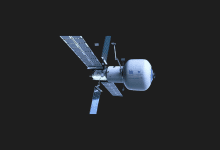

- One of the biggest risks is solar storms. A massive solar flare in 1972 during the Apollo program narrowly missed the astronauts. If this storm had occurred during a Moon mission, the consequences could have been fatal. Even today, existing shields made of metal, plastic, or water cannot provide full protection. Astronauts working on the Mars surface will need to seek refuge in heavily armored shelters within an hour during a possible storm.
- In the longer term, galactic cosmic rays — particles that are nearly impossible to block — will pose serious cancer risks.
The Isolation Factor

Beyond physical risks, the quietest enemy of space is isolation. Living millions of kilometers away from Earth during a mission lasting months will strain the human psychology. Even astronauts on the ISS feel this pressure, and they can communicate with Earth instantly. On Mars missions, the communication delay will extend up to 40 minutes. This means that help cannot arrive in time during an emergency medical or technical crisis. Therefore, no human psychology has been tested for this.
A Prescription for Survival
NASA views exercise as a drug for long missions. On the ISS, astronauts spend more than two hours every day exercising, including running, weightlifting, and cycling. Despite this, astronauts still return weakened because the body remains weightless for the remaining 21 hours.
- Scientists are working on high-protein diets, electrical methods for muscle stimulation, and drugs to slow bone loss to mitigate this decline.
- However, the real solution may come from physics, not biology. Researchers are designing rotating spacecraft to create artificial gravity. While this method has slowed muscle and bone loss in short-term centrifuge tests, making it feasible for long missions involves major engineering challenges. But all these address only physical health. Obstacles related to biology and mind still need to be solved.
How Will the Human Body Change Over Years on Mars?
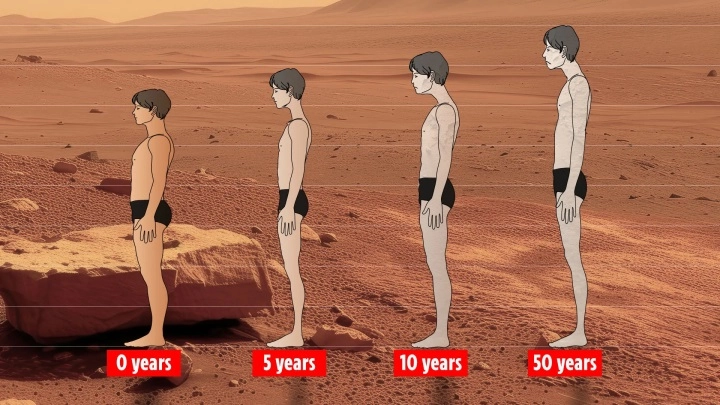
While the human body deteriorates rapidly even during short-term missions in space, living on the Mars surface for extended periods can create much more permanent transformations:
- Within 5 Years: The lower gravity (Mars‘s gravity is about 38% of Earth’s) will rapidly weaken the muscle and bone systems. Despite regular exercise, muscle mass will decrease, and bone density will drop. The heart will weaken over time due to less exertion, and blood circulation and pressure balance will change. As the body’s balance mechanism adapts to the new gravity, the sense of mobility and coordination will be impaired.
- After 10 Years: The musculoskeletal system will partially adapt to the new conditions. Changes in body structure are also expected during this period — spinal elongation, differentiation of fat distribution, and reshaping of posture are likely. However, returning to Earth after a long stay on Mars could lead to serious health problems due to the higher gravity. The constant feeling of low weight and confined living conditions will create psychological effects. Permanent changes in the sense of direction, body awareness, and mood may be observed.
- 50 Years and Beyond (Evolutionary Adaptation): The change may not only be physiological but also on a genetic level. Generations born on Mars could turn into a “new human variant” with longer limbs, weaker bones, and a body structure suited to low gravity. This evolutionary adaptation will make returning to Earth nearly impossible. Furthermore, long-term low gravity could make problems like weakened immune systems, cardiovascular diseases, and chronic illnesses due to muscle atrophy permanent.
The Ultimate Test
While making humanity a multi-planetary civilization is the ultimate goal of the present, achieving this goal requires passing major tests.
Mars, at its most ideal point, is 225 million kilometers away from Earth. A Mars mission, which could take three years round trip, requires astronauts to endure radiation, bone loss, muscle atrophy, isolation, and limited food resources. Simply put, current food technology cannot maintain nutrient-rich diets for such a long period without spoiling. Therefore, building the rockets to go to Mars is not the problem; the main problem is sending humans there and keeping them alive. And this is not a problem that can be solved only with engineering.
You Might Also Like;