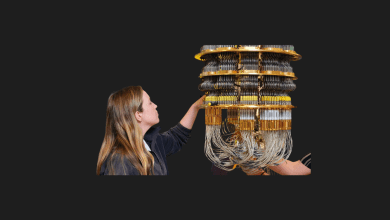

Scientists have successfully transmitted quantum data over standard fiber optic infrastructure. This innovative method could be a significant step in the development of the quantum internet.
The scientific community has taken another important step in laying the foundations of the quantum internet. In a recent study published in the journal Science, researchers succeeded in sending quantum signals through fiber optic cables, which are based on today’s internet infrastructure. This achievement allows quantum data to be transmitted in a manner compatible with classic internet protocols, holding great promise for the future development of the quantum internet.
Liang Feng, a professor of materials science and electrical engineering at the University of Pennsylvania, highlights the importance of this development. Feng noted that most previous quantum communication experiments were limited to isolated laboratory environments or special infrastructures, but this new approach has managed to integrate quantum signals into real-world networks.
The team led by Feng developed a specialized quantum chip called the Q-Chip. This chip carries quantum data over the same fiber optic cables as classic signals, and this process is carried out in a way that is compliant with standard internet protocols.
The Q-Chip Revolution

Unlike the bits that are the fundamental data carriers of classic computers, quantum computers process data using qubits, which can exist in multiple states simultaneously. The entanglement relationship that qubits establish with each other allows data to remain connected regardless of distance. However, this property also makes quantum data extremely sensitive and fragile. Quantum data can collapse the moment it is observed, and the information being carried can be lost.
While the current internet infrastructure uses routers to direct data packets, operating in the same way with quantum data could destroy this delicate information. This is where the Q-Chip comes into play.


The Q-Chip solves this problem by adding a classic “header” to every quantum signal. The header, encoded by fiber optic laser pulses, contains information about the data’s routing and timing. Routers read this header and direct the data to the correct destination, but they do not interfere with the quantum signal. Thus, the quantum and classic signals are transmitted simultaneously, synchronized, and over the same fiber optic cable. Feng describes this technology as “a huge step for transmitting quantum signals without degradation over existing infrastructures.”
To test the developed system, the team used a one-kilometer fiber optic line owned by Verizon. The quantum signal reacted to environmental noise in a way similar to the classic signal. In this case, the degraded signal was corrected with the help of the classic signal, and the quantum data was safely delivered to its destination. This test demonstrates that it is possible to transmit quantum data in a manner compatible with existing infrastructures.
Further stages of the work reveal that the Q-Chip‘s silicon-based structure will facilitate mass production using existing manufacturing processes. Feng states that this technology is a foundational step to launch the first phases of the quantum internet in local and metropolitan-scale networks.
You Might Also Like;