The idea of spending $\$400,000$ on a single piece of protective equipment might seem absurd to an outsider. However, when that equipment is the F-35 Gen III Helmet-Mounted Display System (HMDS), you are not buying a helmet; you are investing in a quantum leap in Augmented Reality (AR) technology—a technological marvel that redefines what a pilot can see and do. This is the apex of real-life “Metaverse” technology, currently dominating the skies.
More Than Protection: The World’s Most Advanced AR Computer

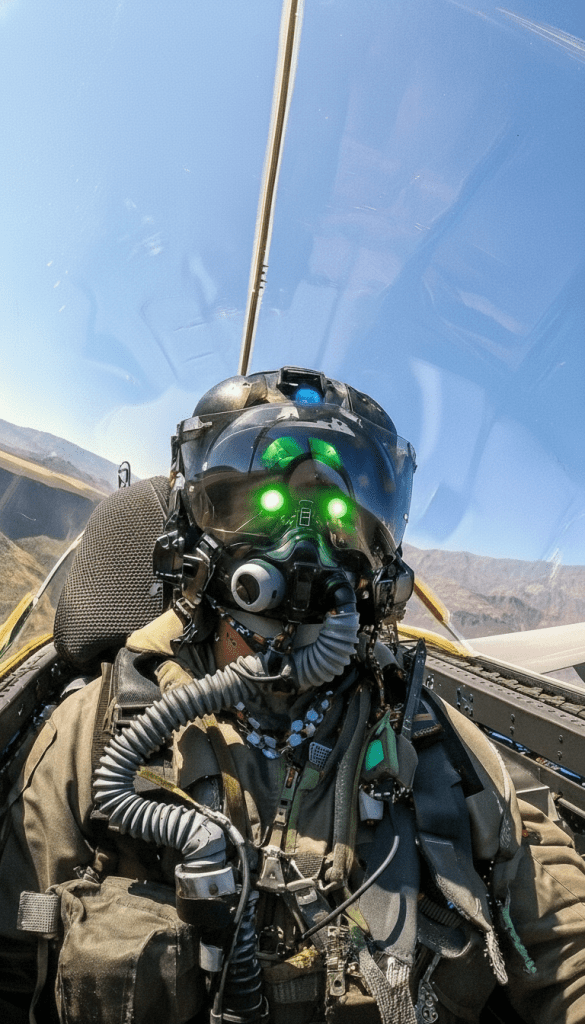
The Gen III HMDS is the brain of the F-35 Lightning II, integrating directly with the jet’s vast sensor network to deliver unprecedented situational awareness.1 It is, arguably, the most sophisticated AR system ever deployed.
Key Capabilities That Justify the Price Tag:
- “X-Ray Vision” (Distributed Aperture System – DAS):
- Six infrared cameras are placed around the jet, feeding a continuous 2$360^\circ$ view directly into the pilot’s helmet.3
- This allows the pilot to literally “see through” the floor or fuselage of the F-35. They can look down, and the helmet displays an image of the world below, unimpeded by the jet’s structure. This is a game-changer for spatial awareness and target acquisition.
- Retinal Projection & Data Fusion:
- Unlike heads-up displays (HUDs) that project onto a limited screen, the HMDS projects critical flight data, weapons status, speed, altitude, and targeting cues directly onto the pilot’s visor.4
- This fused data overlays seamlessly onto the real world. Targets, friendly aircraft, and potential threats are painted with digital symbology wherever the pilot turns their head. The information is always in the line of sight.
- Instantaneous Reality Merge:
- The system boasts minimal latency, crucial for high-speed, dynamic flight. It doesn’t just display digital images; it instantly merges the digital world with physical reality.
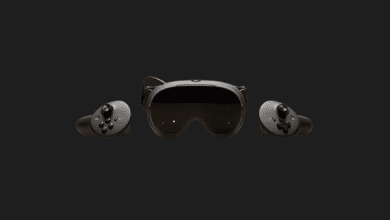
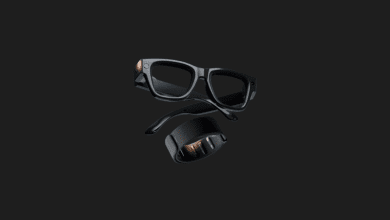
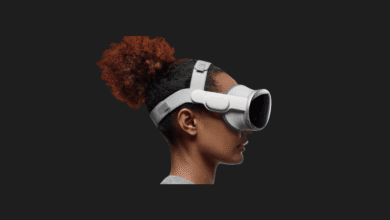
- This is the critical difference between the F-35 HMDS and even the most advanced commercial VR/AR headsets like the Apple Vision Pro. The F-35 system’s integration is a life-and-death matter, requiring military-grade precision, speed, and reliability that far exceeds consumer standards.
The Real-Life Metaverse in the Cockpit

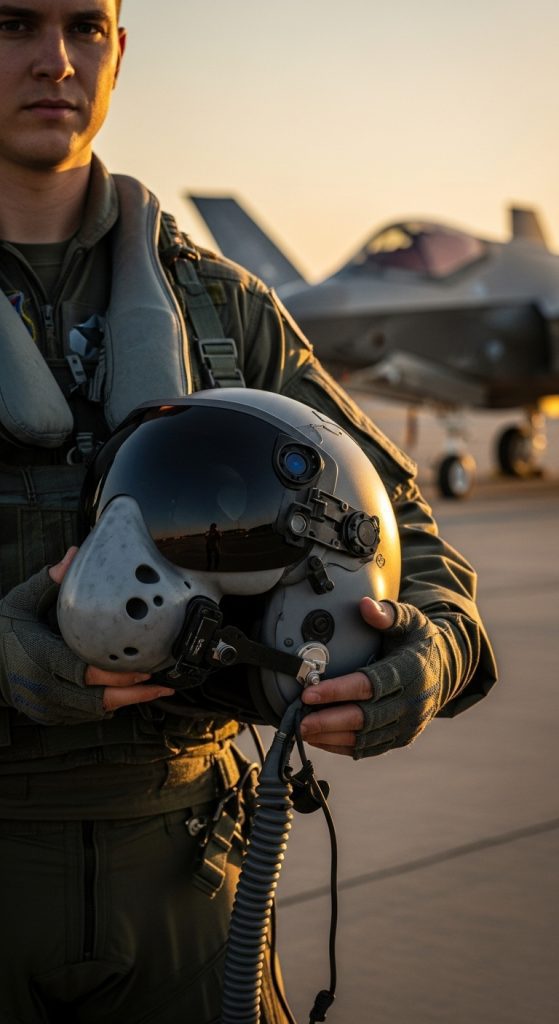
While consumers are just beginning to explore the “Spatial Computing” capabilities of devices like the Apple Vision Pro, F-35 pilots have been operating in a high-stakes, real-time “Metaverse” environment for years.
The HMDS turns the entire environment into a single, cohesive information system. The pilot is not merely looking at data; they are immersed in data. This deep level of immersion and reality-augmentation proves that the most powerful and effective AR technology today is being used not for entertainment, but for achieving mission superiority.
Worth the Trade?
The comparison between a consumer device like the Apple Vision Pro and the F-35 HMDS might seem unfair, yet it highlights the exponential cost of performance, durability, and life-critical integration.
The $\$400,000$ cost covers not just the materials, but the decades of R&D, the military-specification hardening (to withstand G-forces and extreme conditions), the cutting-edge sensor fusion algorithms, and the secure supply chain required for national defense.
Would an F-35 pilot trade their Gen III HMDS for a Vision Pro? Absolutely not. The F-35 helmet is the pilot’s $400,000$ superpower, providing a technological edge that is priceless in combat. It is the ultimate testament to how future technology can fundamentally alter human capability.
You Might Also Like;
- The Mystery of the Far Side: What Is Hiding in the Lunar Shadows? | Metaverse Planet
- The Doomsday Clock Hits 85 Seconds to Midnight: Are We Out of Time?
- Nvidia’s AI Can Now Predict the Future (Of Weather)
-

-

-
-
-
-
-

-
-

-

-

-