
I’ll be honest with you: for a long time, I viewed Mars as a bit of a letdown. We see these high-definition photos from the Perseverance or Curiosity rovers, and while they are breathtaking, they always depict the same thing—a freezing, desolate, bone-dry desert where your blood would literally boil if you stepped outside without a pressurized suit. It felt like a place we might visit, but never a place we could truly live.
But then, I started digging into the topography of the Red Planet, and I stumbled upon something that changed my entire perspective. I found a “hidden” world tucked away inside a massive scar on the planet’s surface.
I’m talking about Hellas Planitia.
This isn’t just another crater. It is a 7-kilometer-deep basin that defies almost everything we think we know about the Martian environment. While the rest of the planet is trying to kill you with sub-zero temperatures and thin air, Hellas Planitia is whispering a different story—a story of liquid water, spring-like warmth, and the first real hope for human colonization.
A Hole So Deep It Creates Its Own Rules

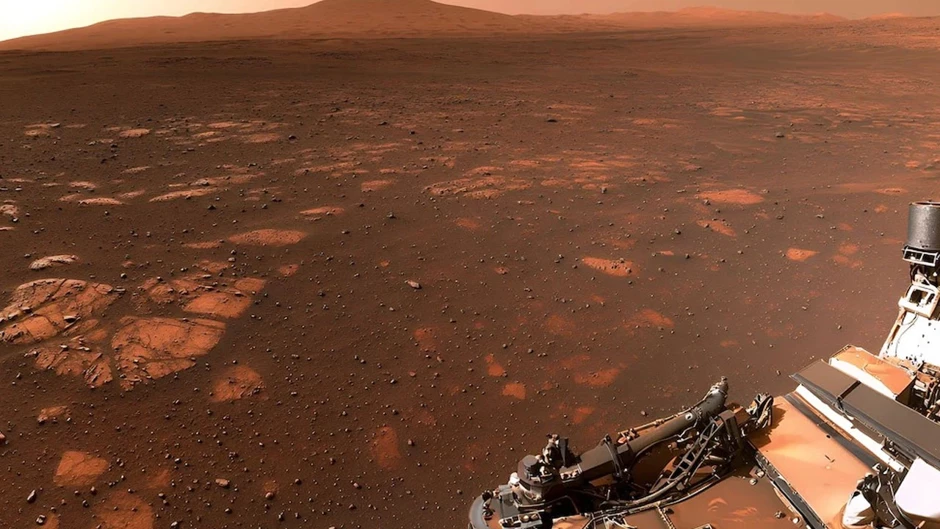
To understand why I’m so obsessed with this place, you have to visualize the scale. We think of the Grand Canyon as deep, but it’s a scratch compared to this. To give you a local perspective that really hit home for me: if you took Mount Ararat and dropped it into the deepest part of Hellas Planitia, the mountain’s peak wouldn’t even come close to the rim. In fact, you’d still have about 1.5 kilometers of empty space above the summit.
When you go that deep into a planet, the rules of physics start to play in our favor.
On the “surface” of Mars, the atmosphere is incredibly thin—about 1% of Earth’s. It’s so thin that water can’t exist as a liquid; it either freezes instantly or evaporates (sublimates) into gas. But as I researched the bottom of Hellas Planitia, I found that the atmospheric pressure is significantly higher there because of the depth.
It’s the “Dead Sea” effect of Mars. Because the air is denser at the bottom, the boiling point of water rises. This creates a tiny, miraculous window where liquid water can actually sit on the surface without disappearing.
The 20°C Martian Spring: Not a Sci-Fi Dream


Here is the part that actually gave me goosebumps. Most of Mars averages a soul-crushing -60°C (-80°F). Even on a “warm” day at the equator, the ground might get warm while your head is still freezing.
However, in the depths of Hellas Planitia, during the peak of the Martian summer, temperatures can climb to a staggering 20°C (68°F).
When I first read that, I had to double-check the source. That’s a pleasant spring afternoon in Istanbul or London. Imagine standing on another planet, 140 million miles away from home, and for a brief moment, you don’t feel the bite of the cosmic cold. You feel a temperature that your body actually recognizes as “comfortable.”
Of course, you’d still need a mask for oxygen and protection from radiation, but the sheer fact that a “thermal oasis” exists on a frozen world changes the math for future explorers. I’ve always thought the first Martian cities would be bleak, underground bunkers, but looking at Hellas Planitia, I can almost see the glass-domed greenhouses and the first Martian parks.
Why the Poles Are Overrated


For years, the conversation about Mars colonies has centered on the North and South Poles because that’s where the ice is. “Follow the water,” NASA says. And I get it—water is life. But the poles are brutal. They are dark for half the year and colder than anything experienced on Earth.
I believe we’ve been looking at the wrong map.
I would much rather build a home in a deep valley where the air is thick enough to provide some natural shielding against cosmic radiation and where the temperature doesn’t require constant, high-energy heating. In Hellas Planitia, the thickness of the atmosphere acts as a natural duvet for the planet.
- Shielding: More air above you means fewer solar particles hitting your skin.
- Water Access: We don’t just need ice; we need water that can be managed. The pressure here makes industrial water use much more feasible.
- Energy Efficiency: Keeping a habitat at 20°C is a lot easier when the outside air is also 20°C, rather than -100°C.
I’m convinced that when the first “Martian Real Estate” market opens up, this basin will be the most expensive “land” on the planet.
My Take: The Psychological Shift

There is a huge psychological barrier to colonizing Mars. If we tell people they are going to live in a place that is essentially a frozen vacuum, only the most hardcore scientists will sign up.
But what if I told you we found a place where you can see liquid streams trickling down crater walls? What if I told you that for a few months a year, the weather is like a mild autumn day?
Suddenly, Mars feels less like a death sentence and more like a frontier.
When I look at the satellite imagery of Hellas Planitia, I don’t just see a geological formation. I see the site of the first Martian marathon. I see the place where the first child born on another planet might take their first steps. It’s a reminder that nature, even on a “dead” planet, has these little pockets of hospitality waiting for us to find them.
What’s Next for the Red Planet?
We are currently in a golden age of Mars exploration. With SpaceX’s Starship nearing operational status and NASA’s Artemis program paving the way for deep space travel, the “Hellas Oasis” isn’t just a curiosity for astronomers anymore. It’s a target.
I’ll be keeping a very close eye on any future rover missions planned for this region. If we can confirm the presence of seasonal liquid brines at the bottom of that pit, the race to Hellas Planitia will officially be on.
I’ve spent hours staring at the topographical maps of this 7-kilometer drop, and I keep coming back to the same thought: we’ve been looking at the stars for so long, but the real secret to living among them might be hidden deep in the ground.
I’m curious, if you had the chance to be one of the first tourists to visit this Martian “spring,” knowing the risks but seeing that 20°C thermometer, would you take the leap? Or does the thought of a 7-kilometer-deep pit feel a bit too claustrophobic for you?
Let’s talk in the comments—I’d love to know if you’re team “Polar Ice” or team “Hellas Basin”!
You Might Also Like;
- The Mystery of the Far Side: What Is Hiding in the Lunar Shadows? | Metaverse Planet
- The Doomsday Clock Hits 85 Seconds to Midnight: Are We Out of Time?
- Nvidia’s AI Can Now Predict the Future (Of Weather)
-

-

-

-

-

-

-

-

-
-

-

-

