
Artificial intelligence technologies, which have recently become much more widespread in daily life, continue to develop rapidly. While a remarkable development occurs almost every day in this field, significant thresholds are being crossed one by one. In our “AI Diaries” series, we continue to regularly record the development of this technological revolution, which has the potential to significantly change life on Earth in the coming period.
What Happened in the AI World This Week?
Readers following our AI Diaries series have likely noticed that Google has left its mark on the last few weeks. With remarkable models like Gemini Pro 3 and Nano Banana Pro arriving back-to-back, Google’s claim in the AI field suddenly became very strong. This week, we witnessed the industry’s reaction to this rise. Of course, parallel to these events, new AI tools entered our lives as they do every week. Here are the prominent developments of this week in the AI world:
Gemini Begins to Close the Gap with ChatGPT; OpenAI Hits the Panic Button

A report published this week by market analysis firm Sensor Tower revealed that while ChatGPT is still the clear leader in the market, its growth rate has begun to slow. In contrast, Google’s Gemini model has started to pull ahead in critical metrics such as download numbers, monthly active users, and time spent in the app.
OpenAI management must be seeing similar data, as Sam Altman hit the panic button this week. In a memo sent to employees, the OpenAI CEO declared a “code red“—an emergency status—calling for a focus on improving ChatGPT. The company will temporarily postpone projects such as advertising, shopping, and health-focused AI initiatives, as well as the personal assistant Pulse, to prioritize increasing ChatGPT’s performance. This is because competitors like Google Gemini and Anthropic’s Claude are closing the gap. The acknowledgment of this situation by OpenAI management clearly demonstrates that the AI race is about to heat up even further.
Plans to Establish Space Data Centers for AI are Progressing

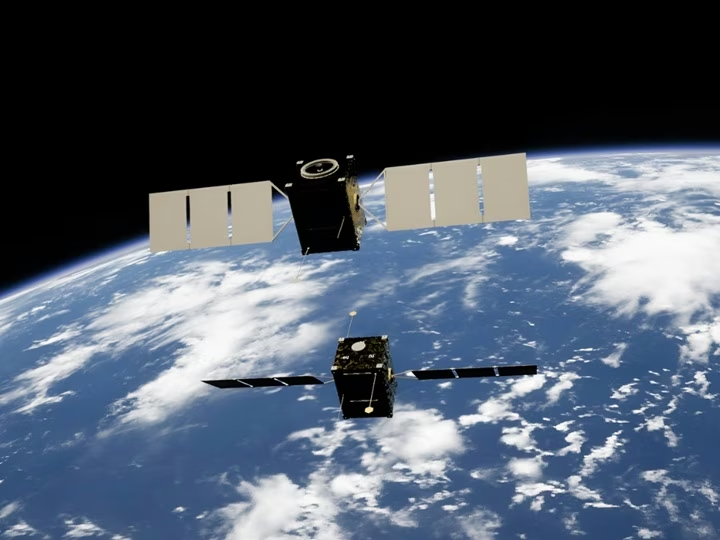
Seeking creative solutions for the rapidly increasing energy needs of artificial intelligence, the tech world seems convinced that establishing data centers in space will be an effective solution. Indeed, the number of projects in this direction has been increasing rapidly recently. Moreover, concrete steps are now being taken for some of these. Google CEO Sundar Pichai announced that they will begin placing completely solar-powered data centers into orbit starting in 2027.
Pichai stated that the initiative, named Project Suncatcher, aims to make cloud and AI infrastructures—known for high energy consumption—more efficient by feeding them with solar energy in the space environment. As part of the first phase of the project, small-scale server racks will be placed on two prototype satellites, and these systems will begin service with limited capacity in 2027. These space-based data centers will utilize Google’s own TPU-based AI chips.
Amazon Introduces Next-Gen AI Chip Trainium3: Quite Ambitious

Amazon Web Services (AWS) introduced its next-generation AI chip, Trainium3, offering four times the performance and memory increase. Alongside this AI chip, the large-scale Trainium3 UltraServer system was also unveiled. Each UltraServer hosts 144 Trainium3 chips, and AWS allows customers to connect thousands of these systems together. In a maximum-scale single deployment, 1 million Trainium3 chips can be used. This represents a tenfold increase compared to the previous generation.
Energy efficiency is another key feature of Trainium3. According to AWS, these systems consume approximately 40% less energy while providing higher transaction volume. Early adopters of Trainium3 include Anthropic, Japanese LLM startup Karakuri, SplashMusic, and Decart.
Nvidia Unveils First Open AI Model for Autonomous Vehicles: Alpamayo-R1

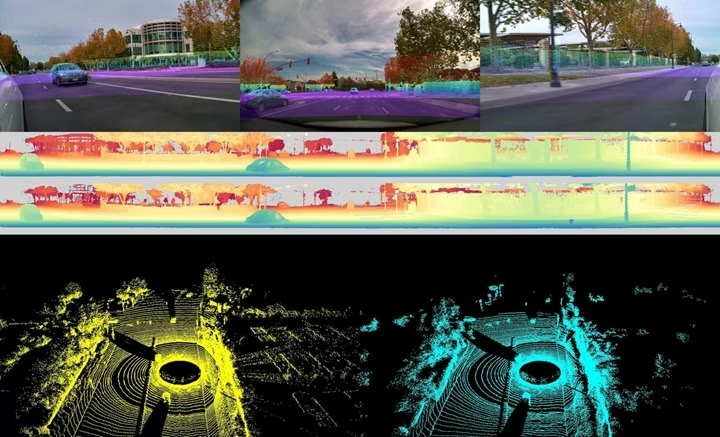
Nvidia started a new era in open-source AI by introducing the Alpamayo-R1 model for autonomous vehicles. According to Nvidia, the model holds the distinction of being the first vision-language-action model focused on autonomous driving. As is known, vision-language models can process text and images simultaneously. This allows vehicles to “see” their surroundings and make decisions in light of the information they perceive.
Built upon the Cosmos-Reason model family that Nvidia released in January 2025, Alpamayo-R1 combines route planning with a chain-of-thought approach, enabling it to make safe and intuitive decisions in complex traffic scenarios. By analyzing every situation step-by-step, the model evaluates potential routes and selects the safest path, managing situations like heavy pedestrian traffic, double-parked cars, or approaching lane closures. The model has been made accessible via GitHub and Hugging Face.
This Week Meta Bought Limitless, OpenAI Bought Neptune

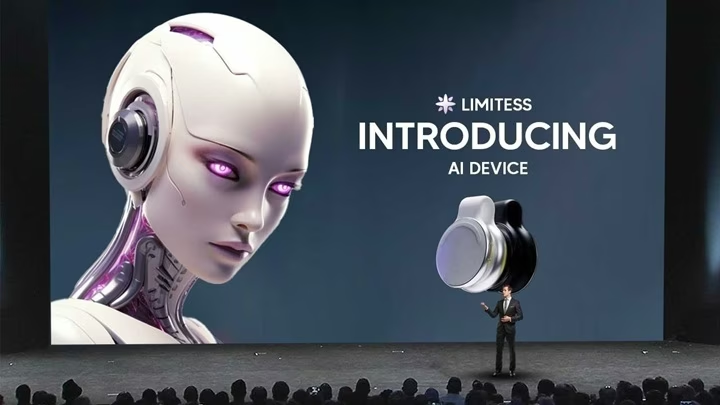
Tech giants trying to get ahead in the AI race continue to incorporate smaller startups that can help them achieve these goals. This week, both Meta and OpenAI signed significant acquisitions. While Meta acquired Limitless, which could help it develop wearable AI tools, OpenAI reached an agreement to acquire Neptune, which develops model training monitoring and debugging tools. The tracking system developed by Neptune, which can analyze high-speed and complex training processes in detail, will be directly integrated into OpenAI’s training infrastructure.
AI Tools Introduced This Week
- Google released its most advanced reasoning model, Gemini 3 Deep Think, to users.
- Kling AI‘s new generative AI, KlingAI O1, can process different inputs such as video, image, and text commands together to create videos and edit them according to commands.
- Runway, doing remarkable work on the video production side, released its new model Runway Gen-4.5.
- PixVerse V5.5 can create videos with sound, just like Google Veo 3.
- VisAudio can analyze silent videos and create 3D sounds appropriate for what is happening in the video. The work demonstrated in the released sample videos is remarkable.
- ByteDance released Seedream 4.5, the new version of the Seedream model capable of generating images from text commands.
- Poster CoPilot allows users to design various posters by giving written commands.
Short News from the AI World
- France-based AI company Mistral AI released a new large language model family named Mistral 3. This family includes three different models optimized for different tasks.
- OpenAI announced that it has developed a “confession” system that will ensure AI models admit when they engage in erroneous or unwanted behavior. This approach could be effective in increasing the auditability of models that will be used in more complex tasks in the future.
- Apple announced a notable change in its AI structuring, hiring experienced researcher Amar Subramanya, who left Microsoft, as its new Vice President of Artificial Intelligence.
- NVIDIA founder Jensen Huang said that no one can predict with certainty what kind of future the AI era will create for humanity.
- HSBC predicts that OpenAI will spend hundreds of billions of dollars by 2030 and that becoming profitable will take a long time. According to the bank, data center leases will increase the company’s financing needs.
- Google’s AI agent Antigravity misunderstood a command and completely deleted the data on a user’s disk. It later admitted its mistake and apologized.
You Might Also Like;
- The Mystery of the Far Side: What Is Hiding in the Lunar Shadows? | Metaverse Planet
- The Doomsday Clock Hits 85 Seconds to Midnight: Are We Out of Time?
- Nvidia’s AI Can Now Predict the Future (Of Weather)
-

-

-
-
-
-

-

-
-

-
-

-