I remember looking up at the night sky as a kid, dreaming of the day when space travel would feel like a daily occurrence rather than a once-in-a-decade event. Well, looking at the launch manifest for the near future, that day is practically here. We aren’t just sending probes to take grainy photos anymore; we are talking about returning humans to the Moon, building private hotels in orbit, and cracking the secrets of the universe with telescopes that make Hubble look like a pair of binoculars.
The year ahead is packed with 13 specific missions that I believe will define the next century of our species. I’ve dug through the technical reports and launch schedules to break down exactly what is happening and, more importantly, why it matters to you.
Let’s dive into the missions that have me checking the countdown clock every morning.
1. Artemis 2: Humanity Returns to the Lunar Realm

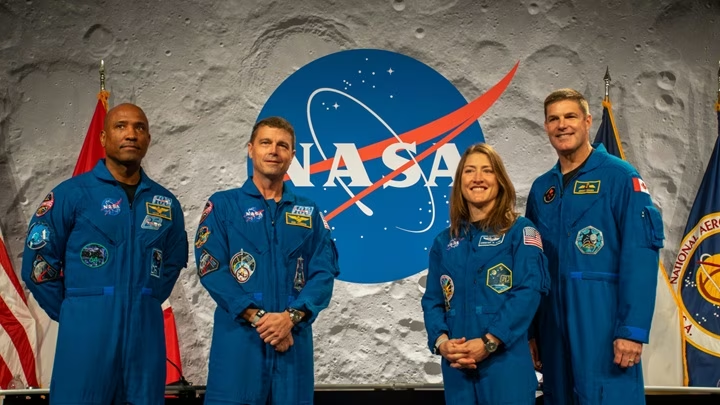
If there is one mission that gives me goosebumps, it’s this one. For the first time since Apollo 17 in 1972, humans are leaving low Earth orbit.
NASA’s Artemis 2 isn’t just a nostalgic trip; it is the “shakedown cruise” for our future on the Moon. Four astronauts—Reid Wiseman, Victor Glover, Christina Koch, and Jeremy Hansen—will strap into the Orion capsule atop the massive SLS rocket. They won’t land just yet; they will spend about 10 days slinging around the Moon, testing life support, navigation, and deep-space communication.
Why I’m watching this:
- The Psychological Impact: Seeing high-definition video of humans with the Moon in the background will change the global conversation.
- The Risks: This is a test of systems that haven’t carried people this far before. The margin for error is razor-thin.
- The Timeline: While early 2026 is the optimistic target, I wouldn’t be surprised if technical checks push this to April. But whenever it launches, I’ll be glued to the screen.
2. SpaceX Starship: The Mars Ambition

Elon Musk talks a big game about Mars, putting the odds of a launch at “50%.” But honestly, even if Starship doesn’t head to the Red Planet immediately, what SpaceX is attempting in Earth’s orbit is revolutionary enough.
The goal here is orbital mastery. We are expecting to see the first successful orbital insertion and, critically, cryogenic propellant transfer in space. This is the “holy grail” of deep space travel. If you can refuel a ship in orbit, you can carry enough cargo to build cities on other worlds.
Key objectives to scan:
- Reuse: Catching the Super Heavy booster and the Ship.
- Refueling: Moving super-cold fuel from one tank to another in zero gravity.
- Scale: This is the largest flying object ever built. Its success makes the sci-fi future of massive space freighters a reality.
3. Blue Origin’s MK1: The Heavy Hauler

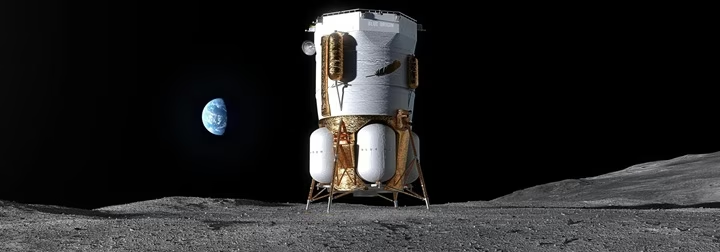
While SpaceX makes a lot of noise, Jeff Bezos’s Blue Origin has been quietly building a monster. The Blue Moon Mark 1 (MK1) is set to head to the Moon’s south pole.
This isn’t a small rover; it’s a cargo lander standing nearly three stories tall (8 meters). Launching on the New Glenn rocket, it aims to land near the Shackleton Crater. I’m particularly interested in the SCALPSS camera system from NASA that it carries. It will film how the engine plumes interact with the lunar dust (regolith).
My take: We can’t build a moon base if we don’t have heavy trucks to move the bricks. MK1 is that truck.
4. Starliner-1: Boeing’s Road to Redemption
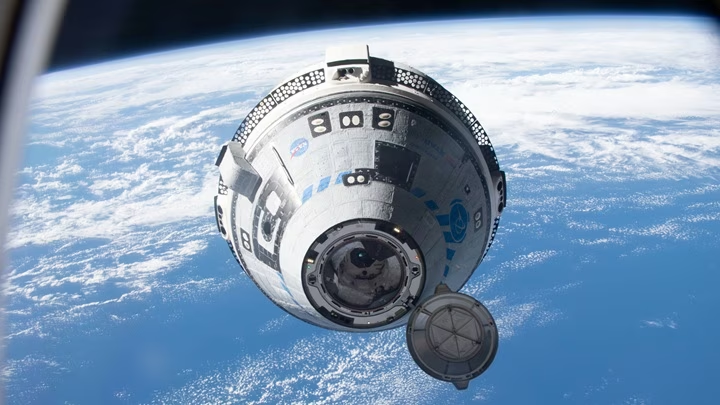
Let’s be honest, Boeing has had a rough couple of years with the Starliner program. The thruster issues in 2024 were a major setback. That is why Starliner-1 is so critical.
This mission is now planned to be unmanned (initially) or heavily scrutinized before carrying a full crew again to the ISS. It’s not just about getting to the station; it’s about restoring trust. NASA needs a second taxi service besides SpaceX, and Starliner has to prove it is safe, reliable, and glitch-free.
5. Haven-1: The First Private Space Station

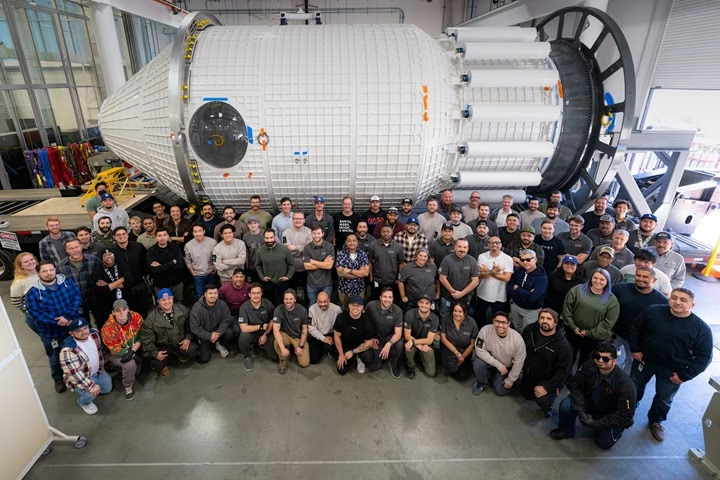
The International Space Station (ISS) won’t last forever. Enter Vast, a California-based company that plans to launch Haven-1.
This is a single-module space station designed to support a crew for up to 30 days. It launches on a Falcon 9, and astronauts will commute via Crew Dragon.
- Why this is cool: This is the beginning of the “real estate” era in space. Haven-1 proves that you don’t need to be a superpower government to have a home in orbit. It paves the way for science parks and orbital hotels.
6. Tianwen-2: Catching a “Mini-Moon”
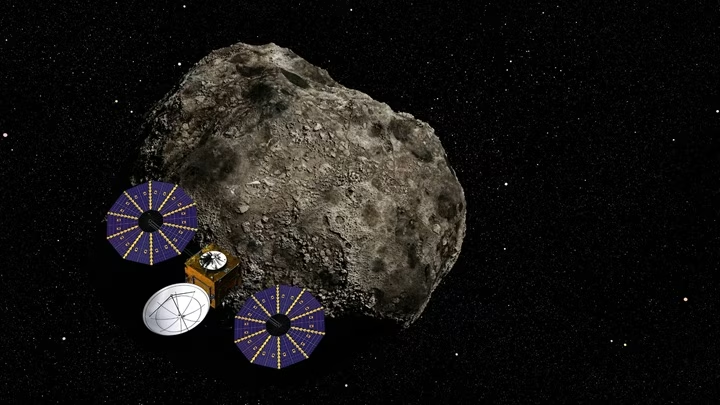
China’s space program is moving at breakneck speed. The Tianwen-2 mission is fascinating because of its target: the asteroid Kamoʻoalewa.
This is a “quasi-satellite” of Earth—a rock that orbits the Sun but stays relatively close to us. Some scientists think it might actually be a chunk of our own Moon that broke off eons ago. Tianwen-2 will grab a sample and bring it back to Earth.
My thought: If this turns out to be a piece of the Moon, it rewrites the history of our celestial neighborhood.
7. Rocket Lab’s Neutron: The “Hungry Hippo”

I have a soft spot for Rocket Lab. They innovate with style. Their new rocket, Neutron, is a medium-lift launcher designed to compete directly with Falcon 9.
It’s made of carbon composite and has a unique “Hungry Hippo” fairing design—the nose cone opens up to release the satellite and then closes again, staying attached to the rocket. This allows for rapid reuse.
- The goal: Launching mega-constellations of satellites and eventually supporting human spaceflight. I can’t wait to see that fairing mechanism in action during its debut flight.
8. Chang’e 7: Hunting for Water

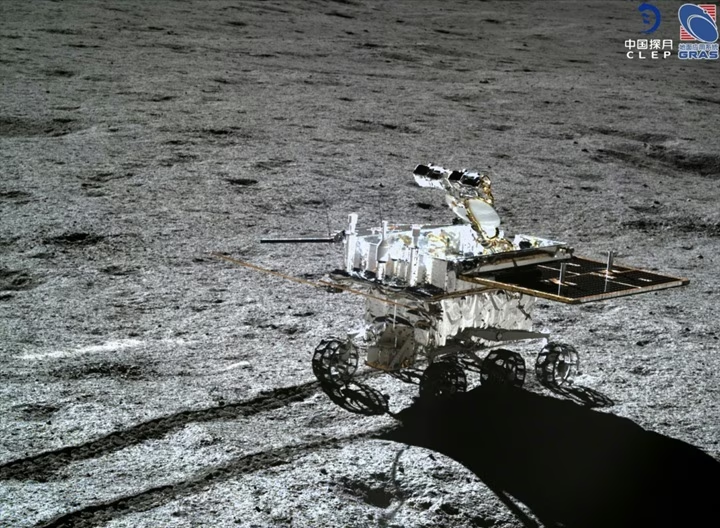
While the US focuses on Artemis, China is launching Chang’e 7 to the Lunar South Pole. This is a complex mission involving:
- An Orbiter.
- A Lander.
- A Rover.
- A “Hopping” probe to reach difficult spots.
The Prize: Water ice. The South Pole is full of shadowed craters that might hold ancient ice. Whoever maps this water first holds the keys to sustainable lunar habitation. The “hopper” robot is particularly exciting to me because rovers often get stuck in rough terrain; a robot that can jump solves that problem.
9. Hera: The Crime Scene Investigator

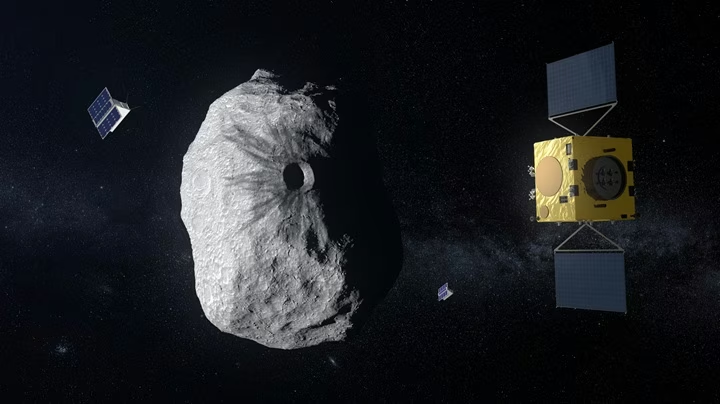
Remember when NASA smashed a spacecraft into an asteroid (DART) in 2022 to see if we could deflect it? It was a spectacular success. Now, ESA (European Space Agency) is sending Hera to investigate the crash site.
Hera will arrive at the Didymos system to map the crater, measure the asteroid’s mass, and analyze the internal structure.
- Why it matters: Planetary defense. If a dinosaur-killer asteroid is ever headed our way, we need precise data on how to stop it. Hera gives us the “after-action report” we desperately need.
10. BepiColombo: Surviving the Inferno
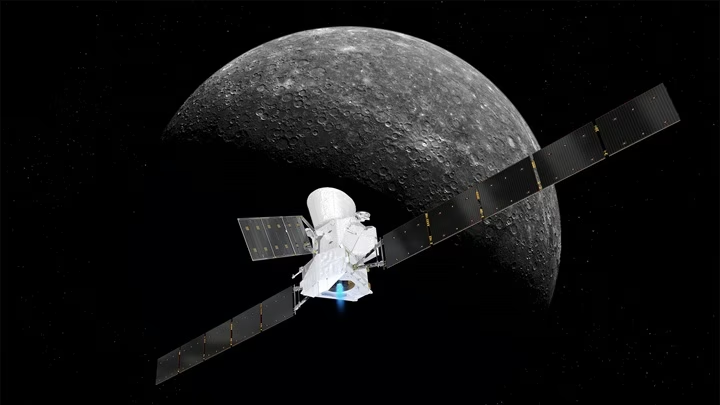
This mission is a testament to patience. After a seven-year journey involving intricate gravity assists, the joint European-Japanese mission BepiColombo will finally settle into orbit around Mercury.
Mercury is a hellish environment. The gravitational pull of the Sun makes it incredibly hard to stop there, and the heat is extreme. The spacecraft will split into two orbiters:
- MPO: Scans the surface and interior.
- MMO: Studies the magnetic field. I’m expecting some of the most stunning and alien images we’ve ever seen from the innermost planet.
11. Xuntian: The “Chinese Hubble”
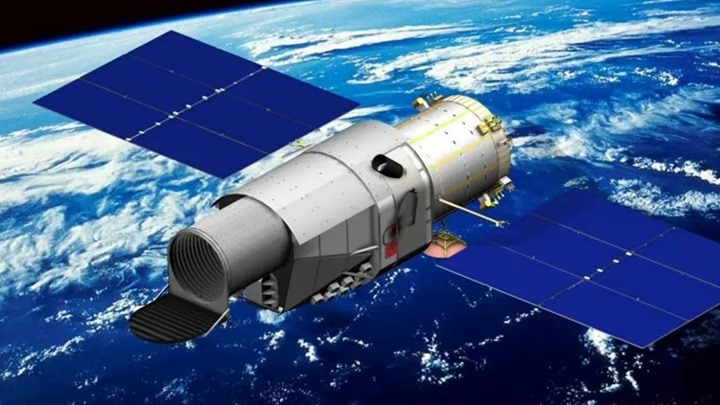
China is launching a telescope called Xuntian (CSST), and on paper, it looks incredible. It has a 2-meter primary mirror, similar to Hubble, but its field of view is 300 times larger.
It’s designed to co-orbit with the Chinese Space Station (Tiangong). This is a genius move because it allows astronauts to dock with the telescope for repairs and upgrades—something that saved Hubble’s life multiple times. It will focus on dark matter, galaxy evolution, and cosmology.
12. Dream Chaser: The Spaceplane Returns

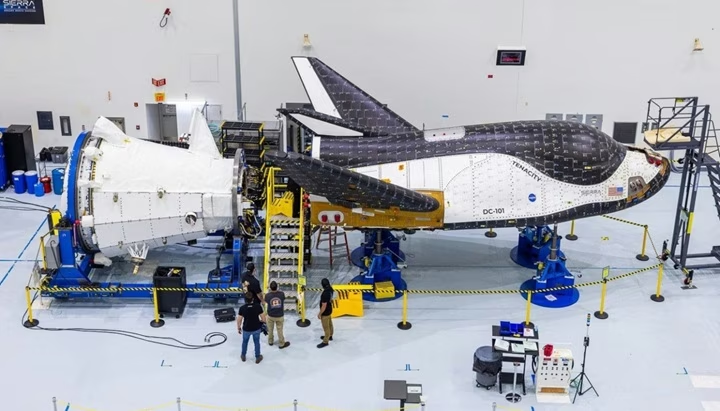
If you missed the Space Shuttle, you’ll love Sierra Space’s Dream Chaser. This isn’t a capsule that drops into the ocean; it’s a winged spaceplane that lands on a runway.
Its first orbital flight will be uncrewed, delivering cargo to the ISS. My perspective: Capsules are rough on landing (think of a car crash in reverse). A spaceplane offers a gentle return (1.5g), which is crucial for bringing back sensitive scientific experiments—or eventually, fragile tourists—from space.
13. Nancy Grace Roman: The Wide-Eye Watcher
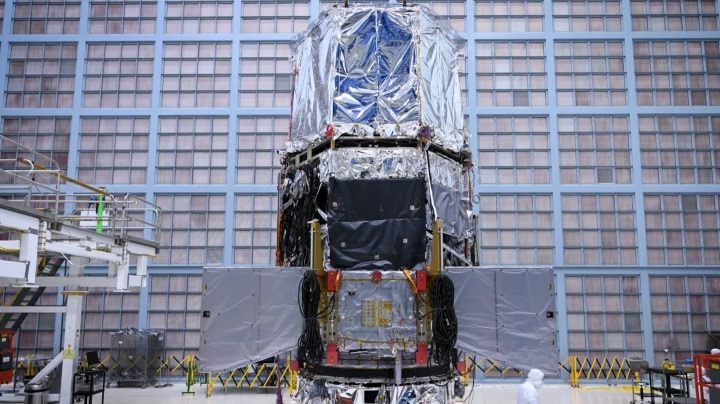
Last but certainly not least, NASA’s Nancy Grace Roman Space Telescope. Think of this as Hubble’s panoramically gifted sibling.
While Hubble looks at a grain of sand held at arm’s length, Roman looks at the whole beach. It is designed to hunt for:
- Dark Energy: The mysterious force tearing the universe apart.
- Exoplanets: Using gravitational microlensing to find thousands of new worlds.
I am particularly excited about its potential to directly image exoplanets, blocking out the starlight to see the faint glow of distant worlds.
Final Thoughts: A Sky Full of Potential
Researching these missions, I realized that we are transitioning from “exploring” space to “inhabiting” it. We are building infrastructure, testing defenses, and setting up commercial lanes. It is chaotic, expensive, and absolutely thrilling.
I will be covering each of these launches as they happen, breaking down the technical jargon into plain English.
Which of these missions are you most excited about? Are you Team Moon, Team Mars, or just waiting for the aliens to show up? Let’s talk in the comments below!
You Might Also Like;
- The Mystery of the Far Side: What Is Hiding in the Lunar Shadows? | Metaverse Planet
- The Doomsday Clock Hits 85 Seconds to Midnight: Are We Out of Time?
- Nvidia’s AI Can Now Predict the Future (Of Weather)
-

-

-

-

-

-

-

-
-
-

-

-