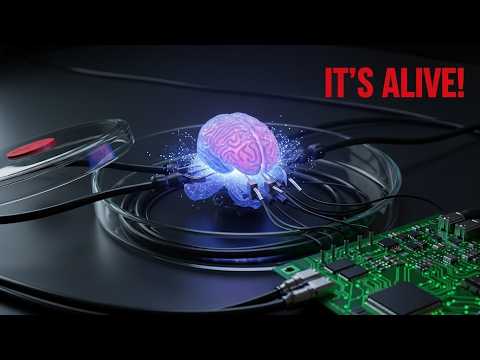
Forget Silicon. The Future is Flesh.
For the past decade, the world has been obsessed with Artificial Intelligence. We worry about ChatGPT taking our jobs or Skynet taking our lives. But while we were looking up at the cloud, scientists were looking down into the petri dish.
The era of silicon computing is hitting a wall. Moore’s Law is slowing down, and our hunger for data is burning the planet. The world’s fastest supercomputers now require the energy of a small city just to run simulations. But nature solved this problem billions of years ago. The human brain operates on just 20 watts of power—barely enough to dim a lightbulb—yet it outperforms every machine we have ever built.
This realization has birthed a new, terrifyingly brilliant field of science: Organoid Intelligence (OI).
What is Organoid Intelligence?


Organoid Intelligence is not science fiction; it is happening right now in laboratories across the globe. Scientists are using stem cells to grow three-dimensional clusters of human brain tissue called “organoids.” These are not plastic chips; they are living, biological neural networks.
Unlike traditional AI, which simulates thinking using binary code (0s and 1s), organoids actually think using chemical and electrical signals, just like you do.
The “DishBrain” Experiment: It Can Play Games

The proof of concept arrived with a project known as “DishBrain.” Researchers at Cortical Labs connected a cluster of 800,000 living neurons to a computer interface and forced them to play the vintage video game Pong.
They didn’t write code to tell the cells how to play. Instead, they used a system of rewards and punishments. When the cells missed the ball, they received a chaotic, unpleasant electrical signal. When they hit the ball, they received a predictable, rhythmic signal.
In just five minutes, the biological tissue learned how to play. It adapted. It evolved. It learned faster than many AI reinforcement learning models. This wasn’t a simulation of learning; it was life struggling to understand a digital environment.
The Rise of “Wetware”

We are moving from “Hardware” and “Software” to “Wetware.”
Imagine a future data center. Instead of rows of humming metal server racks, you walk into a warm, humid room filled with glass canisters. Inside, millions of biological processors float in nutrient-rich pink fluid.
These biological supercomputers could revolutionize everything. They could run the Metaverse with intuitive, human-like NPCs (Non-Player Characters). They could solve medical mysteries that silicon computers can’t grasp. And they could do it all while consuming a fraction of the energy we use today.
The Ethical Nightmare

However, this technology opens a Pandora’s Box of ethical horror. If a computer is made of living brain tissue, does it have rights?
- Can it feel pain? If we “punish” the processor with electrical noise to make it calculate faster, are we torturing a living entity?
- Is it conscious? At what point does a complex neural network become “aware”?
- The Slavery of the Neuron: Are we creating a race of biological slaves, bred only to process our data, trapped forever in a dark server rack without a body?
Conclusion
The transition from silicon to biology seems inevitable due to efficiency demands. But as we rush to build the ultimate computer, we must ask ourselves: Are we ready for our machines to be alive?
The line between man and machine isn’t just blurring; it is vanishing. The computer of the future won’t just sit on your desk. It might be a distant cousin of your own brain, living inside a box.
You Might Also Like;
- The Mystery of the Far Side: What Is Hiding in the Lunar Shadows? | Metaverse Planet
- The Doomsday Clock Hits 85 Seconds to Midnight: Are We Out of Time?
- Nvidia’s AI Can Now Predict the Future (Of Weather)
-

-

-

-

-

-
-

-

-

-

-
-