

I’ve spent the last few days navigating the neon-soaked aisles of CES 2026, and if there’s one thing I’ve learned, it’s that the “robotics revolution” is no longer something we talk about in the future tense. It’s happening in the present, and nowhere is that more evident—or more high-stakes—than in the operating room.
While most of the crowd was busy playing with AI-powered toys or checking out the latest foldable gadgets, I found myself standing in front of something that actually gave me goosebumps: Dynamis. Developed by the Swiss-based LEM Surgical, Dynamis is being hailed as the world’s first surgical humanoid robot.
Now, when I first heard “humanoid,” I expected something out of a sci-fi movie with legs and a face. But Dynamis is different. It’s a humanoid in the way it works, mimicking the incredible dexterity and bimanual coordination of a human surgeon, but with a level of precision that no human hand could ever achieve.
More Than Just a Concept: It’s Already Saving Lives

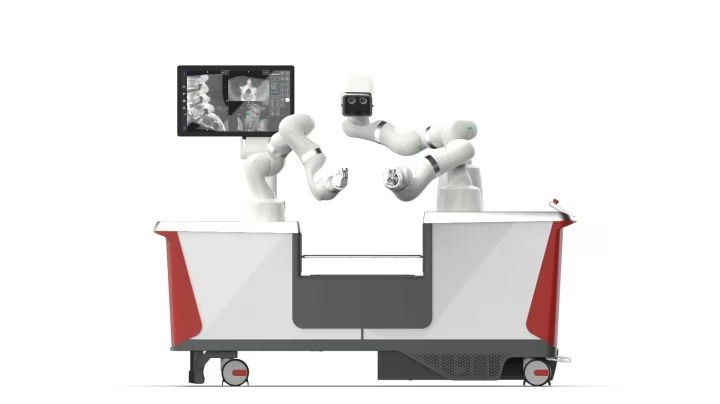
One thing that really bugs me about tech fairs is the “vaporware”—products that look cool but won’t exist for five years. Dynamis is the exact opposite. To my surprise, I learned that this system isn’t just a prototype; it has already received FDA 510(k) clearance and is currently being used for routine spine surgeries at Southern Hills Hospital in Las Vegas.
I had the chance to look closely at the hardware, and the engineering is nothing short of breathtaking. We’re talking about sub-millimeter precision. To put that in perspective, a single human hair is about 0.07 millimeters wide. This robot can position surgical instruments with a level of accuracy that makes the best human surgeons look like they’re working with oven mitts.
Why “Humanoid” in the Operating Room?
You might wonder, “Ugu, why do we need a robot that acts like a human in surgery?” The answer lies in how our bodies are built.
Human surgeons use two hands in a very specific, coordinated dance. One hand might stabilize a vertebrae while the other precisely places a screw. Dynamis mimics this “multi-arm” architecture. * The Three-Arm System: The robot features three distinct arms.
- Precision Duo: Two computer-controlled arms handle the heavy lifting—surgical guidance and the ultra-precise placement of instruments.
- The Eye: The third arm holds and controls the navigation camera, ensuring the “vision” of the robot never wavers.
- The Mobile Base: The entire setup sits on a single mobile unit that can partially tuck under the surgical table.
As someone who appreciates good design, I loved this part. Ameliyathanes (operating rooms) are notoriously cramped and chaotic. By making the robot compact and mobile, LEM Surgical has solved a massive logistical headache for hospitals.
The Secret Ingredient: NVIDIA’s “Physical AI”

As I dug deeper into how Dynamis actually “thinks,” I realized that the hardware is only half the story. The “brain” behind this surgeon is powered by NVIDIA Isaac for Healthcare.
During the presentation, the team explained how the robot uses built-in AI processing to compensate for microscopic movements. Think about it: during surgery, the patient’s body moves slightly due to breathing or heartbeats. Dynamis can sense these tiny shifts in real-time and adjust its arms instantly to maintain perfect stability.
But what really got me excited was their roadmap for the future. They aren’t stopping at just being a “highly precise tool.” They are integrating:
- NVIDIA Jetson Thor: This is a high-performance platform designed specifically for humanoid robots to perform complex “Physical AI” tasks.
- NVIDIA Cosmos: This is an “open-world foundation model” that will allow the robot to learn from every single surgery it performs.
I’ve always said that AI is at its best when it’s helping us do things that are physically impossible for humans. Training a robot on thousands of clinical cases so it can offer augmented support to a surgeon is exactly the kind of “AI for good” I want to see.
The “Ugu” Perspective: Will Robots Replace Surgeons?
Whenever I write about surgical robots, I get the same question: “Would you let a robot operate on your spine?”
Honestly? If it’s Dynamis, yes. I don’t see this as a replacement for the surgeon. I see it as the ultimate upgrade. A surgeon’s expertise, their years of medical school, and their “gut feeling” in a crisis are irreplaceable. But human hands shake. Human eyes get tired. Human bodies get fatigued after a 10-hour surgery.
Dynamis doesn’t get tired. It doesn’t have a “bad day.” It takes the surgeon’s intent and executes it with the perfection of a machine. Seeing it in person made me realize that we are entering an era where “human error” in surgery might actually become a thing of the past.
LEM Surgical announced that the first clinical operations in the U.S. were completed successfully this past November. This isn’t a “maybe” anymore—it’s the new standard for spinal, thoracic, and sacral procedures.
Moving Toward Full Autonomy?


The most provocative part of the CES reveal was the mention of increased autonomy. Right now, the surgeon is the pilot, and the robot is the “fly-by-wire” system. But with the integration of NVIDIA’s latest tech, we are looking at a future where the robot might handle certain routine parts of a procedure autonomously, allowing the human to focus on the most critical, high-level decisions.
It’s a bit like a Tesla on Autopilot—the human is still “in the loop,” but the machine is doing the heavy lifting of maintaining lanes and speed. In a surgery, that translates to higher safety and much faster recovery times for the patient.
Final Thoughts from the Floor
Walking away from the LEM Surgical booth, I felt a strange sense of relief. We spend so much time worrying about AI taking over the world or creating deepfakes, but here is a humanoid robot designed with a singular, noble purpose: to make sure you walk again after a back injury.
The tech is impressive, but the impact on human life is what really matters. If 2026 is indeed the “Year of the Humanoid,” I’m glad some of them are wearing scrubs.
I’m curious to know your thoughts—if you were going in for a major operation, would you feel MORE comfortable or LESS comfortable knowing a humanoid robot was assisting your surgeon? Let’s talk about it in the comments!
You Might Also Like;
- The Mystery of the Far Side: What Is Hiding in the Lunar Shadows? | Metaverse Planet
- The Doomsday Clock Hits 85 Seconds to Midnight: Are We Out of Time?
- Nvidia’s AI Can Now Predict the Future (Of Weather)
-
-
-

-

-

-
-

-

-

-

-

-

