
I’ve always been obsessed with how we’re going to power our future. For years, we’ve heard that nuclear fusion is “30 years away and always will be.” But lately, I’ve been digging into what’s happening at Tokamak Energy in the UK, and honestly, my mind is blown.
I’m talking about the ST40 reactor. This isn’t just another science experiment; it’s a machine that successfully hit 100 million degrees Celsius. To put that in perspective, that is roughly seven times hotter than the center of the Sun.
I spent my afternoon looking at the engineering blueprints and the plasma stability data, and I realized something: we aren’t just watching a lab test. We are watching the birth of a new era for humanity. Let me walk you through why I think this specific machine might be the most important thing we’ve ever built.
Why 100 Million Degrees is the Magic Number

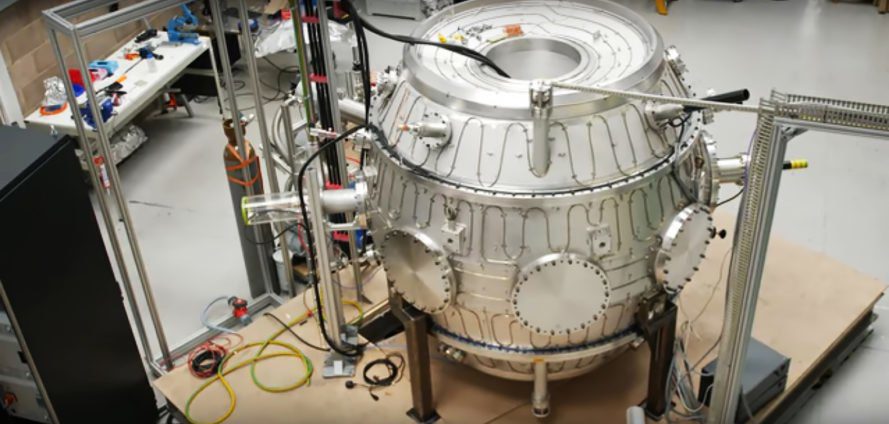
You might be wondering, “Ugu, why do we need to go seven times hotter than the Sun?” It’s a fair question. Inside the Sun, gravity is so massive that it forces atoms together even at “lower” temperatures. Here on Earth, we don’t have that crushing gravitational force, so we have to compensate with pure, raw heat.
At 100 million degrees, the hydrogen isotopes (deuterium and tritium) move so fast that they overcome their natural repulsion and fuse together. When they do, they release a staggering amount of energy.
When I first saw the thermal readings from the ST40, I got goosebumps. Reaching this “commercial threshold” in a compact reactor is the holy grail. It’s the point where the physics says, “Yes, this can actually work as a power plant.”
The Spherical Advantage: Why Size Matters

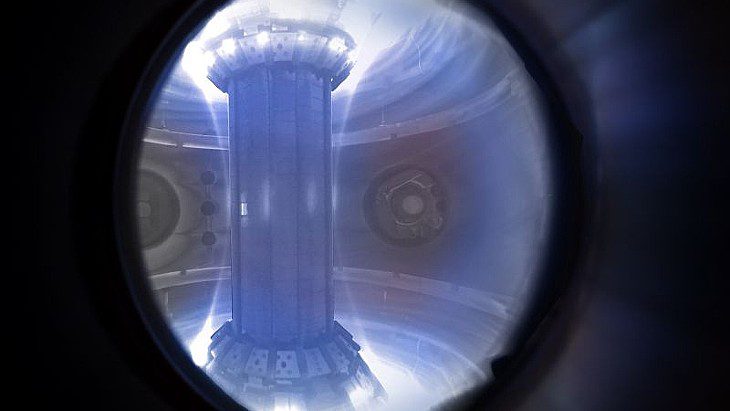
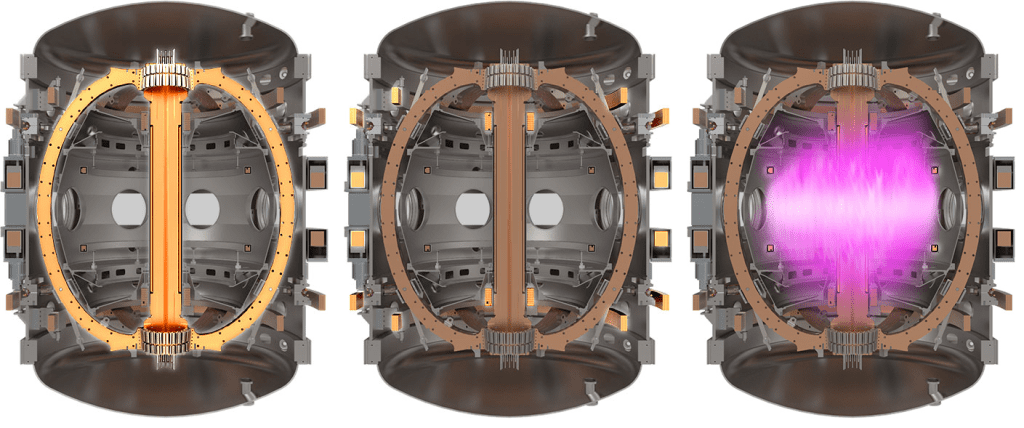
Most people think of fusion reactors like the massive ITER project in France—basically a building-sized machine that costs billions. But the ST40 is a “Spherical Tokamak.” Think of a traditional tokamak as a giant donut. A spherical tokamak, like the ST40, is more like a cored apple.
I’ve been tracking the efficiency of these designs, and the “apple” shape is a game-changer for a few reasons:
- Efficiency: It holds the plasma much more tightly with less magnetic effort.
- Cost: Because it’s smaller, it’s cheaper to build and iterate on.
- Speed: Tokamak Energy can test new ideas in months, not decades.
I personally believe that the future of energy won’t come from one giant “death star” reactor, but from thousands of these compact, modular units hidden away in industrial zones, quietly powering entire cities.
High-Temperature Superconductors: The Secret Sauce


You can’t just hold 100-million-degree plasma in a metal tank; it would melt instantly. You need powerful magnetic fields to “suspend” the plasma in a vacuum.
This is where the ST40 gets really “sci-fi.” They use High-Temperature Superconductors (HTS).
I find this fascinating because these magnets allow the reactor to be much smaller while generating much stronger fields. It’s like replacing a massive, old-school vacuum tube computer with a modern microchip. Without HTS, the ST40 would just be a very expensive heater. With it, it’s a prototype for a limitless energy engine.
My Take: Is This the “Second Fire”?

I often say that fusion is like humanity discovering fire for the second time. The first fire gave us warmth and cooked our food, but it also created smoke and relied on burning resources.
Fusion is different. * No Meltdowns: If something goes wrong, the plasma just cools down and the reaction stops. It’s physically impossible for it to “blow up” like a fission plant.
- Zero Carbon: No CO2, no greenhouse gases. Just helium as a byproduct (which we actually need more of!).
- Infinite Fuel: The fuel comes from seawater and lithium. We have enough to power Earth for millions of years.
As I was reading the latest progress reports, I couldn’t help but feel a bit emotional. If we get this right, the concept of “energy poverty” disappears. Imagine desalination plants running for free, or vertical farms producing food with zero energy costs.
The Road Ahead: Challenges and Reality
I’m an optimist, but I’m also a realist. We aren’t plugging our toasters into the ST40 tomorrow.
The biggest hurdle right now isn’t the heat—it’s the duration. The ST40 hits these temperatures in short bursts. The next step is “steady state” operation—keeping that star burning for hours, days, and years.
Also, we need to figure out how to efficiently capture the heat and turn it into electricity. It sounds simple, but when you’re dealing with temperatures that high, the engineering becomes a beautiful, complex nightmare.
Why I’m Betting on Private Fusion
In the past, fusion was a government-only game. Now, companies like Tokamak Energy (and others like Commonwealth Fusion Systems) are moving at “startup speed.” I think this private sector competition is exactly what we needed to break the “30-year” curse.
Conclusion: The Star in the Room
Seeing the ST40 achieve what it has makes me realize that we are no longer just “dreaming” about the future. We are building it. We are literally bottle-feeding a star in a lab in Oxfordshire.
I’m convinced that within our lifetime, the “Fusion Age” will begin, and it will change everything from how we travel through space to how we live in our homes.
But I want to hear from you—because honestly, this stuff is a lot to wrap your head around. Do you think we should be pouring every cent we have into fusion research, or should we keep our focus on perfecting solar and wind for now? Let’s chat in the comments—I’ll be there!
Stay curious, Ugu | Metaverse Planet
You Might Also Like;
- The Mystery of the Far Side: What Is Hiding in the Lunar Shadows? | Metaverse Planet
- The Doomsday Clock Hits 85 Seconds to Midnight: Are We Out of Time?
- Nvidia’s AI Can Now Predict the Future (Of Weather)
-

-

-
-

-
-

-

-

-

-

-

-

