

Hey everyone, it’s Ugu!
I’ve always found it a bit funny—and honestly, a little frustrating—how we have robots capable of exploring the craters of Mars, yet the one in my living room gets defeated by a thick rug or a single doorstep. For years, the “staircase” has been the final boss for robot vacuums. We’ve seen workarounds, like buying one robot for every floor or carrying the poor thing up and down like a mechanical toddler.
But while I was checking out the latest reveals from CES 2026, I saw something that made me realize the “flat-land” era of cleaning is finally over. Roborock just unveiled the Saros Rover, and it’s not just another vacuum with more suction power. This thing has legs.
Let’s talk about why this is the most significant design shift I’ve seen in home robotics in a decade.
Evolution Beyond the “Disk” Design

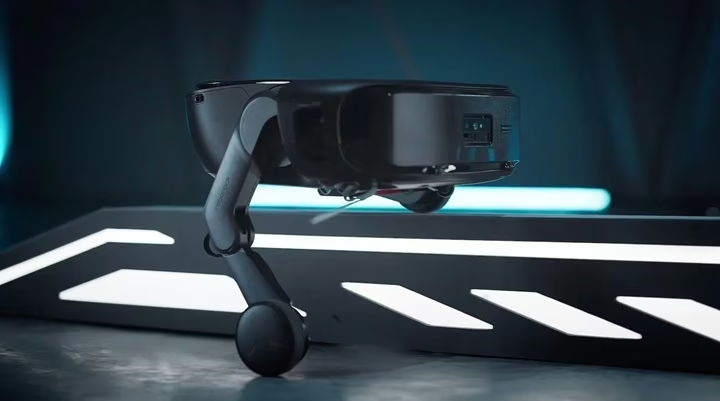
For twenty years, the robot vacuum has been a disk on wheels. It’s a design that works for 2D spaces but fails miserably in a 3D home. When I first saw the Saros Rover, it looked like something out of a sci-fi movie.
Roborock describes it as the world’s first robot vacuum with articulated wheel-legs. Instead of being tucked under the body, these wheels are attached to limbs that can move independently.
I watched the live demonstration where the Rover approached a five-step staircase. I expected it to struggle or move clunkily, but it climbed those five steps in about 40 seconds. It uses one leg to stabilize itself while the other reaches for the next level. It wasn’t just “climbing”—it was cleaning every single step as it went. I’ve spent my afternoon thinking about the engineering required to keep a vacuum seal on a vertical transition, and honestly, it’s brilliant.
The Secret Sauce: AdaptiLift Chassis 3.0
The magic behind this movement is what they call the AdaptiLift Chassis 3.0. I’ve been tracking Roborock’s chassis tech for a while, but this is a massive leap forward.
This system allows the robot to:
- Adjust Height Dynamically: It can lift its entire body up to 8.4 cm off the ground. That means those high door thresholds or thick “shag” carpets that used to trap your old robot are now non-issues.
- Navigate Slopes and Curves: It’s not just for straight stairs. The independent suspension allows it to handle curved steps and steep ramps.
- Maintain Balance: Sensors calculate the center of gravity in real-time so it doesn’t tumble backward—a nightmare scenario for anyone with expensive hardwood floors.
I personally think the “legs” are a game-changer for accessibility. If you live in a multi-story home, the “chore” of floor maintenance has just been cut in half because you no longer have to play “robot sherpa.”

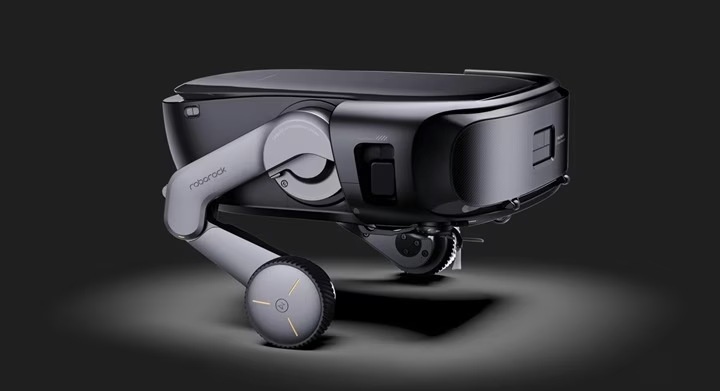
You can’t give a robot legs without giving it a brain that understands height. The Saros Rover uses a suite of 3D spatial sensors and AI-powered navigation that I find quite impressive.
In the demo, the robot didn’t just “hit” the stairs and try to climb. It scanned the environment, recognized the stairs as a traversable path rather than an obstacle, and mapped out the most efficient way to climb. It’s using real-time object recognition to distinguish between a “stair it should climb” and a “box it should go around.”
As someone who loves the intersection of AI and hardware, seeing this level of environmental awareness in a household appliance makes me wonder: what’s next? If it can climb stairs, can it eventually learn to open doors or clear toys off the floor?
The “Catch”: It’s Still a Rover in Training
Now, I have to temper my excitement with a bit of reality. Roborock was very clear that the Saros Rover is currently a concept.
There is no official release date yet, and there are still some unanswered questions. For instance, the current prototype only vacuums. They haven’t decided if they can integrate a mopping system into this specific leg-based design.
I’ll be honest: if I have to choose between a robot that mops but stays on one floor, and a robot that vacuums my entire three-story house by itself, I’m picking the climber every single time. However, knowing how competitive the market is, I wouldn’t be surprised if the final consumer version finds a way to squeeze a water tank in there.
Why I Think This Changes Everything

For the longest time, “Home Robots” were just “Smart Appliances.” But the Saros Rover feels like it’s crossing the line into becoming a true mobile robot.
By solving the mobility issue, Roborock is opening the door for robots to do more than just clean. Once a robot can move freely across different levels of a house, it becomes a platform. It could be a mobile security camera, a delivery bot for items between floors, or even an elder-care assistant.
I’m genuinely excited because this marks the end of the “frustrating” era of robotics—where we had to adapt our homes (by removing rugs or adding ramps) to fit the robot. Now, the robot is finally adapting to us.
Conclusion: Are You Ready for a Legged Roommate?
The Saros Rover is a bold statement. It tells us that the future of the smart home isn’t just about software; it’s about physical capability. Seeing it climb those stairs felt like watching a bird fly for the first time—it just felt right.
But I want to get your take on this. To me, this is a “shut up and take my money” kind of innovation, but I know some people prefer simplicity.
Would you trust a legged robot to roam around your house while you’re asleep, or does the idea of a “climbing” vacuum feel a bit too much like a sci-fi movie for your liking? Let’s chat in the comments!
Stay curious, Ugu | Metaverse Planet
You Might Also Like;
- The Mystery of the Far Side: What Is Hiding in the Lunar Shadows? | Metaverse Planet
- The Doomsday Clock Hits 85 Seconds to Midnight: Are We Out of Time?
- Nvidia’s AI Can Now Predict the Future (Of Weather)
-
-

-

-

-

-
-

-

-

-

-

-

