
I’ll be honest with you—whenever I look at traditional solar panels, I see a brilliant piece of technology trapped in a terribly clunky design. They look like giant, rigid calculators strapped to our roofs. I’ve always thought there had to be a better way to integrate clean energy into our homes without ruining the aesthetic of our neighborhoods.
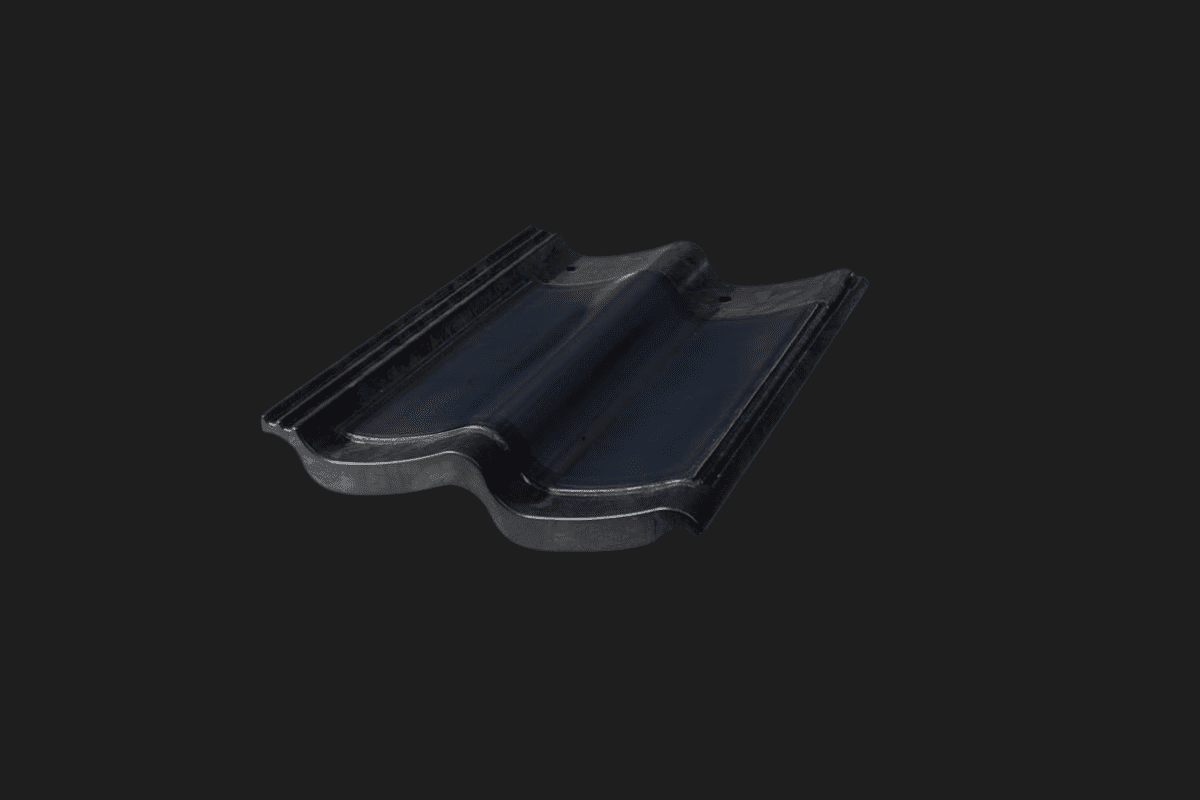
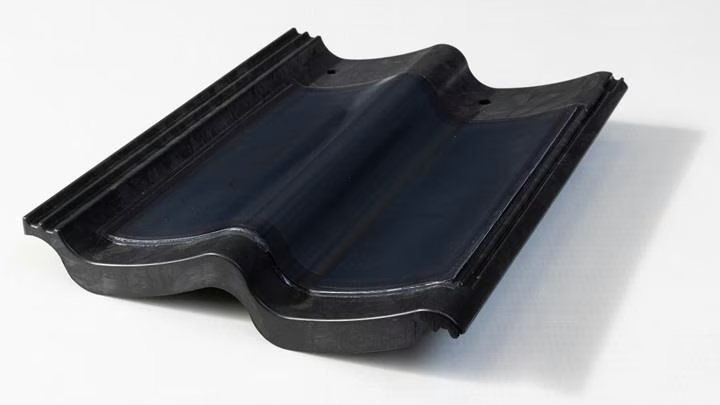
Recently, while researching the latest trends in renewable tech, I stumbled upon a breakthrough from the Netherlands that genuinely made me sit up and take notice. The researchers at TNO have developed the world’s first solar roof tile based on perovskite cells. And the best part? It’s actually curved.
Let me walk you through why this is such a massive deal for the future of our smart homes, and why it’s not just another lab experiment destined to be forgotten.
Breaking the Mold: The TNO Breakthrough

For the longest time, making a solar panel curved meant sacrificing a massive amount of its efficiency. Solar cells, particularly traditional silicon ones, like to be flat. But the team at TNO took a different route.
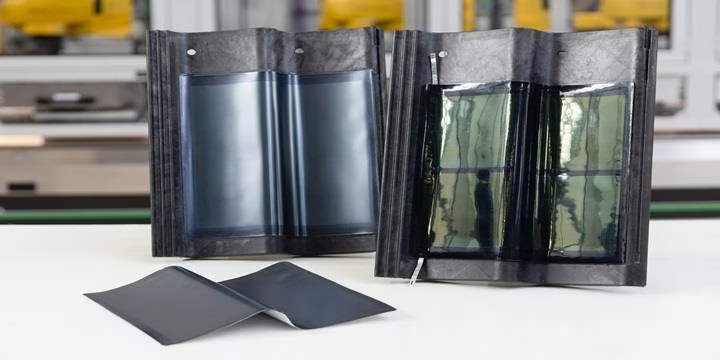
Using flexible perovskite solar modules, they partnered with ASAT B.V. to integrate this technology directly onto a curved composite roof tile. When I looked at the performance data, I was genuinely surprised.
- Lab Performance: In isolated lab conditions, these individual flexible modules hit an efficiency of 13.8%.
- Real-World Application: When bent and mounted onto the curved roof tile, they maintained a highly respectable 12.4% efficiency.
This means that applying the module to a sloped, curved surface had a very limited negative impact on its ability to generate power.
Why Perovskite is the “Holy Grail” of Next-Gen Solar

If you aren’t familiar with perovskite, you’re going to hear this word a lot in the next few years. Manufacturing traditional silicon panels is an energy-intensive, complex process. Perovskite changes the game entirely.
Here is why I think this material is the key to our urban energy future:
- Printable Like a Newspaper: Perovskite modules can literally be manufactured in rolls, using processes very similar to printing a daily newspaper. This drives production costs straight down to the floor.
- Featherweight and Flexible: Because they are as thin as a film, they weigh next to nothing. This completely removes the need for heavy, reinforced roof structures.
- Low-Light Champions: Even when the sky is incredibly cloudy, or the sun isn’t hitting the roof at the perfect angle, perovskite often outperforms traditional silicon in drawing out usable energy.
By integrating these right into the building materials (Building-Integrated Photovoltaics, or BIPV), we are eliminating the need for massive, ugly solar farms or placing heavy infrastructural loads on suburban houses. The roof is the power plant.
From the Lab to Your Roof
What excites me most about TNO’s announcement isn’t just the science—it’s the readiness. I see so many “miracle technologies” that are decades away from hitting the market.
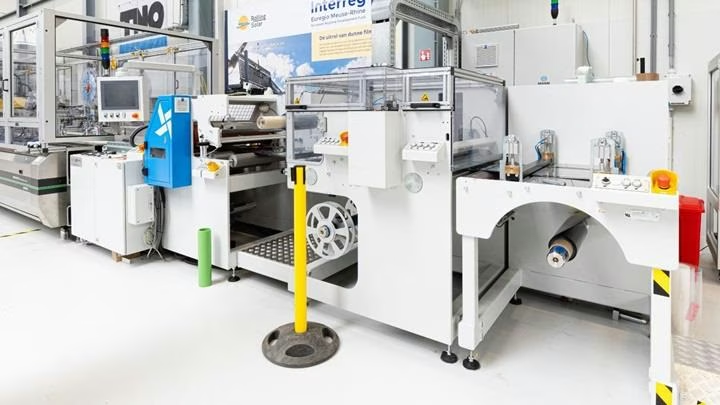
TNO, however, has specifically designed their material and manufacturing processes to be compatible with existing industrial standards. They didn’t just make a tiny millimeter-sized cell; they scaled it up from small lab samples to 10×10 centimeter flexible modules, and finally, into a fully functional, ready-to-use solar tile.
They’ve even set up a pilot production line and launched a new spin-off company, Perovion Technologies, explicitly to commercialize this tech. They mean business.
Let’s Be Real: The Reality Check
Now, I wouldn’t be doing my job if I didn’t look at the downsides. As much as I love this innovation, perovskite is not perfect.
- The Durability Problem: This is the elephant in the room. Traditional silicon panels can easily sit on your roof and take a beating from the weather for over 20 years. Perovskite historically struggles with moisture and heat degradation. TNO is working hard on reliability, but it’s still a hurdle.
- The Efficiency Gap: 12.4% is amazing for a curved, flexible tile, but it’s still behind top-tier competitors. For context, just a few months ago, I was looking at Jackery’s Solar Roof tiles, which hit a staggering 25% efficiency.
However, there is a catch: those Jackery tiles weigh about 4.5 kg each. If you want a lightweight, seamless, and incredibly cheap-to-produce alternative, perovskite is still the clear winner in the long run.
Integrating technology seamlessly into our physical world is exactly what the future of smart cities is all about. We are moving away from bolt-on accessories and moving toward homes that are inherently intelligent and self-sustaining from the very materials they are built with.
I’m keeping a close eye on Perovion Technologies to see when these tiles will actually be available for residential purchase.
What do you think? If the cost was significantly lower than traditional solar panels, would you be willing to replace your current roof with these flexible, curved solar tiles, even if they had a slightly shorter lifespan? Let’s discuss it in the comments below!
You Might Also Like;
- A Century-Old Aviation Dream Reborn: The Channel Wing VTOL Takes Flight
- The Dawn of the Automated Battlefield: How Ground Robots Are Redefining Warfare
- The Insatiable Hunger of AI: Why Tech Giants Are Chasing Natural Gas
-

-

-

-

-
-
-

-

-

-

-

-

