Every time I back up my files, stream a 4K movie, or run a heavy AI prompt, I rarely stop to think about the physical reality of the “cloud.” We treat the internet like an invisible magic trick, but the truth is, the internet lives in massive, incredibly loud, and heavily air-conditioned warehouses known as data centers.
Recently, while diving into how the artificial intelligence boom is physically expanding our infrastructure, I stumbled upon a fascinating shift in how these mega-facilities are secured. The silent heroes walking the server aisles aren’t just human security guards anymore. They are four-legged, highly advanced robotic dogs.
I wanted to dig deeper into why companies are spending hundreds of thousands of dollars on robotic pets, and what I found completely changed my perspective on the future of physical security. Let me break down why robots have become the ultimate guardians of our digital lives.
The Scale Problem: Why Humans Aren’t Enough Anymore


To understand why robots are stepping in, you have to understand the sheer scale of modern data centers. We aren’t talking about a small server room in the basement of an office building. Facilities today span millions of square feet.
With the explosive demand for AI and cloud computing, these infrastructures are growing at an unprecedented rate. There are currently about 5,000 data centers operating in the U.S. alone, with another 1,000 currently under construction.
When a facility is the size of several football fields, relying solely on human patrols becomes incredibly inefficient.
- Humans get tired.
- Humans can’t naturally see a 2-degree temperature spike in a server rack.
- Humans can’t continuously patrol a freezing cold, heavily noise-polluted environment 24/7 without taking breaks.
This is exactly where robotic solutions are stepping in, not just as a gimmick, but as a critical operational necessity.
Meet the Robotic Guard Dogs

Currently, two major models are dominating the data center security space. Let’s look at the hardware that is actually out there patrolling the floors right now.
1. Boston Dynamics’ Spot: The Indoor Inspector
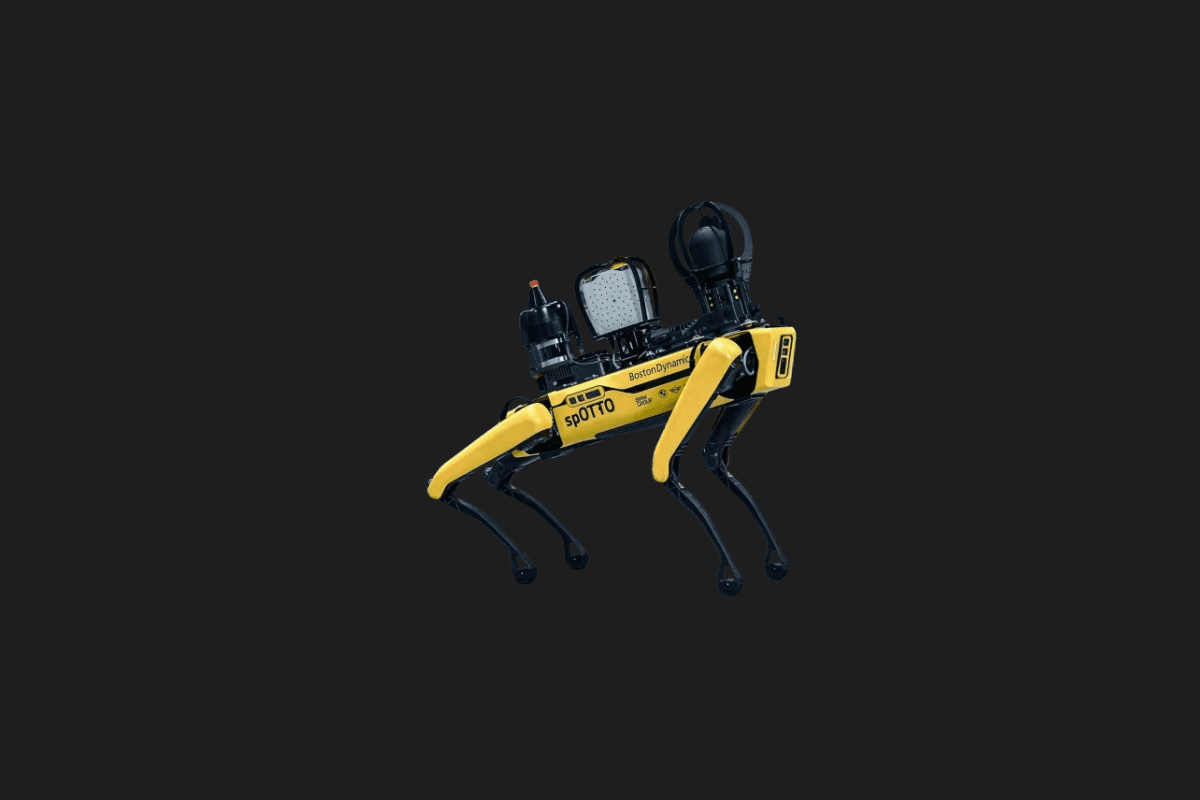
If you’ve seen viral videos of a yellow robot dog dancing or opening doors, you already know Spot. Designed by Boston Dynamics, it’s about the size of a medium dog, but its capabilities are far beyond anything biological.
Spot is built to navigate complex terrains, climb stairs, and work tirelessly in environments that are too hot, too cold, or too dusty for humans. But what makes it invaluable for data centers isn’t its legs; it’s the payload.
Spot is typically equipped with:
- Thermal Sensors: To instantly detect if a server rack is overheating.
- Acoustic Sensors: To listen for the specific high-pitched whine of a failing cooling fan.
- Water Detection: To spot microscopic leaks from liquid cooling systems before they short-circuit millions of dollars of hardware.
When I first looked at the price tag, I was shocked. A fully equipped Spot costs anywhere from $175,000 to $300,000. But here is the crazy part: data center operators claim that by preventing just one major outage or hardware meltdown, Spot pays for itself in just 18 months. ### 2. Ghost Robotics’ Vision 60: The Perimeter Patroller While Spot handles the intricate indoor server aisles, Ghost Robotics’ Vision 60 is specifically tailored for harsh outdoor perimeter security.
Data center campuses are massive, and their exterior fences, rooftops, and parking lots need constant surveillance. The Vision 60 provides security teams with continuous, high-definition video feeds while autonomously walking the fence line.
- The Cost Factor: The base model starts at $165,000.
- The ROI: To put that in perspective, a 24/7 human security team for a massive campus can easily cost $150,000 per year in salaries, benefits, and insurance. The robot requires zero salary, just electricity to recharge.
Ghost Robotics makes an important point that I agree with: they aren’t trying to replace human guards completely. Instead, these robots act as force multipliers, expanding the reach of the human security team sitting safely in the control room.
Real-World Application: The Novva Data Centers


To see if this was just marketing hype, I looked into who is actually using this tech. Novva Data Centers in West Jordan, Utah, is a prime example. Their flagship facility spans a mind-boggling 1.5 million square feet.
Novva actively uses Boston Dynamics’ Spot robots to patrol their facility. The robots autonomously walk pre-programmed routes, collecting environmental data and checking equipment. If a power unit gets too hot or a cooling pipe drips a single drop of water, Spot flags the anomaly and sends an instant alert to the human staff.
It handles the tedious, repetitive checks flawlessly, freeing up human engineers to focus on complex problem-solving rather than walking empty corridors for eight hours a day.
My Take: The Future of Infrastructure
When you realize that almost every aspect of modern society—our banking apps, hospital records, communication grids, and AI tools—relies on these physical servers, the idea of having robotic dogs protecting them doesn’t seem like sci-fi anymore. It feels like a necessity.
I honestly think this is just the first wave. As data centers transition to liquid cooling to support next-gen AI chips, the environmental monitoring required will become so microscopic that human senses simply won’t be able to keep up.
We are building the brain of the future, and we are hiring robots to act as its immune system.
So, I want to ask you: If you were running a multi-billion dollar tech facility, would you trust a fleet of autonomous robot dogs to handle your security, or does handing over the keys to robots still make you a little nervous? Let’s discuss it in the comments!
You Might Also Like;
- A Century-Old Aviation Dream Reborn: The Channel Wing VTOL Takes Flight
- The Dawn of the Automated Battlefield: How Ground Robots Are Redefining Warfare
- The Insatiable Hunger of AI: Why Tech Giants Are Chasing Natural Gas
-
-

-
-
-
-

-
-

-
-

-
-