
I have to admit something: I absolutely hate parking.
It doesn’t matter how advanced my car gets or how great the driving experience is; the moment I enter a crowded parking garage, my stress levels spike. Circling for 20 minutes, trying to squeeze into a spot between two SUVs that can’t stay in their lines, and—if you drive an electric vehicle (EV) like I do—the constant anxiety of finding a charger that actually works.
But what if you never had to park again? What if your building did it for you, and even plugged your car in while you slept?
While researching new infrastructure trends this week, I stumbled upon a project in Menlo Park, California, that feels like it was ripped straight out of a sci-fi novel. It’s called Lume, and it’s not just an apartment complex; it’s a glimpse into how our cities might function in the very near future. Let’s dive into how this robotic system is changing the game for EV owners.
The End of “Charger Hogging”


If you own an EV, you know the unspoken war that happens at charging stations. Someone plugs in their car at 6 PM, it finishes charging by 9 PM, but they leave it there until the next morning. That spot is dead for everyone else. It’s frustrating, it’s inefficient, and it causes neighbor disputes.
The system at the Lume complex, managed by Greystar, solves this with a brilliant mix of automation and robotics.
Here is how the workflow actually happens, and it’s surprisingly seamless:
- Drop and Go: You don’t drive into the garage. You leave your car at the transfer bay at the entrance.
- The Shuffle: The automated system lifts your car and whisks it away to a storage spot in the three-story structure.
- On-Demand Juice: When you need a charge, you don’t go move your car. You just tap a button on a smartphone app.
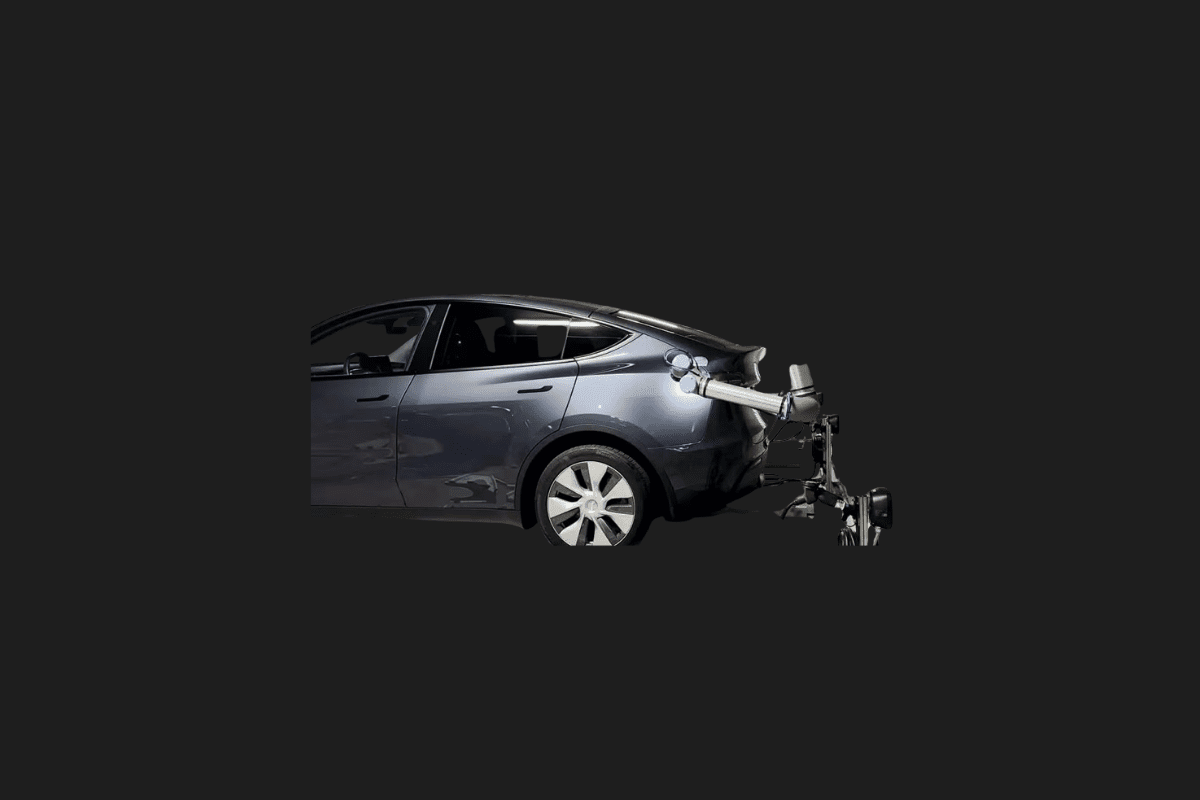
- Robotic Connection: This is the cool part. The system moves your car to a dedicated charging bay. A robotic arm identifies your charge port, opens it, and plugs the cable in. No humans involved.
- The Rotation: Once your battery is full, the robot unplugs the car, and the system moves your vehicle back to a standard parking spot, freeing up the charger for the next neighbor.
I find this incredibly smart because it maximizes infrastructure. You don’t need 450 chargers for 450 cars. You just need a few high-speed robotic bays and a system that rotates the cars efficiently.
High-Density Tech in the Heart of Silicon Valley


It’s no surprise this is happening in Menlo Park. This is the heart of Silicon Valley, right in Meta’s backyard. The sheer density of the area demands clever solutions.
The Lume garage holds over 450 vehicles across three levels. If this were a traditional ramp-style garage, it would likely need double the footprint to account for driving lanes, ramps, and human error (we need wide spaces to open our doors). By removing the human driver from the equation, they can pack cars in tighter and stack them higher.
Why this matters for the industry:
- Space Efficiency: Developers can build more housing and less concrete parking blocks.
- Safety: No dark corners or pedestrian accidents inside the garage.
- Convenience: It turns parking into a valet service without the tipping.
The Price of Living in the Future

Of course, there is a catch. There is always a catch.
As much as I love the tech, I looked up the leasing costs, and let’s just say my wallet started sweating. This is luxury living. Rent at Lume reportedly starts around $3,300 per month for the smallest units.
You aren’t just paying for the apartment or the yoga studio and pool (which they also have); you are paying for the privilege of never touching a charging cable again. For the tech elite in Silicon Valley, that time saved might be worth the cost. But for the rest of us? We might be waiting a while for this tech to trickle down to standard condos.
My Verdict: A Blueprint for Smart Cities
I’ve seen plenty of “automated parking” videos where cars get stuck or the system glitches. But the addition of the robotic charging arm is what makes this specific project significant.
As we move toward a world where EVs are the standard, the “one charger per parking spot” model is unsustainable. It’s too expensive to wire every single inch of a garage. Dynamic systems like this—where the car goes to the charger, not the other way around—are the only logical path forward for dense urban cities.
It might seem like a luxury perk today, but I predict that in 10 or 15 years, this will be standard building code for high-rises in places like New York, Istanbul, and Tokyo.
I’d love to hear your take: Would you trust a robotic arm to plug in your car, or would you be worried about coming downstairs to find your paint scratched?
You Might Also Like;
- The Mandalorian & Grogu Trailer Breakdown: Is This the Star Wars Comeback We Need?
- The Era of Instant Creation: How Light is Replacing Layers in 3D Printing
- Real-Life Robocop Is Closer Than You Think
-

-

-

-

-

-

-

-
-

-

-

-
