

I spend a lot of time looking up at the night sky, usually admiring the Moon as this constant, peaceful guardian of our planet. But recently, a piece of news caught my attention that changes how I look at that cratered surface. There is a rock out there—Asteroid 2024 YR4—and it has a date with destiny.
This isn’t your typical “End of the World” asteroid story. This rock isn’t aiming for Earth. It’s aiming for our neighbor, the Moon.
While a 60-meter rock hitting Earth would be a disaster, hitting the Moon is… complicated. It has arguably split the scientific community right down the middle. On one side, you have geologists salivating at the data; on the other, safety experts sweating over our satellites.
I’ve dug into the details of this potential 2032 impact, and honestly, it’s like a script from a sci-fi movie where the scientists can’t agree on whether to push the button.
Meet the Intruder: 2024 YR4

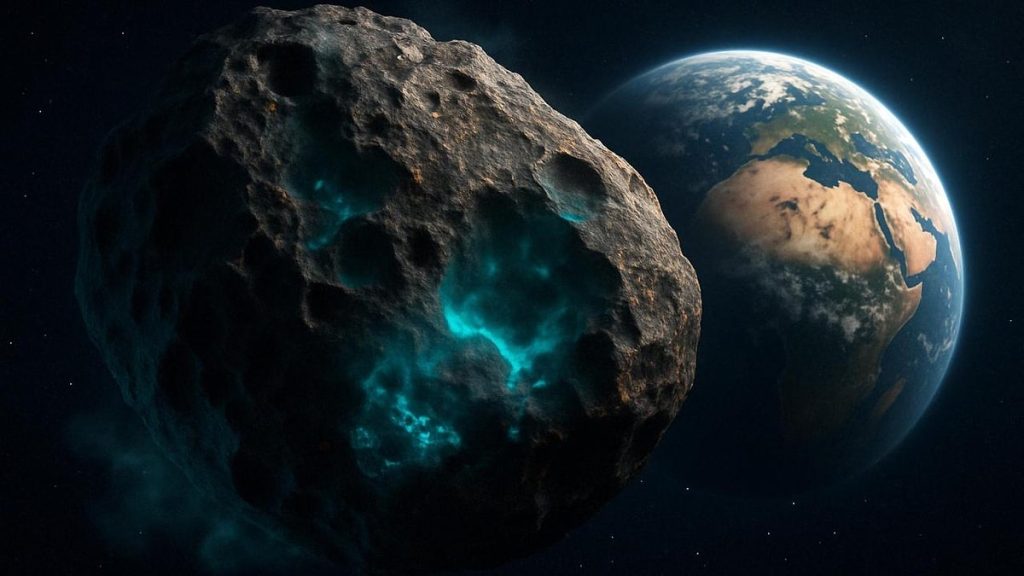
Let’s get the specs out of the way first. 2024 YR4 is a space rock approximately 60 meters (about 197 feet) in diameter.
Currently, astronomers calculate the probability of it striking the Moon at around 4%. That might sound low to you, but in the world of orbital mechanics, 4% is massive. It’s high enough that space agencies are taking it very seriously.
If this collision happens, it won’t be a gentle tap.
- The Energy: It would release energy equivalent to a mid-sized thermonuclear explosion.
- The Scar: It would create a brand new crater roughly 1 kilometer wide.
- The View: If you are standing in the Pacific region when it happens, you could likely see the flash of impact with your naked eye.
For me, the idea of witnessing a new crater being formed in real-time is terrifyingly beautiful. But the aftermath is where things get tricky.
Team Science: “Let It Hit!”

For planetary scientists, this is the Holy Grail. We have spent billions of dollars trying to understand what’s inside the Moon. We’ve sent landers, rovers, and astronauts, but we still have questions about its core and internal layers.
If 2024 YR4 hits, it acts like a cosmic hammer.
Why is this valuable?
- Seismic Clarity: The impact would trigger a “Moonquake” with a magnitude of roughly 5.0. This would send seismic waves rippling through the Moon, allowing us to “X-ray” its deep interior structure like never before.
- Thermal Data: Telescopes like the James Webb Space Telescope (JWST) could watch the molten ejecta cool down, providing unprecedented data on crater formation and lunar evolution.
I can understand their excitement. It’s a “free” experiment. Nature is offering to do a smash-test that we could never ethically or financially justify doing ourselves.
Team Safety: “The Debris Nightmare”

However, not everyone is cheering for the impact. There is a very real, very dangerous downside that I hadn’t initially considered until I looked deeper into the orbital dynamics.
What goes up must come down—or in this case, orbit.
When you blast a 1-kilometer hole in the Moon, millions of tons of dust, rock, and debris get thrown into space. Because the Moon has low gravity and no atmosphere to slow things down, that debris travels fast and far.
The Risk to Earth: Calculations suggest that about 400 kilograms of this lunar debris could be ejected directly toward Earth’s orbit.
This is where the nightmare scenario kicks in. It’s not about rocks hitting us on the ground; it’s about rocks hitting our satellites.
- Infrastructure at Risk: Our GPS, internet, weather monitoring, and military communications rely on a fragile web of satellites.
- The Kessler Syndrome: If a piece of lunar rock smashes into a satellite, that satellite shatters into thousands of pieces. Those pieces then hit other satellites. It triggers a chain reaction that could render low-Earth orbit unusable for generations.
It is a strange irony: A scientific breakthrough on the Moon could knock out our internet on Earth.
The 2028 Decision Point

So, what do we do? Do we intervene?
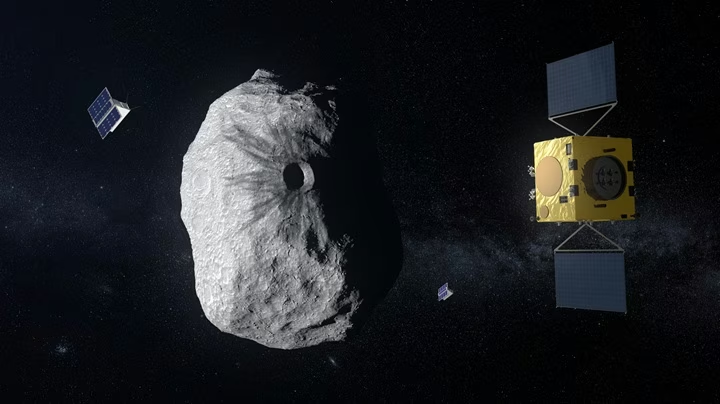
This is where the story gets tense. Space agencies are currently looking at “deflection missions.” Essentially, we could send a kinetic impactor (like NASA’s DART mission) to nudge the asteroid just enough to make it miss the Moon.
But we can’t decide yet. In 2028, the asteroid will make a close pass by Earth. During this flyby, astronomers will take precise measurements to finalize the trajectory. That is the deadline. That is when humanity has to decide: Do we play goalie for the Moon, or do we let nature take its course?
My Perspective: The Ultimate Trade-Off
I find myself torn. On one hand, the geek in me wants to see that flash on the Moon. I want to see the data. I want to know what’s inside our celestial neighbor.
On the other hand, the idea of risking our orbital infrastructure—the very backbone of modern civilization—for a science experiment feels incredibly reckless. There is a silver lining, though: if the debris hits Earth’s atmosphere, it would burn up, creating a spectacular, once-in-a-lifetime meteor shower. But is a pretty light show worth risking the internet? Probably not.
This situation reminds me that we aren’t just observers of the universe anymore; we are active participants. We have the power to change the path of celestial bodies. The question is no longer can we, but should we?
I’d love to hear your take on this cosmic gamble. If you were in charge of the space agency, would you deflect the rock to protect our satellites, or let it hit for the sake of scientific discovery?
You Might Also Like;
- Is Our Reality Just High-End Software? Exploring the Simulation Hypothesis
- The Sky Is Getting Crowded: February 2026 Space Launch Schedule
- The Cosmic Dilemma: Should We Let an Asteroid Hit the Moon?
-
-
-
-
-
-

-

-
-
-
-
-

