
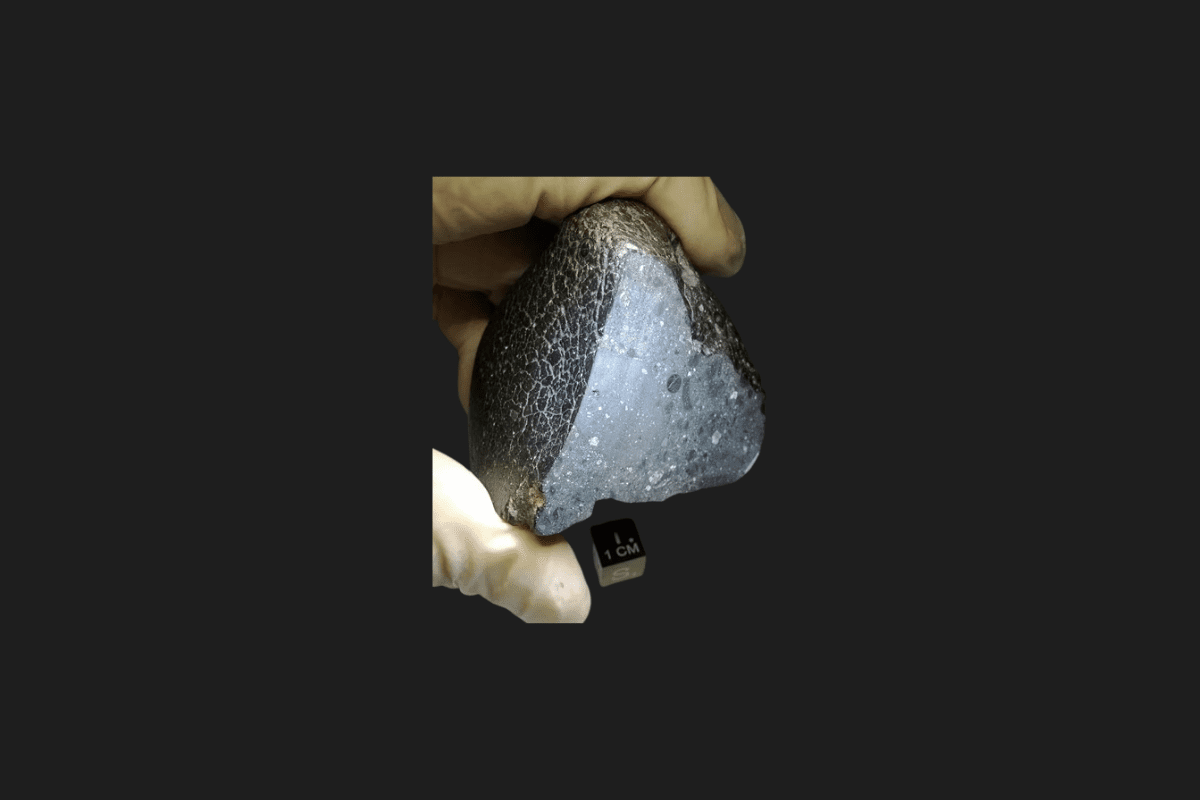
I’ve always looked at Mars and wondered how such a frozen, desolate world could have once been a blue oasis. We’ve seen the dried-up riverbeds from satellite photos, and we’ve watched the rovers trek through dusty craters, but there is nothing quite like holding a piece of the planet in your hands to tell the real story.
Recently, I was diving into some fascinating research out of the Technical University of Denmark, and it honestly changed how I view the Martian past. It centers around a legendary rock found in the Sahara Desert back in 2011: NWA 7034, or as it’s more affectionately known, “Black Beauty.”
This isn’t just any space rock. It’s a 4.48-billion-year-old messenger that contains secrets about Martian water that we are only just beginning to decode.
More Than Just a Dry Rock


For a long time, the consensus was that Mars had water, but perhaps it was fleeting or trapped only on the very surface. However, when the team in Denmark used neutron and X-ray tomography to peer inside Black Beauty—without breaking it, mind you—they found something startling.
Embedded within this ancient breccia (a rock made of various fragments fused together) are clusters of iron oxyhydroxide (H-Fe-ox). These minerals are rich in hydrogen. To put it simply: they are evidence of water.
Here’s why I find this incredible:
- High Water Content: These clusters make up about 0.4% of the rock’s volume but hold roughly 11% of its total water content.
- Deep Chemistry: These minerals don’t just “happen.” They form when liquid water interacts chemically with rocks.
- The “PPM” Factor: Black Beauty has a water content of about 6,000 ppm (parts per million). That makes it one of the “wettest” Martian meteorites we’ve ever analyzed.
A Global Phenomenon, Not a Local Accident


What really got me thinking was the connection to NASA’s Perseverance rover. Right now, Percy is chilling in the Jezero Crater, thousands of miles away from where Black Beauty likely originated. Yet, both sites show evidence of these same hydrated iron minerals.
To me, this suggests that water wasn’t just a “lucky break” in one valley. It suggests that the early Martian crust was soaked. We aren’t just talking about a few puddles; we are talking about a planet where water was an active, deep-seated part of the geology.
Why This Matters for Us


When I see data like this, I realize that our future missions—the ones being planned by NASA and various international agencies to bring Martian soil back to Earth—aren’t just “science experiments.” They are archaeological digs into the history of a sibling planet.
If Mars was this wet 4.4 billion years ago, it means the window for life to start was much wider than we previously thought. It makes me wonder: if the water was that deep in the crust, could life have retreated even deeper as the surface dried out?
I’m personally keeping a close eye on the upcoming Mars Sample Return missions. If a random rock found in the Sahara can tell us this much, imagine what a pristine, carefully selected core sample from the Martian highlands will reveal.
I’ve always felt that Mars is a mirror of Earth’s potential future—or perhaps its past. Do you think we’ll find that life on Mars was just as common as water seems to have been, or was the “Blue Mars” era too short for anything to actually crawl out of the mud?
I’d love to hear your theories on this.
You Might Also Like;
- The $40 Billion Typo: How One Click Turned 700 People into Instant Billionaires
- 3D Printing Just Got a ‘Muscle’ Upgrade: The End of Rigid Robots?
- MachineGames Confirms Wolfenstein 3 Is Inevitable
-

-

-

-

-

-
-

-

-
-

-

-

