I was going through my morning reading today, catching up on the latest Web3 developments, when a piece of news from France completely stopped me in my tracks. We usually talk about the stress of holding Bitcoin during a market crash, the anxiety of staring at red charts, or the fear of a complex smart contract hack. But honestly, this latest report made my blood run cold. It turns out, protecting your digital assets is no longer just about firewalls and complex passwords; it’s about sheer physical survival.
A recent investigation out of France has revealed a terrifying trend: organized gangs are now hunting down crypto investors in real life. They aren’t trying to phish your email; they are literally kidnapping people and using torture to extract seed phrases. I had to read the numbers twice to make sure I wasn’t reading a script for a dystopian cyberpunk movie.
The Chilling Statistics

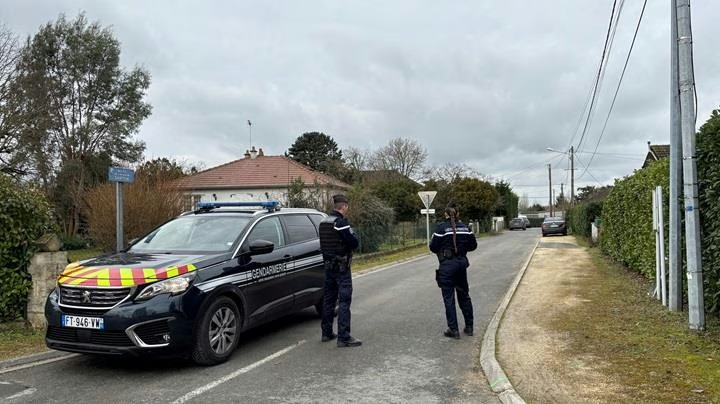
When I looked at the data, the sheer scale of the operation blew my mind. Over the last three years, 132 Bitcoin investors have been kidnapped and subjected to torture in France alone. Here is how those terrifying numbers break down:
- 18 victims were targeted early on.
- The following year saw a massive spike with 67 victims.
- This past year, another 47 victims fell prey to these gangs.
These aren’t just petty thefts. In one single incident, attackers managed to walk away with a staggering 8 million Euros.
But what really caught my attention—and honestly, what adds a layer of dark irony to this whole situation—is that one of the victims was David Balland, the co-founder of the hardware wallet giant, Ledger. Think about that for a second. Ledger is the absolute gold standard for keeping crypto safe from hackers. Yet, all the military-grade encryption in the world means absolutely nothing when a wrench is involved. It proves a point I’ve been thinking about a lot lately: we spend so much time securing our digital perimeter that we completely forget our physical one.
The Dark Side of Decentralization


I have always praised the decentralized nature of crypto. I love that no central authority can freeze my assets or tell me what I can and cannot do with my money. But as I researched this story, the dark side of that freedom became blindingly obvious.
These gangs are specifically targeting crypto wealthy individuals precisely because of decentralization. Once they force you to hand over your assets, the transaction is irreversible. There is no customer service hotline to call, no bank manager to freeze the transfer, and thanks to privacy coins and mixers, tracing the stolen funds often leads to a dead end. The ecosystem has created a new generation of wealth, but it has also created the perfect, untraceable loot for organized crime.
A Dystopian Reality: How Are They Finding Us?


French security forces are currently running 12 separate investigations into these kidnappings, and they have already arrested 88 people. What shocked me to my core was discovering that among those arrested are 10 children. The fact that minors are being recruited into rings that kidnap and torture people for Bitcoin shows just how deeply this rot has set in.
But the most terrifying question I kept asking myself while reading the reports was: How on earth do these gangs know exactly who to target? Crypto is supposed to be pseudonymous. Unless you are running around screaming about your portfolio on Twitter, nobody should know how much you hold. Yet, some sources are pointing to a horrifying possibility: tax office breaches.
There are strong allegations that these gangs managed to infiltrate government tax databases to identify individuals paying taxes on massive crypto gains. I find this absolutely infuriating. We do the right thing by declaring our assets and paying our taxes to the state, expecting the state to protect our data in return. Instead, that very compliance is turning investors into literal targets. If our government databases become hit-lists for criminal syndicates, the entire social contract is broken.
My Personal Take on Crypto OpSec (Operational Security)
I can’t just drop this heavy news on you without talking about what we can do about it. As someone who lives and breathes this space, this news has been a massive wake-up call for me. We need to upgrade our physical OpSec immediately. If I were building a security plan today, here is exactly how I would approach it:
- Embrace Stealth Wealth: I know it’s tempting to flex your gains, buy the flashy car, or post your NFT wins on social media. My advice? Don’t. The loudest guy in the room is the easiest target. Keep your crypto life and your public life as separate as possible.
- Use Duress PINs: If you are using a hardware wallet, make sure it has a duress PIN feature. This allows you to type in an alternative PIN that opens a “fake” wallet with a small amount of funds, satisfying an attacker while keeping your main stash hidden.
- Multi-Signature (Multi-Sig) Wallets: This is something I’m looking into heavily right now. A multi-sig setup requires multiple devices (sometimes kept in completely different physical locations) to approve a transaction. If someone breaks into your house, they physically cannot steal your entire net worth because the other “keys” are locked away somewhere else.
- Geographic Diversification of Assets: Never keep all your recovery seeds in your house. Use secure bank vaults or trusted legal custodians for your backups.
The reality is, the rules of the game have changed. As mass adoption continues, the predators aren’t just hiding behind keyboards anymore—they are waiting outside our doors. It makes me wonder: as we build the future of decentralized finance, are we entirely prepared for the physical risks that come with holding our own keys?
You Might Also Like;
- The Scientific Reality Behind the “Little Green Men”
- The Mind-Bending Weight of a Dead Star
- Tactical Force: The Leaked Cost and Release Date of Star Wars Zero Company
-

-
-

-

-

-
-
-

-

-

-

-