Paralyzed Patients Now Steer Wheelchairs With Their Minds


I just finished watching the latest video released by Elon Musk’s Neuralink, and honestly, I am still trying to wrap my head around what I saw. We talk a lot about artificial intelligence and emerging tech on this platform, but witnessing a paralyzed individual confidently navigate a wheelchair through complex environments—using absolutely nothing but their thoughts—hits differently.
It feels like we just crossed a massive threshold in human history.
This isn’t just another cool gadget or a minor software update. We are looking at a fundamental shift in how we approach severe physical disabilities. Let’s break down exactly what happened in the latest PRIME clinical trial and why I believe this is the most important tech story of the decade.
Stepping Inside the PRIME Study

For those who might be out of the loop, Neuralink has been running its PRIME (Precise Robotically Implanted Brain-Computer Interface) study, aiming to give individuals with severe paralysis the ability to control external devices.
In their latest update, they showed participants doing something incredible: they were completely bypassing physical joysticks. By utilizing the N1 brain implant, users could drive their wheelchairs forward, backward, and even adjust their seat settings entirely through mental commands. Watching the live feed from the wheelchair-mounted cameras as they navigated indoor hallways and outdoor spaces safely was genuinely mind-blowing.
How Do You “Think” a Wheelchair Forward?
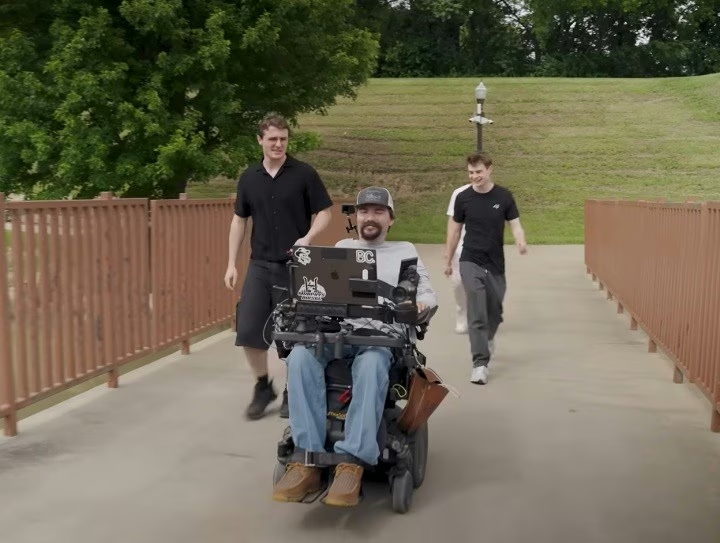
When I was researching how this actually works, the underlying mechanics fascinated me. It’s a masterclass in combining neuroscience with advanced machine learning.


Even if a person is physically paralyzed, the neurons in their brain’s motor cortex are still firing, trying to send movement signals. The Neuralink system acts as a high-tech translator. Here is how the magic happens:
- Real-Time Interception: The implant continuously records the electrical signals produced by the brain’s intention to move.
- AI Translation: A sophisticated machine learning model decodes these raw neural spikes into digital commands in real-time.
- The Virtual Joystick: The user controls a virtual cursor on a screen. Pushing this mental cursor up moves the chair forward, and pulling it down reverses it.
- Variable Speed: The further the user pushes that mental cursor from the center, the faster the wheelchair moves. It’s incredibly intuitive.
The Hardware Behind the Miracle
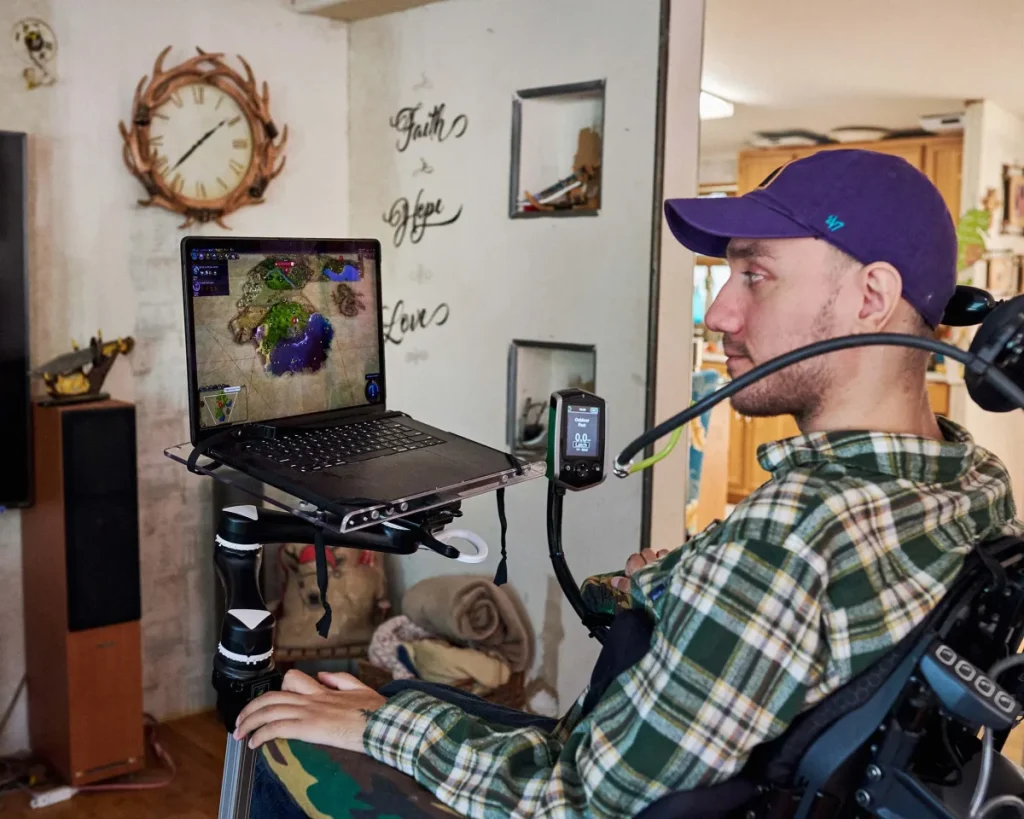
As a tech guy, I always want to know what’s under the hood. The sheer miniaturization of the N1 implant is a marvel of modern engineering. We aren’t talking about clunky headsets; this is virtually invisible once installed.
Here is what makes the N1 chip so groundbreaking:
- Tiny Footprint: The implant itself is only about 23 millimeters in diameter.
- Massive Data Collection: It utilizes a staggering 1,024 electrodes to read brain activity.
- Microscopic Threads: These electrodes are distributed across more than 100 flexible threads, each one significantly thinner than a single human hair.
- Robotic Precision: Because human hands aren’t steady enough to work at this microscopic level, Neuralink built a custom surgical robot to precisely weave these threads into the brain without damaging surrounding blood vessels.
The Ultimate Safety Net
One of the first questions that popped into my head was, “What happens if the user gets distracted or sneezes? Does the chair just speed off?”
Neuralink clearly thought of this. They engineered a brilliant, fail-safe mechanism into the core software. If the user loses focus or stops actively intending to move, the virtual cursor automatically snaps back to the center position. The wheelchair immediately decelerates and comes to a complete, safe stop. It’s a crucial feature that ensures involuntary thoughts or sudden distractions don’t translate into dangerous physical movements.
The Road Ahead
Now, we have to stay grounded. Neuralink was very clear in stating that this was a demonstration of a technology still deep in its research phase, not a commercial product launch. They need a lot more clinical data before this becomes widely available.
Since Noland Arbaugh became the first human recipient in January 2024, the program has expanded. As of late June, 26 people worldwide have received the N1 implant, and the parallel GB PRIME study in the UK has recently brought on seven new patients.
I’ve covered tech for a long time, but seeing a technology actively restore independence to those who thought they had lost it forever is profoundly moving. We are watching the birth of an entirely new era in human-computer interaction.
I’m incredibly curious to hear your take on this. If brain-computer interfaces like this become entirely safe and mainstream in the next decade, what other physical, daily tasks would you want to control purely with your mind? Let’s talk about it in the comments below!
You Might Also Like;