
Hey everyone, Ugu here. If you’ve been watching the rapid explosion of artificial intelligence as closely as I have, you probably know there’s a massive, silent challenge brewing behind the scenes. It’s not about coding or algorithms—it’s about raw electricity.
Running massive language models takes an unbelievable amount of power, and the tech giants are desperately searching for clean, infinite energy sources. Now, it looks like OpenAI is ready to make a massive leap straight into the realm of sci-fi.
I just read the latest reports from Axios, and I have to tell you, this blew my mind: OpenAI is currently in talks to purchase massive amounts of fusion energy from Helion Energy. Let’s break down exactly what this means, why it’s a game-changer, and how it actually works.
The Ultimate Power Play: OpenAI and Helion

We aren’t talking about throwing a few solar panels on the roof of a data center here. If this early-stage agreement goes through, OpenAI is securing a massive slice of the future energy grid.
Here is what the numbers look like:
- The Deal: OpenAI would purchase 12.5% of Helion’s total energy output.
- The 2030 Goal: This translates to a staggering 5 gigawatts of electricity annually.
- The 2035 Goal: By the next decade, that number scales up to an eye-watering 50 gigawatts.
To put that into perspective, 1 gigawatt is roughly enough to power a mid-sized city. OpenAI is preparing for an era where AI doesn’t just need a plug; it needs its own dedicated power grid. Interestingly, OpenAI isn’t alone in this bet. Microsoft (OpenAI’s biggest partner) has already committed to buying energy from Helion starting in 2028.
The Sam Altman Connection

There is a fascinating layer of corporate drama here, too. If the name Helion sounds familiar, it’s because Sam Altman, the CEO of OpenAI, has been a major financial backer of the fusion startup.
However, to keep things clean and avoid conflicts of interest during these massive energy negotiations, Altman recently announced that he has stepped down from his position as chairman of Helion’s board. It’s a smart move that shows just how seriously both companies are taking this potential partnership.
Why Helion is Different: Ditching the Steam Turbine
When I usually think of nuclear energy—even experimental fusion—I picture a massive, incredibly complex facility that basically just boils water. Most traditional fusion concepts use magnetic confinement to create intense heat, which then turns water into steam to spin a giant turbine. Honestly? That always felt a bit archaic to me. We’re building miniature suns just to run a fancy steam engine?
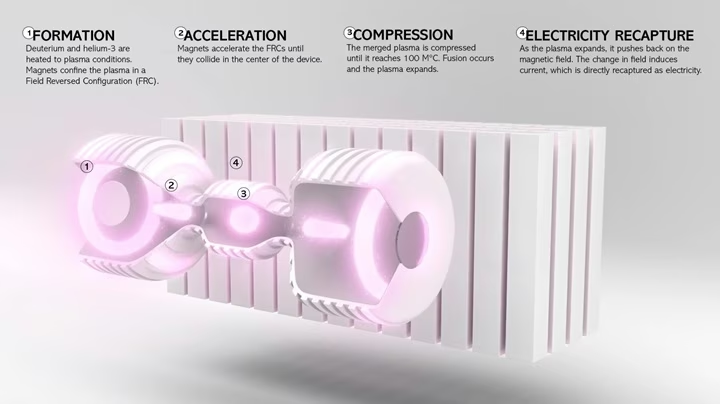
Helion is taking a completely different, revolutionary approach. They are skipping the steam turbine entirely. Here is how their futuristic tech actually works:
- The Hourglass Reactor: Helion uses a unique, hourglass-shaped reactor.
- The Fuel: They inject a mix of deuterium and helium-3 into both ends of the reactor, turning it into plasma.
- The Collision: These plasmas are accelerated to 1 million miles per hour and smashed together in the center.
- Direct Conversion: The resulting collision reaches unimaginable temperatures, triggering a fusion reaction. But instead of boiling water, the energy released interacts directly with the reactor’s magnetic fields to generate electricity instantly.
It is elegant, incredibly high-tech, and if they can scale it, it will change the world.
The Race Against Time (and Temperature)
Scaling this technology is where the real challenge lies. Helion isn’t just trying to build one working machine; they are trying to build an entire infrastructure from scratch.
Every single Helion reactor is designed to produce 50 megawatts of electricity. If you do the math on OpenAI’s energy demands, Helion needs to build:
- 800 reactors by 2030.
- An additional 7,200 reactors by 2035.
That is a monumental manufacturing challenge. But Helion is making serious progress with their Polaris prototype. In February, they announced that their plasma reached 150 million degrees Celsius.
For context, the core of our Sun is about 15 million degrees. Helion is already running ten times hotter than the Sun! However, to achieve full commercial operation, they need to hit the magic number of 200 million degrees. If they manage to pull this off and get commercial fusion reactors online before 2030, they will completely eclipse their rivals in the energy sector.
My Final Thoughts
I’ve been writing about tech for a long time, and a lot of “breakthroughs” end up being just hype. But watching AI companies realize they need to literally invest in creating artificial stars just to power their servers is a humbling reminder of how fast our world is changing. The synergy between advanced AI and infinite clean energy feels like the true beginning of the future.
What do you guys think? Do you believe Helion can actually build thousands of commercial fusion reactors in just a few years, or is this timeline a bit too optimistic? Drop your thoughts in the comments below, I’d love to hear your take!
You Might Also Like;
- A Century-Old Aviation Dream Reborn: The Channel Wing VTOL Takes Flight
- The Dawn of the Automated Battlefield: How Ground Robots Are Redefining Warfare
- The Insatiable Hunger of AI: Why Tech Giants Are Chasing Natural Gas
-

-

-

-

-

-

-

-
-

-

-

-