Whenever I watch a humanoid robot stumble over a slightly uneven rug or see an autonomous vehicle get confused by a poorly painted stop sign, I realize something crucial: the hardware isn’t our biggest bottleneck anymore. It’s the data. Teaching a machine to understand the messy, unpredictable physical world is infinitely harder than teaching a chatbot to write a poem.
I’ve been tracking the evolution of machine learning for years, and I’ve always found that the hardest part of building physical AI isn’t writing the code—it’s finding enough high-quality, edge-case data. That’s why I was genuinely thrilled when I saw Nvidia’s latest announcement at GTC. They aren’t just releasing another chip; they are open-sourcing the recipe for creating the data itself.
Let’s dive into what Nvidia’s Physical AI Data Factory Blueprint actually is, and why I believe it’s going to fundamentally change how we build robots and autonomous systems.
Solving the “Long-Tail” Problem in Physical AI


If you are training an autonomous car, capturing footage of normal highway driving is easy. But what about a scenario where a truck drops a couch on a snowy road during a solar eclipse? We call these “long-tail scenarios”—rare but critical events that an AI must know how to handle. You can’t exactly crash a thousand cars in real life just to collect data on what a crash looks like.
Nvidia’s new blueprint is essentially a digital assembly line that solves this exact problem. It automates the generation, augmentation, and validation of data for physical AI models. Instead of sending fleets of cars or robots out into the world for millions of hours to hopefully encounter a rare event, developers can now synthesize this data artificially but with physical accuracy.
By using the Nvidia Cosmos foundation models and coding agents, a small, limited dataset can be transformed into a massive, highly diverse training library.
The Three-Step Magic: Inside the Data Factory

When I dug into the technical architecture of this blueprint, I loved how systematically Nvidia broke down the data pipeline. It operates in three distinct, automated stages:
- 1. Curation (Cosmos Curator): You can’t just feed raw, noisy data into an AI and expect magic. The Curator acts as the meticulous editor. It sifts through massive amounts of raw input, selecting and organizing only the most relevant, high-quality data points needed for the specific task at hand.
- 2. Amplification (Cosmos Transfer): This is where the real heavy lifting happens. The Transfer system takes that curated data and multiplies it. It diversifies the scenarios, adding varying lighting conditions, different physics constraints, and new obstacles, effectively creating those hard-to-find long-tail scenarios out of thin air.
- 3. Validation (Cosmos Evaluator): Before this synthetic data is fed into a multi-million-dollar training run, it has to be verified. The Evaluator checks the generated data for physical accuracy and ensures it is actually suitable for training, preventing the AI from learning “hallucinated” physics.
Cloud Partnerships: Democratizing the Compute Power

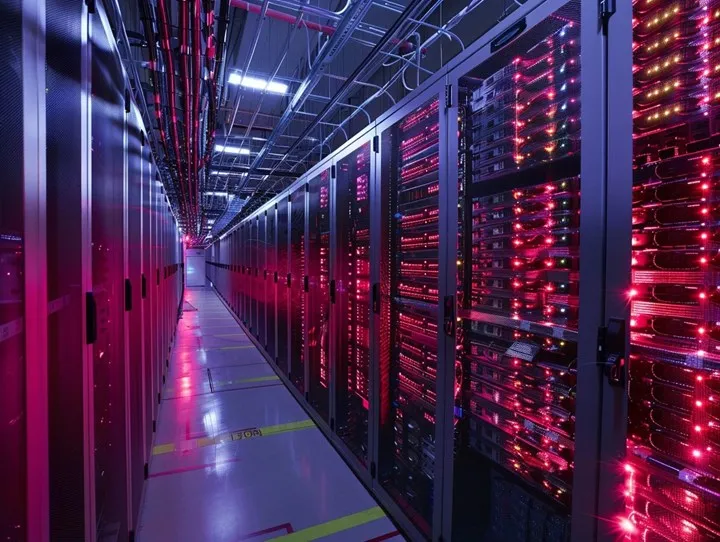
What stands out to me is that Nvidia isn’t keeping this locked in a proprietary silo. They are actively integrating this initiative with major cloud providers like Microsoft Azure and Nebius.
Why does this matter? Because running a data factory requires an astronomical amount of accelerated computing power. By baking this blueprint directly into cloud services, developers don’t need to build their own supercomputers. They can spin up the compute power they need, generate their high-volume training data, and spin it back down.
Industry heavyweights are already all in. Companies like Uber are using it to refine their autonomous vehicle tech (which makes total sense, given the complex urban environments they operate in). Meanwhile, pioneers like Skild AI, FieldAI, and Hexagon Robotics are leveraging the architecture to train general-purpose robots that can adapt to environments they’ve never seen before.
Orchestration: Letting AI Build AI


As a developer, I know that managing workflows across different computing environments can be an absolute nightmare. Nvidia addresses this with OSMO, an open-source orchestration framework designed to manage these massive workflows seamlessly across different clusters, drastically reducing the manual setup time.
But here is the detail that actually made me smile: the integration with coding agents. Nvidia has built this blueprint to play nicely with Claude Code, OpenAI Codex, and Cursor. We are literally entering an era where AI coding assistants are helping developers build data factories to train even more advanced physical AIs. The feedback loop is tightening, and the development speed is about to go exponential.
The Road Ahead
Nvidia plans to release the Physical AI Data Factory on GitHub this coming April. By making this reference architecture open and accessible, they are essentially giving the entire robotics industry a standardized playbook.
I honestly think we will look back at this release as the moment the training wheels came off for humanoid robots and autonomous systems. We are moving from a world where AI learns by passively observing our data, to a world where AI dynamically generates the exact universe of data it needs to master physical reality.
It makes me wonder about the timeline of actual integration into our daily lives. With data no longer being the bottleneck, how long do you think it will be before a universally capable, artificially trained robot becomes a standard appliance in our homes? Are we ready for a physical world that learns as fast as the digital one? Let me know what you think.
You Might Also Like;
- A Century-Old Aviation Dream Reborn: The Channel Wing VTOL Takes Flight
- The Dawn of the Automated Battlefield: How Ground Robots Are Redefining Warfare
- The Insatiable Hunger of AI: Why Tech Giants Are Chasing Natural Gas
-
-
-
-

-

-
-
-
-

-

-

-