I have a confession to make: I check my weather app at least five times a day. And yet, I still get caught in the rain without an umbrella more often than I’d like to admit. We’ve all been there, right? The app says “Sunny,” but the sky says “Apocalypse.”
For decades, predicting the weather has been one of the hardest computational problems in science. It requires massive supercomputers solving complex physics equations. But Nvidia, the company we usually associate with high-end gaming and the Metaverse, just dropped a bombshell that might fix our trust issues with weather forecasts.
They have announced three new open-source AI models that can predict weather up to 15 days in advance. And the kicker? They are doing it 1,000 times faster than traditional methods.
Let’s dive into what this means for us, for the planet, and for the concept of the “Digital Twin.”
Enter the “Earth-2” Era

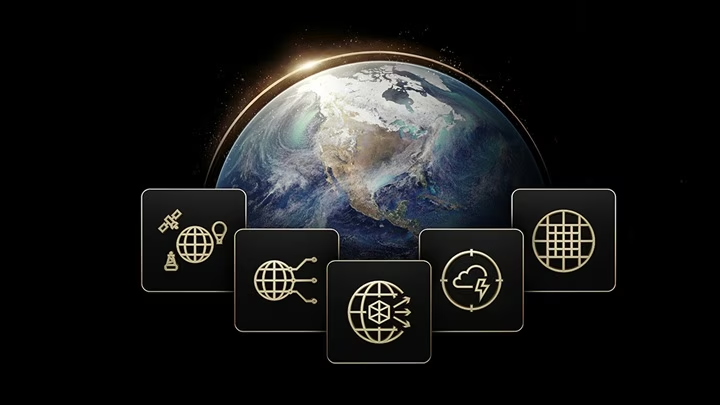
Nvidia has been working on a project called Earth-2 for a while now. The goal is audacious: to build a complete digital twin of our planet to simulate climate change and weather patterns.
This week, they took a massive leap forward by releasing three specific AI models under this umbrella. These aren’t just minor updates; they represent a fundamental shift in how we look at meteorology.
Why does this matter?
- Speed: Traditional simulations take hours on a supercomputer. Nvidia’s AI does it in seconds or minutes.
- Cost: Because it’s faster and runs on GPUs, the energy and financial cost of running a forecast drops dramatically.
- Accuracy: They aren’t just guessing; they are outperforming the current giants.
The Three New AI Models: Breaking It Down

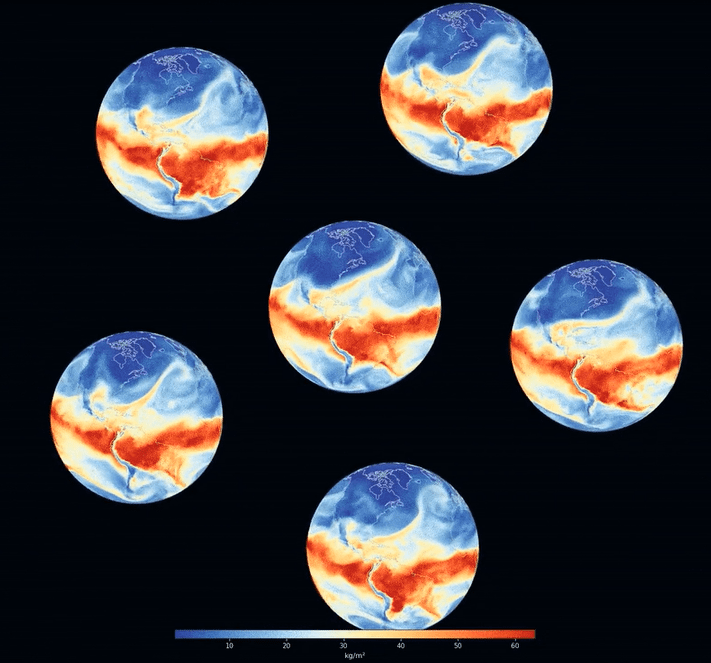
Nvidia didn’t just release one generic “Weather AI.” They released a toolkit for different needs. Here is what I found most interesting about each one:
1. The Long-Range Prophet (Earth-2 Medium Range)
This is the heavyweight champion of the announcement. This model can predict weather patterns up to 15 days out.
I was reading the comparison data, and it’s impressive. Nvidia claims this model outperforms Google DeepMind’s GenCast (which was the previous gold standard launched in December 2024) in over 70 different weather variables.
The Secret Sauce: “Atlas” There is a bit of mystery here. Nvidia mentioned that this model is built on a new architecture called Atlas. They haven’t released all the technical details on Atlas yet, but it signals a move away from specialized, niche AI structures toward more scalable, transformer-based designs (similar to what makes ChatGPT work, but for weather).
2. The Storm Watcher (Nowcasting)
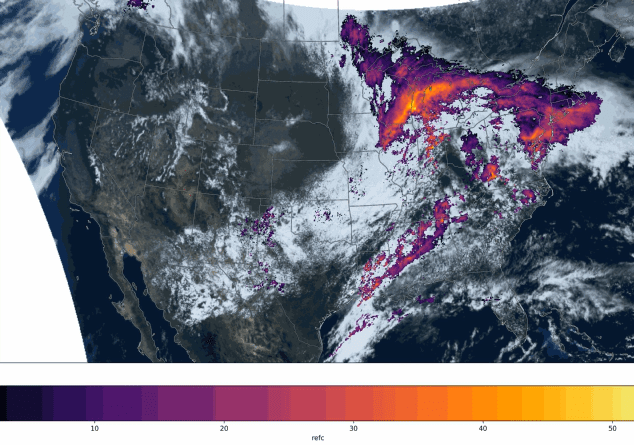
While knowing the weather two weeks from now is great for planning a vacation, knowing what happens in the next 6 hours is vital for survival.
The Nowcasting model focuses entirely on the immediate future.
- It analyzes storms, lightning, and flash floods.
- It uses global geostationary satellite data.
- My take: This is a game-changer for local decision-making. If a tornado is forming, you don’t have time to wait for a physics simulation to finish. You need an answer now. This model provides that speed.
3. The Global Pulse (Data Assimilation)
This is the geeky part, but stick with me because it’s crucial. Before you can predict the weather, you need to know exactly what the weather is right now all over the world.
This involves taking data from thousands of sources—weather balloons, ships, satellites, ground stations—and stitching them together.
- The Old Way: This process used to eat up 50% of a supercomputer’s processing power.
- The Nvidia Way: Their AI does this on GPUs in minutes.
A Philosophical Shift: Physics vs. AI

This announcement highlights a massive philosophical change in science that I find fascinating.
Mike Pritchard, Nvidia’s Director of Climate Simulation, put it perfectly. We are moving away from purely “physics-based” simulations (where the computer calculates the math of every fluid dynamic) to “AI-based” inference.
AI looks at historical patterns. It learns how the atmosphere behaves. It doesn’t need to solve the equation from scratch every single time; it recognizes the pattern and predicts the outcome. This is why it’s 1,000x faster.
Why Insurance Companies Are Cheering

You might wonder, “Who buys this tech besides weather channels?” The answer is Insurance Companies.
I know, insurance isn’t the sexiest topic, but climate change is costing them billions. Floods, hurricanes, and “once-in-a-century” storms are happening every year now.
- Legacy models are too slow to run thousands of “what-if” scenarios.
- With Nvidia’s AI, an insurance company can simulate a hurricane 10,000 times in different variations to understand the risk.
This helps them price policies better and, hopefully, helps cities plan better infrastructure to avoid disasters.
Ugu’s Perspective: The Digital Twin is Here
As someone who writes about the Metaverse, I view this through a specific lens. When we talk about the Metaverse, people usually think of cartoon avatars and virtual meetings.
But this—Earth-2—is the real industrial Metaverse.
Nvidia is building a functional, living, breathing digital copy of our planet. By making these models open source, they are democratizing access to this technology. It means a researcher in a developing country with a decent GPU rig can now run weather models that previously required a multimillion-dollar supercomputer.
The “Black Box” Problem However, I do have one reservation. As we move from physics (which we can explain) to AI (which is often a “black box”), we need to be careful. If the AI gets it wrong, can we explain why? Trusting a machine to predict a hurricane requires a leap of faith.
But considering how often my current weather app gets it wrong, I’m ready to give the AI a shot.
Final Thoughts
Nvidia is proving once again that they are the backbone of the AI revolution. They aren’t just selling chips; they are building the software infrastructure that runs the world.
The ability to predict the future—even just the weather—is a superpower. And now, that superpower is open source.
I’d love to know your thoughts: Do you trust AI to tell you when to evacuate before a storm, or would you still rely on the old-school meteorologist on TV? Let’s discuss in the comments below!
You Might Also Like;
- Unitree PUMP MAX Review: The Ultimate Portable Smart Gym
- The End of an Era: Breaking Down the Epic Dune: Part Three Trailer
- How Apple’s LiTo is Turning a Single Photo into Photorealistic 3D Magic
-
-
-
-
-
-

-
-

-
-

-

-