I have been covering Elon Musk’s moves for years, and just when I think I have his strategy figured out, he completely flips the table.
We used to talk about Starlink as a way to get internet to rural farmhouses or planes over the Atlantic. That was the “Phase 1” thinking. But the news breaking today regarding SpaceX’s filing with the FCC changes everything. Musk isn’t just trying to connect the internet anymore; he wants to move the internet’s brain off the planet entirely.
SpaceX has officially applied to launch one million satellites. Yes, you read that right. One. Million. To put that in perspective, before Starlink, there were only a few thousand active satellites in history.
The goal? To turn Earth’s orbit into a massive, solar-powered Orbital Data Center to feed the insatiable hunger of Artificial Intelligence.
The “Compute Crunch” on Earth


Let’s be honest about the situation down here on terra firma. We are hitting a wall. I’ve written before about how AI models like Grok 3 and GPT-5 are power vampires. They consume gigawatts of electricity and require millions of gallons of water just to keep their servers from melting.
We are running out of:
- Clean Energy: Grids are overloaded.
- Land: You can’t just build a gigafactory anywhere.
- Cooling: Keeping GPUs cold is expensive and environmentally taxing.
I realized looking at this filing that Musk sees Earth as a bottleneck. If the laws of physics and local zoning boards prevent you from building more data centers on the ground, the only place left to go is up.
Why Move the “Brain” to Space?

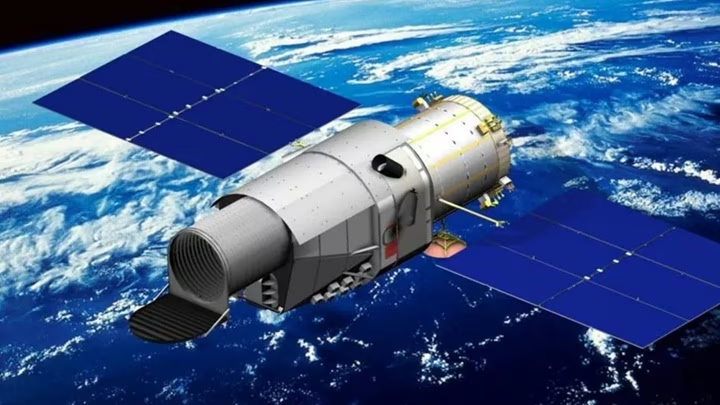
At first glance, shooting servers into space seems like the most expensive way to solve a problem. But when I dug into the engineering logic behind the SpaceX proposal, it actually makes terrifyingly brilliant sense.
1. Infinite, Free Cooling
On Earth, nearly 40% of a data center’s energy bill goes to air conditioning. In space? It is naturally freezing. By venting heat directly into the vacuum, Musk eliminates one of the biggest costs in the AI industry instantly.
2. Unfiltered Solar Power
Here on Earth, solar panels have to deal with clouds, night cycles, and atmospheric filtering. In orbit, the sun never really sets if you position the satellites correctly. It is 24/7, high-intensity, free energy. These “flying data centers” will be entirely self-sufficient.
3. Low Maintenance (Eventually)
The filing claims that once these units are up, the operational costs drop to near zero compared to terrestrial centers. There are no security guards to pay, no property taxes, and no electricity bills.
The Scale: One Million Satellites


This is the part that makes my head spin. Currently, the plan was for Starlink to hit around 15,000 satellites. That already had astronomers and safety experts worried.
A jump to one million isn’t an upgrade; it’s a planetary shell.
Musk is effectively proposing a “Dyson Sphere Lite” around Earth. A mesh network of computing nodes that process AI tasks in the vacuum of space and beam the answers down to us. This aligns perfectly with his other venture, xAI.
While Amazon and Google have played with the idea of space-based cloud computing before, nobody has ever had the launch capacity to make it real. Musk owns the rockets (Starship) and the AI (xAI). He is vertically integrating the future of computing.
The Elephant in the Orbit: Space Junk


I have to play devil’s advocate here because this scares me a little.
The Low Earth Orbit (LEO) is already crowded. Adding a million new objects raises the risk of Kessler Syndrome—a theoretical scenario where one collision creates debris that causes a chain reaction, eventually trapping us on Earth behind a wall of shrapnel.
The FCC filing emphasizes that these satellites are designed to de-orbit safely and burn up if they fail, but with a million units, even a 0.1% failure rate leaves thousands of uncontrollable bullets flying around the planet.
As a tech enthusiast, I love the ambition. As someone who wants humanity to eventually travel to Mars, I worry we might be building a cage around our own planet.
Is This the Future of AI?

The “AI Arms Race” has shifted. It is no longer just about who has the smartest code; it is about who has the infrastructure to run it.
If SpaceX gets approval for this (and that’s a big “if” given the regulatory hurdles), the internet’s physical infrastructure will fundamentally change. The “Cloud” will no longer be a metaphor for a server farm in Virginia; it will literally be in the clouds.
Google and Amazon are watching this closely. If Musk pulls this off, he cuts his operational costs by a magnitude that competitors stuck on Earth simply cannot match.
My Verdict
This is the most “Elon” move I’ve seen in years. It’s high risk, scientifically sound on paper, but logistically a nightmare. But if there is one thing I’ve learned covering this industry: never bet against the guy who lands rockets backwards.
I’ll be watching the FCC hearings closely. This isn’t just about faster internet or smarter chatbots; it’s about who owns the sky.
What do you think? Is an orbital data center the genius solution to our energy crisis, or are you worried about turning our sky into a parking lot for servers?
Let me know in the comments below!
You Might Also Like;
- A Quantum Paradox: Using “Noise” to Cool the Ultimate Computer
- Star Wars: Galactic Racer Finally Brings Back the Speed We’ve Been Waiting For
- Musk’s Orbital Brain: One Million Satellites to Power AI
-

-

-
-

-

-

-

-

-

-
-
-