By the year 2100, humanity may have established its first permanent settlement on Mars. While today the idea remains aspirational, rapid advances in spaceflight, robotics, biotechnology, and in-situ resource utilization (ISRU) are laying the foundation for large-scale colonization.
This article explores how a Martian colony could scientifically function—its infrastructure, energy systems, agriculture, social dynamics, and long-term prospects.
1. Transportation to Mars


Human travel to Mars will likely rely on reusable heavy-lift spacecraft, similar to SpaceX’s Starship concept.
By 2100, propulsion may include:
- Methane/oxygen chemical engines produced locally on Mars
- Nuclear thermal propulsion to reduce travel time
- Possible ion or plasma engines for cargo transport
Typical travel duration may be 3–6 months, depending on orbital alignment.
2. Colony Location


Likely candidate regions include:
- Mid-latitude zones with subsurface ice
- Valles Marineris surroundings
- Gale Crater & Elysium Planitia
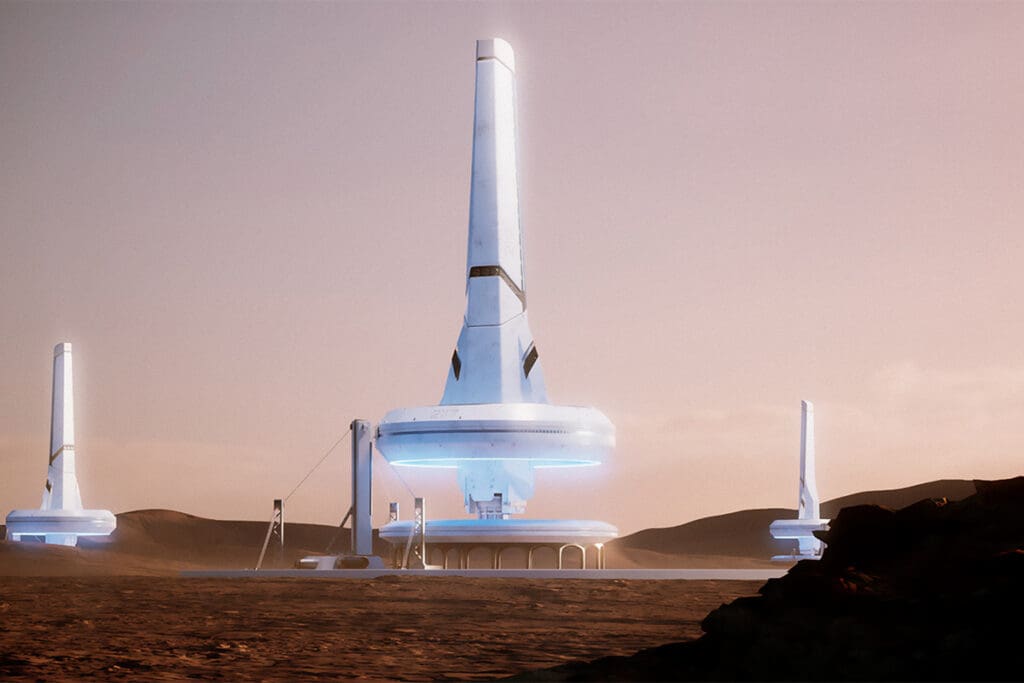
These regions provide access to water ice, favorable solar illumination, and geological stability.
3. Habitat Design


Due to thin atmosphere and extreme radiation, surface structures must be heavily shielded.
Possible Habitat Types
✅ Subsurface habitats (lava tubes or excavated caves)
Offer natural radiation protection.
✅ Inflatable pressurized domes
Covered with Martian soil (regolith) for shielding.
✅ 3D-printed structures
Built using regolith-based concrete.
Internal environments would maintain:
- Earth-like air pressure
- ~21% oxygen
- Controlled humidity & CO₂ filtering
Artificial gravity is still difficult; rotating centrifuge-like sections may be used for health purposes.
4. Life-Support Systems


Atmosphere
Closed ecological systems will regulate gases:
- CO₂ produced by humans & industry
- Converted back to O₂ by plants and algae
Water
Water obtained via:
- Melting subsurface ice
- Recycling >95% of used water
Food
Food likely produced locally via:
- Hydroponics
- Aeroponics
- Genetically engineered plants adapted to low pressure & high CO₂
Martian soil is toxic (perchlorates), requiring chemical treatment before use.
5. Energy Infrastructure

Primary power sources:
1. Solar Farms
- Effective but limited by dust storms
2. Nuclear Reactors
- Reliable base-load source
- Essential for winter and dust storms
3. Methane Fuel
- Manufactured via Sabatier reaction
- Used for rockets, machinery & heating
Energy storage via:
- Batteries
- Hydrogen production
6. Robotics & Automation

Robots handle:
- Construction
- Mining
- Transportation
- Medical assistance
- Maintenance
Autonomous mining equipment extracts:
- Ice
- Regolith
- Metals
AI systems manage life-support reliability and perform dangerous tasks outside shelters.
7. Medical & Health Challenges
Key biological issues:
- Radiation exposure
- Low gravity (0.38 g)
- Muscular & bone degeneration
- Psychological effects of isolation
Prevention & treatment strategies:
- Radiation-shielded living areas
- Regular strength training
- Pharmaceuticals to reduce bone loss
- Virtual social environments
Advanced telemedicine and robotic surgery will support healthcare.
8. Population Size
By 2100, a realistic population is:
➡️ 1,000–50,000 people
Early population is mostly scientists, engineers, and technicians.
Long-term settlements might include families and educators, but reproduction in Mars gravity remains medically uncertain.
9. Economy & Industry
Key industries:
- Mining & resource processing
- Fuel production (methane)
- Scientific research
- Manufacturing via 3D printing
- Exporting knowledge, patents, and data to Earth
A Martian economy will focus on self-sufficiency rather than export trade.
10. Terraforming Feasibility
Large-scale terraforming by 2100 is unlikely due to:
- Insufficient atmospheric CO₂
- Low gravity (atmosphere escapes into space)
- Scale requiring millennia
However, local micro-terraforming—pressurized domes with controlled ecology—will be widespread.
11. Social & Political Structure
Likely governance models:
- Charter-based system managed by Earth & local councils
- Corporate–government partnerships
- Strict environmental regulations
Digital communication will be delayed by 3–22 minutes, affecting real-time decision-making.
Martian culture may evolve independently, prioritizing cooperation, problem-solving, and shared survival.
12. Daily Life in 2100
Expected lifestyle features:
- Indoor work & habitation
- Virtual Earth experiences
- Limited EVA (spacewalk) outside habitats
- Education via remote systems
- Communal food production
- Shared laboratories, recreation zones, and green spaces
Transportation:
- Pressurized rovers
- Maglev tunnels between colonies
13. Long-Term Outlook
Mars colonies represent the first step toward becoming a multi-planetary species.
Lessons from Mars will help humans expand to:
- Jupiter’s icy moons (Europa, Ganymede)
- Titan
- Free-floating space habitats
Mars is the training ground of interplanetary civilization.
Conclusion
By 2100, Mars colonization will likely transition from isolated scientific outposts to semi-self-sufficient settlements supported by local manufacturing, advanced robotics, and sustainable farms. Although terraforming remains distant, humans may live safely underground or within shielded megastructures supported by renewable energy and nuclear reactors.
A Martian colony will be one of humanity’s most ambitious achievements—reshaping science, culture, and our understanding of life beyond Earth.
You Might Also Like;
- A Century-Old Aviation Dream Reborn: The Channel Wing VTOL Takes Flight
- The Dawn of the Automated Battlefield: How Ground Robots Are Redefining Warfare
- The Insatiable Hunger of AI: Why Tech Giants Are Chasing Natural Gas
-

-

-

-

-

-

-

-

-

-
-
-