

South Korean automotive giant Hyundai has officially unveiled its new Unmanned Firefighting Robot. Recently announced and donated to South Korea’s national fire agency, this highly advanced device is designed to tackle extreme emergencies without putting human lives at risk.
Developed in close collaboration with Kia, Hyundai Rotem, and Hyundai Mobis, the robot is engineered to enter highly hazardous environments characterized by extreme heat, explosion risks, toxic gases, and dense smoke. The remotely controlled system can independently detect the source of a fire, analyze the surrounding situation, and approach the flames to perform direct extinguishing operations.
Core Technology and Hardware


The Unmanned Firefighting Robot is built upon the HR-SHERPA, a multi-purpose unmanned vehicle platform originally developed for military operations. It has been heavily modified for disaster response, integrating:
- Unmanned electric driving technology
- Long-range remote control systems
- Advanced imaging sensors
- An extreme-condition thermal management system
To survive in the harshest conditions, the robot features a self-spraying water cooling system and specialized structural insulation. This robust design protects its internal battery and electronic systems, allowing the robot to safely operate in temperatures reaching up to 800°C.

Maneuvering through a burning building requires precision. The robot is equipped with a sophisticated driving assistance system that actively detects surrounding terrain and obstacles, significantly reducing the risk of collisions in narrow or complex environments.
- Speed and Agility: The system can reach speeds of up to 50 km/h and is capable of overcoming various physical obstacles.
- AI-Powered Vision: The integrated camera system utilizes both short-wave and long-wave infrared thermal imaging sensors. This provides human operators with a crystal-clear view of the environment, cutting right through thick smoke, dust, and high temperatures to safely analyze the fire zone.
- Independent Motor Drives: Each of the robot’s six wheels is powered by its own dedicated electric motor. This structural design enables 360-degree maneuverability and ultra-precise movements in tight spaces.
Innovative Extinguishing Tools
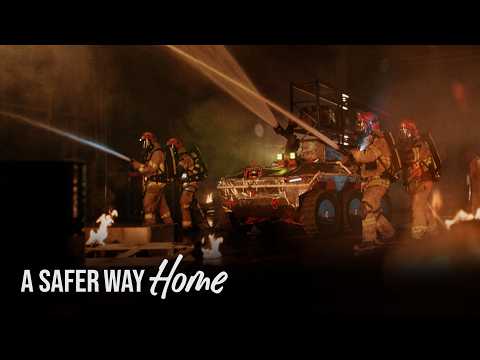
Beyond just spraying water, the robot’s high-pressure fire hose features a photoluminescent coating. This means the hose physically glows in dark or heavily smoke-filled environments, naturally illuminating safe entry paths and escape routes for human firefighters following behind.
The Future: Fully Autonomous Firefighting

Hyundai is not stopping at remote control. The company aims to collaborate further with the National Fire Agency and the National Fire Research Institute to develop a fully autonomous firefighting system in the future. The ultimate goal is an advanced disaster response platform capable of analyzing fire conditions, pinpointing the source, and calculating the most effective extinguishing method—all completely without human intervention.
You Might Also Like;
- The Dark Side of Nanotechnology: Could Microscopic Swarms Erase Billions?
- The Illusion of Digital Immortality: Are You Really Uploading Your Mind?
- The View That Changes Everything: Artemis 2’s Deep Space Eclipse
-
-

-
-
-
-

-
-

-
-

-
-
