Have you ever had that heart-stopping moment while driving? You know the one I mean. You are cruising down a narrow street, scanning for danger, but there is a delivery van parked on the right. Your eyes tell you the road is clear, but your gut tells you something might be behind that van.
Suddenly, a kid chasing a soccer ball runs out. You slam on the brakes.
We rely on our eyes, and modern cars rely on cameras and sensors that mimic our eyes. But what if our cars didn’t need to “see” to know something was there? What if they could look through obstacles?
I’ve been following the latest R&D coming out of Hyundai and Kia, and they are working on exactly this. It isn’t magic; it’s a technology called UWB (Ultra-Wideband), and it might just be the biggest leap in automotive safety I’ve seen in years.
The Limitation of Modern “Smart” Cars
Let’s be honest about the current state of technology. We talk about ADAS (Advanced Driver Assistance Systems) all the time. I drive cars with Lidar, Radar, and high-def cameras. They are fantastic.
But they all share one fatal flaw: Line of Sight.
If a camera can’t see the pedestrian because of a wall, it can’t warn you. If the Lidar laser hits a parked truck, it doesn’t know what is behind that truck. Until now, the industry’s solution has simply been “add more sensors.”
Hyundai and Kia are taking a different approach. Instead of trying to make the car see better, they are teaching the car to communicate with the environment.
Enter the “Vision Pulse”: How UWB Works

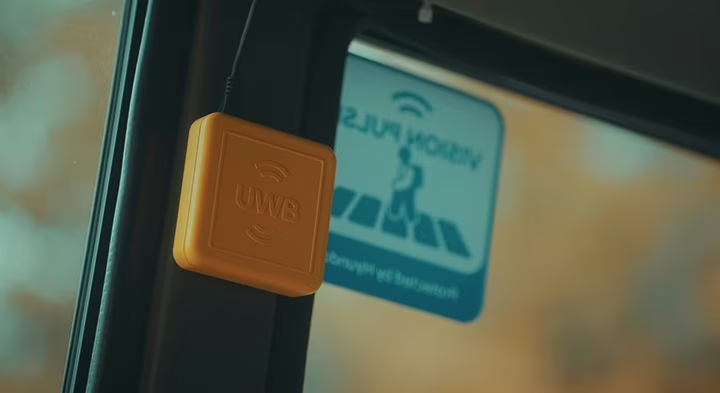
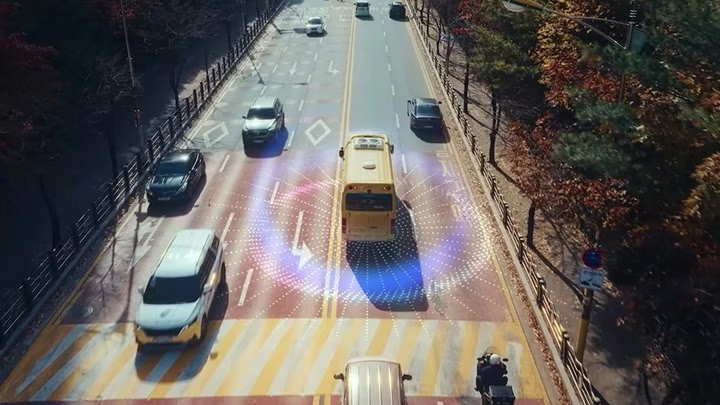
The technology is built around UWB (Ultra-Wideband) transceivers. If you aren’t a hardware geek like me, think of UWB as a super-powered, highly accurate version of Bluetooth that operates like a bat’s sonar.
Here is how the Hyundai/Kia system (often referred to as Vision Pulse in concepts) works in the real world:
- The Ping: Your car sends out a UWB radio signal while you drive.
- The Echo: Any UWB-enabled device within 100 meters answers that signal.
- The Calculation: The car analyzes the response time (Time of Flight) and the angle of arrival.
- The Result: The car knows the exact location of that device with 10-centimeter precision.
Seeing Through Walls
The game-changer here is that UWB uses radio waves. Unlike a camera lens, radio waves don’t care if there is a brick wall, a parked bus, or a thick fog bank in the way.
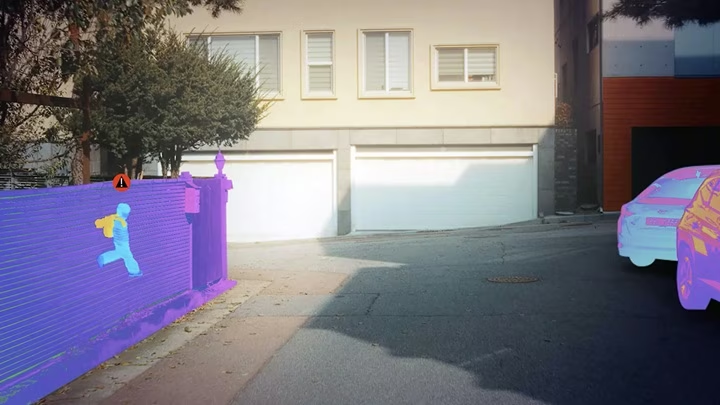
If another car is speeding toward a blind intersection, your car “feels” it coming before it is visible. If a child is hiding behind a barrier, the car knows exactly where they are.
The system is incredibly fast, updating positioning in just 1 to 5 milliseconds. In a crash scenario, those milliseconds are the difference between a close call and a tragedy.
The Secret Weapon: You Are Already Part of the Network

When I first read about this, my skepticism kicked in. “Great,” I thought. “But this only works if everyone is wearing a special beacon, right?”
Wrong. And this is where the genius lies.
You are probably holding the beacon right now. The UWB ecosystem has been quietly building up in our pockets for years. Hyundai and Kia aren’t trying to distribute millions of new devices; they are piggybacking on the tech we already own:
- Smartphones: Apple has included UWB chips since the iPhone 11. Samsung has them in the Galaxy S21 Ultra and newer.
- Trackers: Apple AirTags and Samsung Galaxy SmartTags use UWB.
- Other Cars: Brands like Tesla, BMW, Volkswagen, and Mercedes are already integrating UWB for digital key features.
This means the infrastructure is already there. The car doesn’t need to identify who is behind the wall; it just needs to know something carrying a UWB signal is moving on a collision course.
Real-World Testing: From Factories to Kindergartens

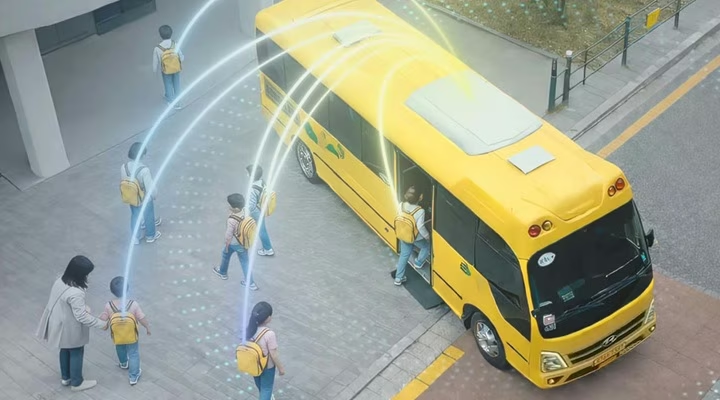
Hyundai and Kia aren’t just running computer simulations; they are testing this in the messy, unpredictable real world. I dug into some of their pilot programs in South Korea, and the use cases are fascinating.
The “Digital Backpack” for Kids
One of the most touching tests involved school buses. We all know children are unpredictable. They run, they trip, and they are small enough to disappear in a bus driver’s blind spot.
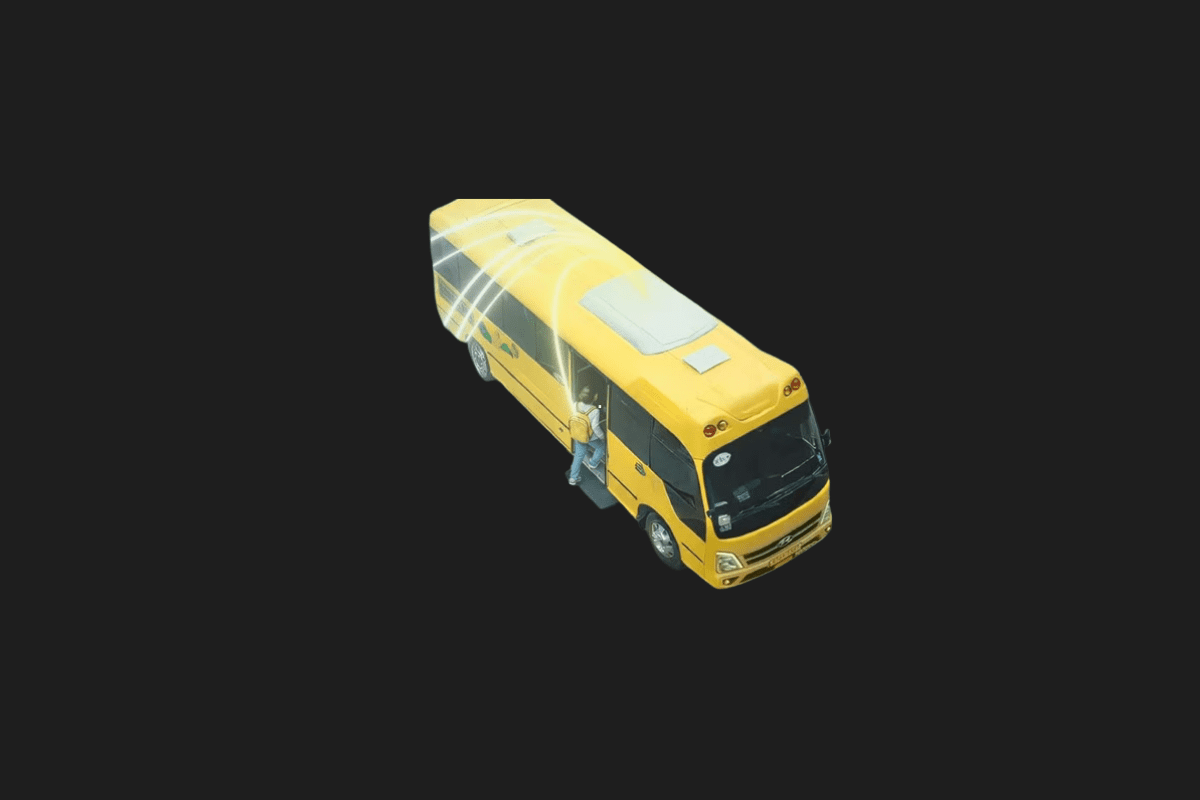
In the test, students had UWB tags attached to their backpacks (shaped like toys—a nice touch). The bus driver had a screen showing the precise location of every child, whether they were seated inside or running near the wheels outside. Even if a child was in a complete blind spot, the system alerted the driver not to move.
The Industrial “Sixth Sense”
They also deployed this at the Kia PBV conversion center and the Busan port. In these environments, forklifts and heavy machinery are constantly buzzing around. By equipping workers with UWB vests or tags, the machinery could automatically brake if a worker walked behind a stack of crates.
Beyond Traffic: Disaster Recovery

While analyzing this tech, I realized the potential goes far beyond avoiding fender benders.
Imagine an earthquake or a building collapse. Finding survivors is a race against time. If this UWB scanning technology becomes standard in vehicles or handheld rescue devices, first responders could scan a pile of rubble and detect the UWB signals from the victims’ phones or watches.
It could literally pinpoint a survivor buried under concrete with 10cm accuracy. That is the kind of technology that gives me chills in the best way possible.
My Perspective: The Privacy Question
Of course, as a tech enthusiast, I have to play devil’s advocate. This technology essentially turns our cars into scanning devices that track the phones of everyone around us.
While the current implementation focuses on “collision avoidance” (anonymous positional data), it opens the door to privacy conversations. Do I want every car I walk past to know exactly where I am?
However, looking at the trade-off, I lean towards safety here. If my phone broadcasting a ping can stop a 2-ton SUV from hitting me at a crosswalk, I’ll take that deal.
What’s Next?
Hyundai and Kia haven’t given a firm release date for the consumer rollout of this full “X-Ray” safety suite, but considering the hardware is already in their 2025 models (mostly for digital keys), a software evolution isn’t far off.
We are moving from an era where cars protect us, to an era where cars predict the world around us.
I want to hear from you. Would you feel safer knowing cars are tracking your phone’s location to prevent accidents, or does the idea of “X-Ray” cars feel a bit too invasive for your taste?
Drop a comment below and let’s discuss!
You Might Also Like;
- Privacy is Dead? Meta Wants Its Smart Glasses to Scan Your Face
- The “Everything App” is Here: X Confirms Incoming Stock and Crypto Trading
- Hyundai and Kia’s X-Ray Vision: Seeing the Invisible on the Road
-
-
-
-
-
-

-

-
-
-
-

-