

I remember trying to build a small virtual reality environment a while back. I needed a 3D model of a vintage desk lamp. I snapped a photo of one I had in my office, ran it through one of the popular AI image-to-3D generators available at the time, and waited. What came out was… disappointing, to say the least. The shape was somewhat there, but it looked like a dull piece of gray clay. The metallic finish, the way the light bounced off the curved shade—all of that was completely lost. It lacked soul.
That experience taught me a very frustrating lesson about 3D design: getting the shape right is only half the battle. The real magic, the thing that tricks our brains into believing an object is actually sitting in front of us, is how it interacts with light.
This is exactly why I’ve been obsessively reading up on Apple’s latest AI model, LiTo, which they recently presented at the ICLR conference. Apple isn’t just trying to generate 3D shapes from a single photo; they are actively solving the lighting problem. And from what I’ve seen, this is going to fundamentally change how we create digital content.
Let’s break down why LiTo is such a massive leap forward and what it means for the future of spatial computing.
The Problem with “Plastic” 3D Generation

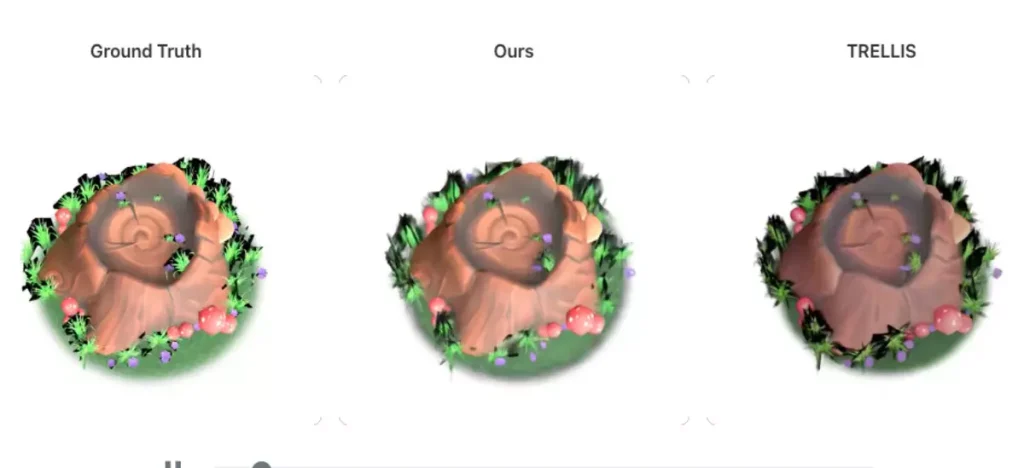
To understand why LiTo is a big deal, we have to look at where the industry is currently stuck.
Most text-to-3D or image-to-3D AI models are obsessed with geometry. They look at a 2D picture and try to guess the volume, the edges, and the depth. But when it comes to the texture, they usually just paste the flat colors from the photo directly onto the 3D mesh.
The result? The object looks completely static and artificial. If you rotate it in a 3D engine, the reflections don’t move. The shadows are baked right into the texture. It looks like a cheap plastic toy rather than a photorealistic asset.
The LiTo Difference: Mastering the “Surface Light Field”


When I dove into Apple’s research paper, one specific term caught my eye: Surface Light Field. This is the secret sauce behind LiTo.
Instead of just guessing the physical shape of a coffee mug or a car, LiTo is trained to understand how light behaves on different materials. Here is what it actually does when you feed it a single photograph:
- It calculates specular highlights: It knows that if an object is shiny, the glare of the light should move as you walk around the object.
- It understands material properties: It can tell the difference between matte leather, glossy plastic, and reflective metal, applying the correct visual physics to the generated 3D model.
- It isolates the lighting: Rather than baking the shadows from the original photo into the 3D model, it learns the “appearance” of the object, allowing it to dynamically react to the lighting of whatever virtual environment you place it in.
This is a monumental shift. By treating light and reflection as vital components of the 3D generation process, LiTo creates assets that actually look like they belong in the real world.
Head-to-Head: Beating the Current Standard
I always take corporate AI demos with a grain of salt, but the comparative data Apple provided is hard to ignore.
When put up against existing heavyweights in the open-source 3D generation space, like TRELLIS, LiTo showed a massive improvement in structural consistency. One of the biggest headaches with AI-generated 3D models is that they often look great from the front, but when you rotate to the back, the mesh breaks down, hallucinates extra limbs, or distorts the texture.
LiTo holds its ground. Because it calculates the light field alongside the geometry, the object remains incredibly stable and visually coherent from every single viewing angle.
Why is Apple Doing This? (Hint: Think Spatial)
I always find it fascinating to look at why a company is developing a specific technology. Apple isn’t suddenly trying to compete with Blender or Maya just for the fun of it.
If you look at their broader hardware strategy, the existence of LiTo makes perfect sense. Apple is betting heavily on spatial computing. Devices like the Vision Pro are incredible pieces of hardware, but they are starving for native 3D content. Building high-quality 3D assets traditionally takes hours, sometimes days, of painstaking work by skilled artists.
Imagine a near-future scenario where:
- E-commerce transforms: A small business owner takes a single photo of their new sneaker design with an iPhone, and LiTo instantly generates a flawless 3D model that you can examine in AR on your coffee table.
- Game Development accelerates: Indie developers can populate entire virtual worlds simply by taking reference photos of objects in the real world, drastically cutting down production time and costs.
- Personalized Spatial Environments: You could snap a photo of your childhood teddy bear and have a permanent, photorealistic 3D digital replica sitting on your virtual desk while you work in a spatial UI.
The Road Ahead
Apple is clearly accelerating its AI efforts, but they are doing it in a very “Apple” way. They aren’t just chasing the hype of text-based chatbots; they are building highly specialized, practical AI models that directly feed into their ecosystem.
LiTo proves that we are moving past the era of clunky, plastic-looking AI generation. We are entering an era where capturing reality—with all its complex lighting and textures—is as easy as tapping a shutter button.
I’m genuinely excited to see when Apple will integrate this directly into their developer tools, or perhaps even directly into the iOS camera app.
It makes me wonder about our physical surroundings. If you could point your camera at absolutely anything in your room right now and instantly turn it into a flawless, relightable 3D digital asset, what is the very first thing you would capture? Let me know your thoughts down below!
You Might Also Like;
- The Dark Side of Nanotechnology: Could Microscopic Swarms Erase Billions?
- The Illusion of Digital Immortality: Are You Really Uploading Your Mind?
- The View That Changes Everything: Artemis 2’s Deep Space Eclipse
-
-
-

-

-

-
-

-
-
-

-

-

