I have a confession to make: I have been waiting for a flying car since I was five years old.
We were promised a future where we would zip out of our garages, press a button, and soar over traffic jams like The Jetsons. Instead, for the last decade, all we really got were giant, noisy drones that you can’t actually drive on the road.
But this week, something changed.
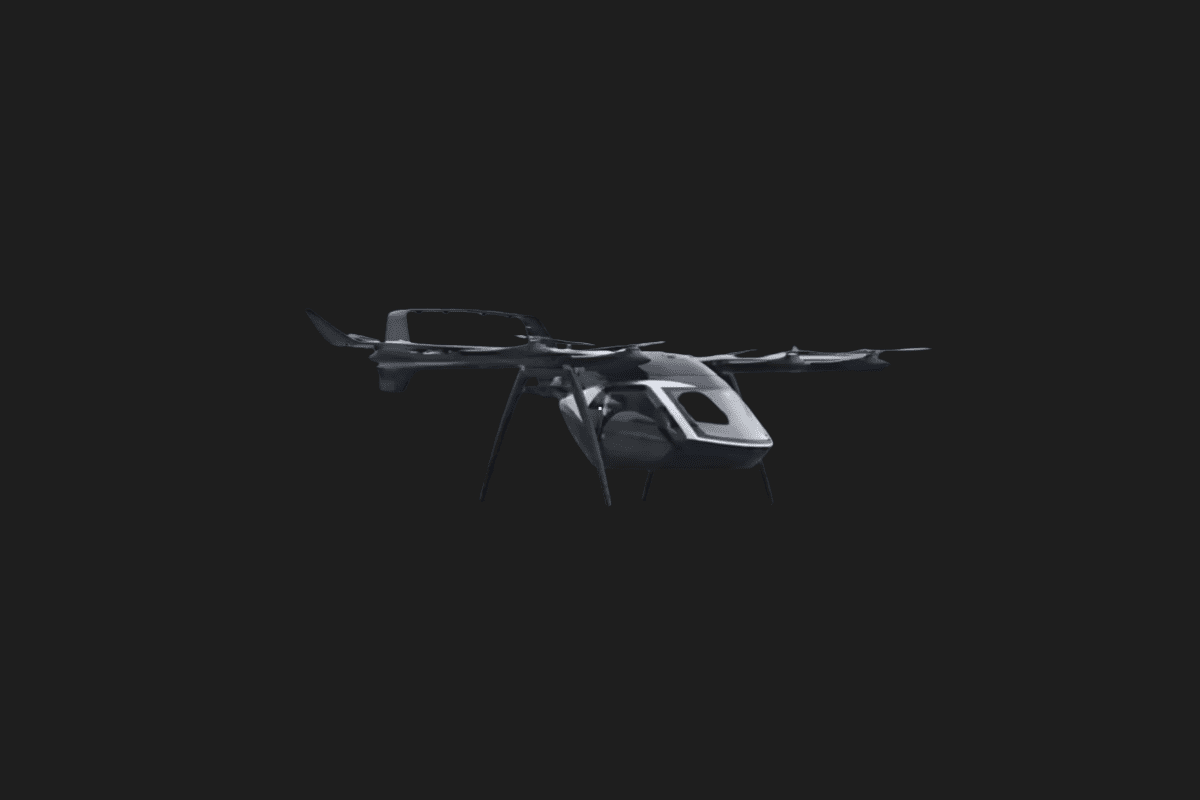
I’ve been tracking a development out of China that feels less like a standard aviation update and more like a scene from Transformers. The China Aerospace Science and Technology Corporation (CASC) just successfully test-flew a vehicle that doesn’t just fly or drive—it splits apart to do both.
This is the Modular eVTOL (electric Vertical Take-Off and Landing) vehicle, and honestly, it might be the smartest design I’ve seen in years.
Let’s break down why this strange, three-part machine has me so excited.
The “Lego” Philosophy of Transportation

Most flying car concepts fail because they try to do two things at once: be a good car (heavy, safe, wheels) and a good plane (light, aerodynamic). Usually, you end up with a terrible car and a terrible plane.
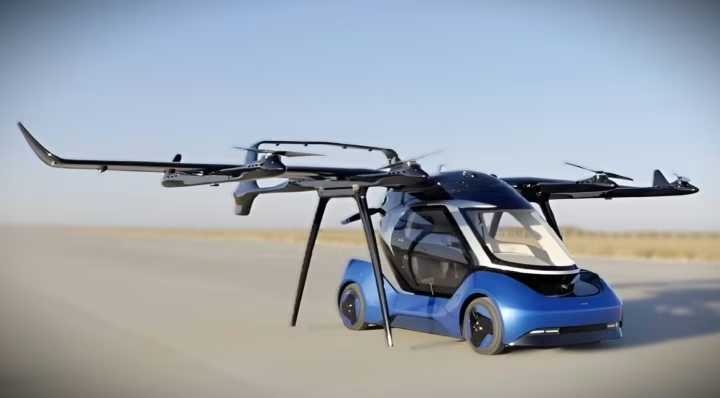
The engineers at CASC decided to cheat. Instead of making one vehicle, they made three modular components that snap together:
- The Ground Module (The Chassis): This is essentially a smart, electric skateboard. It has wheels, batteries, and drives like a car.
- The Cabin (The Pod): This is where you sit. It’s the passenger shell.
- The Air Module (The Wings): This is a giant drone rig with wings and rotors.
Here is the magic:
When you are on the ground, the Cabin sits on the Chassis, and you drive normally. When you want to fly, the Air Module swoops down, locks onto the Cabin, lifts it off the Chassis, and flies away. The wheels stay on the ground.
It’s brilliant because the flying part doesn’t need to carry the heavy wheels, and the driving part doesn’t need to carry the giant wings.
The Test Flight: By the Numbers

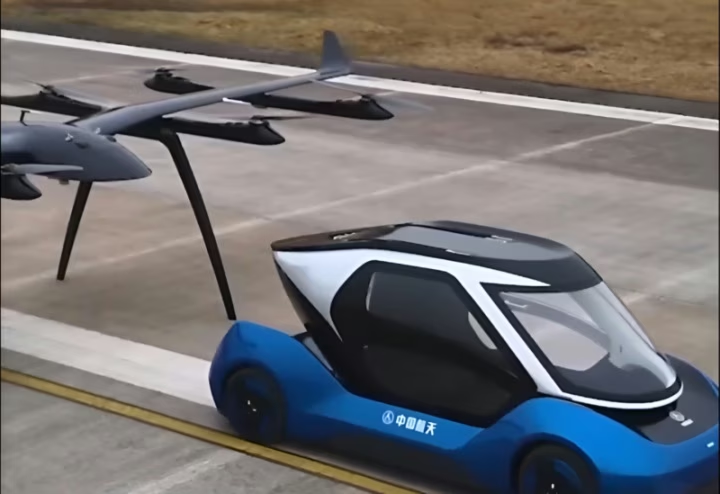
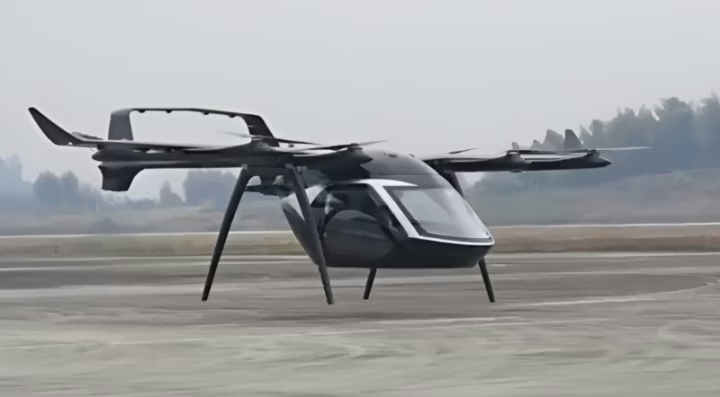
This wasn’t just a CGI render. CASC actually flew this thing. The prototype completed its maiden flight recently, verifying that the automatic locking mechanism actually works (which is a relief, because you definitely don’t want your car falling off the wings mid-air).
Here are the specs that caught my eye:
In the Air (The Flight Module)
- Speed: Up to 150 km/h (That’s faster than most highway speed limits).
- Altitude: Operates below 3,000 meters.
- Capacity: Currently tested with two passengers.
On the Ground (The Chassis)
- Range: Over 300 km on a single charge.
- Tech: Fully electric, “smart” cable-controlled chassis.
The Rivalry: CASC vs. Xpeng
If this modular concept sounds familiar, you might be thinking of Xpeng, the Chinese EV giant. I’ve written about their “Land Aircraft Carrier” before. But there is a key difference here, and it shows two different philosophies colliding.
| Feature | Xpeng (Land Aircraft Carrier) | CASC (New Modular eVTOL) |
| The Design | A 6-wheeled van that carries a drone inside it. | A chassis that separates from the cabin entirely. |
| The Vibe | “I have a drone in my trunk.” | “My car is the drone’s payload.” |
| Origin | Commercial EV Sector | State-backed Aerospace Sector |
Xpeng’s approach is basically a mother-ship carrying a baby helicopter. CASC’s approach is true modularity—the cabin itself is the cargo.
To me, CASC’s approach is riskier but potentially more revolutionary. Imagine a future where you don’t own the wings or the wheels. You just own the “Cabin.” You order a “Ground Chassis” to take you to the airport, then an “Air Module” picks up your pod and flies you to another city, where another set of wheels is waiting. It’s seamless logistics.
Why Do We Need This? (Beyond the Cool Factor)

Okay, aside from looking awesome, why are they building this?
The developers are pitching this for three main areas:
- Urban Commuting: Skipping the gridlock in Beijing or Istanbul.
- Logistics: Moving cargo containers without needing to unload/reload them—just unclip the pod and fly it.
- Emergency Response: This is the big one. Imagine an ambulance that can drive through a tunnel but then get picked up by a drone to fly over a blocked bridge.
The “But…” (There is Always a But)
I’m an optimist, but I’m also a realist. As much as I want to pre-order this, we are years away from seeing it in our driveways.
- Regulation: Air Traffic Control for planes is hard enough. Air Traffic Control for thousands of separating car-pods? That’s a regulatory nightmare.
- Safety: The “docking” mechanism needs to be 100% fail-proof. If that latch fails at 1,000 meters, there is no backup plan.
- Certification: CASC has proven it can fly. Now they have to prove it’s safe enough for the public.
Final Thoughts
We are watching the “Cambrian Explosion” of aviation. Just like in the early days of the automobile where cars had tillers instead of steering wheels, right now nobody knows exactly what the future flying car looks like.
Is it a big drone? Is it a plane with folding wings? Or is it this modular, shapeshifting robot from CASC?
I’m betting on modularity. It makes too much sense from a physics standpoint to ignore. Why carry dead weight when you can just leave the wheels behind?
What about you?
If you had to commute tomorrow, would you trust a machine that automatically unclips your car from its wheels and lifts you into the sky? Or do you prefer your vehicle to stay in one piece?
Let me know in the comments—I’d love to hear if you’re brave enough for the maiden voyage!
Ugu.
You Might Also Like;
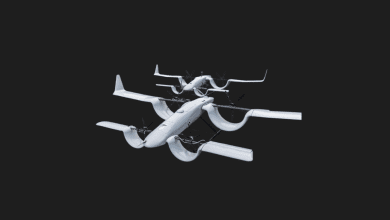
- A Century-Old Aviation Dream Reborn: The Channel Wing VTOL Takes Flight
- The Dawn of the Automated Battlefield: How Ground Robots Are Redefining Warfare
- The Insatiable Hunger of AI: Why Tech Giants Are Chasing Natural Gas
-
-
-

-

-
-

-
-

-

-

-

-