

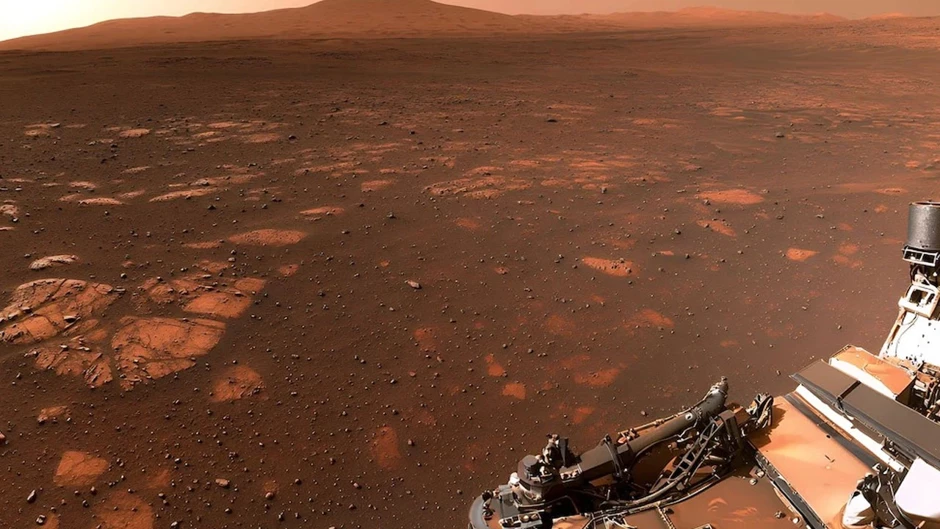
I’ve been following the Perseverance mission since that breathtaking landing in Jezero Crater, but what just happened at NASA’s Jet Propulsion Laboratory (JPL) honestly gave me goosebumps. We aren’t just sending robots to space anymore; we are sending thinkers.
For the first time in history, NASA has handed over the steering wheel—or rather, the pathfinding logic—of a multi-billion dollar rover to Artificial Intelligence. This isn’t just a software update; it’s a fundamental shift in how we explore the cosmos.
Why “Google Maps” Doesn’t Work on Mars


To understand why I’m so excited about this, you have to realize how painfully slow Mars driving used to be. On Earth, we open an app, and 225 million kilometers away, people think it’s just as easy. It’s not.
Until now, every single meter Perseverance moved was the result of meticulous human labor. Engineers at JPL would pore over satellite images from the Mars Reconnaissance Orbiter, calculate the angle of every rock, the depth of every sand trap, and the incline of every slope. One wrong move and a 2.7-billion-dollar piece of machinery becomes a permanent lawn ornament.
But in December, that changed. NASA integrated Claude AI models (developed by Anthropic) to see if an algorithm could handle the stress of Martian navigation.
The 450-Meter Leap of Faith


I found the details of the test flights—well, “test drives”—fascinating. On December 8th and 10th, the team fed the AI raw terrain data and satellite imagery. They basically told the AI: “Here is the goal. Find the safest path without flipping the rover or getting stuck.”
The result?
- The AI mapped out a route that took the rover 450 meters across challenging terrain.
- It identified hazards with the precision of a seasoned JPL veteran.
- The scientists checked the work, hit “send,” and Perseverance nailed it.
For context, this rover spent 3.5 months just trying to climb 500 meters out of Jezero Crater in 2024. In four years, it has only covered about 40 kilometers. That is a snail’s pace. By letting AI handle the “boring” parts of route planning, we are effectively taking the leash off our Martian explorer.
My Take: The End of “Remote Control” Exploration
What really strikes me here isn’t just the driving. It’s the autonomy. NASA Administrator Jared Isaacman mentioned that this tech will change how we view other planets.
I see a future where we don’t just send one rover and wait hours for a signal to travel back and forth. We send “swarms” of autonomous explorers that talk to each other, decide which rocks are worth lasering, and navigate canyons without waiting for a human in California to wake up and check the coordinates.
As I was digging into this report, I realized that we are finally moving past the “drone” phase of space travel and into the “robotic colleague” phase. The AI isn’t just a tool; it’s becoming a member of the crew.


The JPL experts are already hinting at what’s next. They want AI to sift through the thousands of images Perseverance takes daily to find the “needles in the haystack”—those tiny geological anomalies that might prove life once existed on Mars. Instead of humans spending weeks looking at red dust, the AI will ping us and say, “Hey, look at this specific rock; it looks weird.”
How do you feel about AI taking control of hardware 225 million kilometers away? Does the idea of “autonomous explorers” make you excited for faster discoveries, or does the lack of human oversight worry you?
You Might Also Like;
- The $40 Billion Typo: How One Click Turned 700 People into Instant Billionaires
- 3D Printing Just Got a ‘Muscle’ Upgrade: The End of Rigid Robots?
- MachineGames Confirms Wolfenstein 3 Is Inevitable
-

-
-
-
-
-
-
-
-
-
-

-

