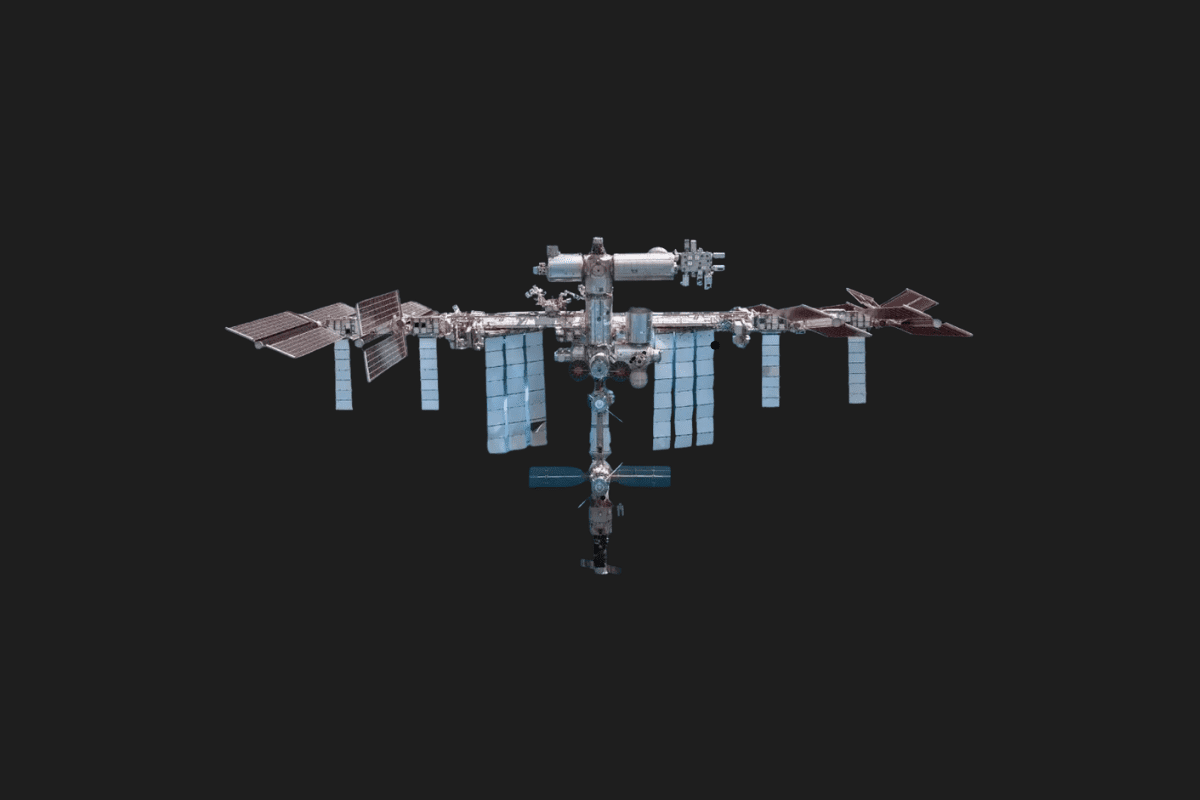
Orbiting silently above our heads, the International Space Station (ISS) stands as a monumental achievement of human collaboration and ingenuity. For over two decades, it has been a home to astronauts and a laboratory for groundbreaking research. While many are familiar with its existence, the ISS holds many secrets and surprising details that highlight the incredible nature of this outpost in space. Here are 10 facts about the ISS that are truly out of this world.
1. It is the size of a football field


. Many imagine the ISS as a small, cramped capsule, but the reality is far more expansive. The station’s structure, end-to-end, measures about 109 meters (357 feet) long, making it just shy of the length of an American football field. This massive structure includes living quarters, laboratories, and external trusses supporting giant solar arrays.
2. It travels at a staggering speed


The ISS hurtles through space at approximately 28,000 kilometers per hour (17,500 miles per hour). This incredible velocity means the station circles the entire Earth in about 90 minutes. For the astronauts on board, this results in a unique celestial rhythm.
3. Astronauts witness 16 sunrises and sunsets daily


Because of its high speed and orbital path, the crew of the ISS experiences 16 sunrises and 16 sunsets every 24 hours. This constant cycle of light and dark presents unique challenges for maintaining a normal sleep schedule, requiring strict routines and specially designed lighting to simulate a regular day-night cycle.
4. It has more living space than a six-bedroom house


Inside the station, the pressurized volume is equivalent to that of a Boeing 747 jumbo jet. This provides a surprisingly spacious interior that includes six sleeping quarters, two bathrooms, a gymnasium, and a 360-degree bay window called the Cupola, offering breathtaking views of Earth.
5. Drinking water is recycled from sweat and urine


Water is a precious and heavy resource to transport to space. To conserve it, the ISS is equipped with an advanced water recycling system. This system recycles about 93% of all water, including moisture from the astronauts’ breath, sweat, and even urine, purifying it into clean drinking water.
6. The ISS runs on millions of lines of computer code


. The complex operations of the International Space Station are managed by a vast network of computers. There are more than 1.5 million lines of flight software code on the station itself, supported by over 3 million lines of code on the ground. This intricate software is crucial for everything from life support to conducting scientific experiments.
7. It is a bustling hub for scientific research


The ISS is first and foremost a scientific laboratory. Since its launch, it has hosted more than 3,000 scientific experiments from researchers in over 100 countries. These experiments cover a wide range of disciplines, from biology and physics to astronomy and human health, taking advantage of the unique microgravity environment.
8. You can see it from Earth with the naked eye
On a clear night, the ISS is one of the brightest objects in the sky. It looks like a fast-moving, bright white dot crossing the heavens. Because its path is predictable, websites and apps from space agencies like NASA can tell you exactly when and where to look up to spot the station as it passes over your location.
9. Eight miles of wire connect its electrical system
To power its myriad of systems and experiments, the ISS has a complex electrical grid. This system is connected by approximately eight miles (13 kilometers) of wiring. The electricity itself is generated by massive solar arrays that have a wingspan longer than that of an Airbus A380.
10. Living in space changes the human body
The microgravity environment has peculiar effects on the human body. Without the pull of gravity, astronauts can grow taller temporarily. However, it also leads to the loss of bone and muscle mass. To counteract this, astronauts must exercise for at least two hours every day using specially designed equipment. Another strange effect is on the feet; the calluses on the soles of their feet peel off, while the tops of their feet can become rough from being used to navigate in microgravity.
You Might Also Like;
- The Mystery of the Far Side: What Is Hiding in the Lunar Shadows? | Metaverse Planet
- The Doomsday Clock Hits 85 Seconds to Midnight: Are We Out of Time?
- Nvidia’s AI Can Now Predict the Future (Of Weather)
-

-

-
-
-
-
-

-
-
-

-

-