

Please find below the article “10 Best DeFi Wallets in 2026,” presented in the same format and based on the data you provided. I have selected the top 10 wallets from your list and bolded key terms for clarity.
10 Best DeFi Wallets in 2026
In this article, we’ll take a closer look at the 10 best DeFi wallets in 2026.
DeFi wallets allow users to store, manage, trade, and interact with decentralized applications (dApps) and Web3 projects using crypto assets. Through DeFi wallets, users can interact with decentralized exchanges (DEXs) like Uniswap, liquid staking platforms, lending protocols, NFTs, and SocialFi apps.
The biggest advantage of DeFi wallets is that they offer users full control and ownership over their crypto assets. Assets held in DeFi wallets are controlled directly by users, unlike centralized platforms.
Crypto assets held in centralized exchanges and centralized wallets are under the control of the respective platform. For example, exchanges such as Binance and OKX have full control over user assets, and in a negative scenario, you may lose the funds you entrusted to the exchanges. This is because the private keys of the wallets where crypto assets are stored on exchanges are held by the exchanges, not the users.
Why Are DeFi Wallets More Secure?
- Full Control: DeFi wallets provide users with complete control and ownership over their assets.
- Miscellaneous Services: They offer access to various DeFi services, such as decentralized exchanges, liquid staking platforms, lending protocols, and NFTs.
- Non-Custodial Wallets: Some centralized exchanges, such as Binance, Crypto.com, and Bitget, provide non-custodial wallets that allow users to move their assets between exchange accounts and DeFi wallets.
These wallets help users manage their assets securely and gain more flexibility and freedom in the world of decentralized finance.
Difference Between DeFi Wallets and Regular Crypto Wallets
There are distinct differences between DeFi wallets and regular crypto wallets. Regular crypto wallets are developed to support a wide range of coin and blockchain networks. On the other hand, DeFi wallets are optimized for DeFi activities such as yield farming, lending, and trading, and offer powerful features for these activities.
Features of DeFi Wallets:
- DeFi Hub: DeFi wallets allow you to interact with various dApps and protocols on different blockchain networks, such as Solana, Ethereum, Avalanche, and Binance Smart Chain.
- Self-Custody: Most DeFi wallets allow users to secure their private keys, offering greater control and security.
- Seed Phrase Recovery: They create a unique recovery phrase of 12-24 words to restore wallet access in case the device is lost or damaged.
- Multi-Platform Support: DeFi wallets can have desktop and mobile apps, as well as web browser extensions.
In summary, DeFi wallets are specifically designed for the DeFi ecosystem and provide their users with unique features and opportunities that regular crypto wallets don’t offer. Of course, DeFi wallets do have some drawbacks, which we will touch on in the relevant sections of our article.
10 Best DeFi Wallets
Here are the 10 best DeFi wallets in 2026. We chose these wallets based on criteria such as functionality, key features, and security.
MetaMask: The Most Popular Ethereum DeFi Wallet


MetaMask, developed by ConsenSys, is one of the most popular DeFi wallets, supporting a wide range of tokens and blockchains. It is designed to facilitate user access to Ethereum-based decentralized applications (dApps) and DeFi projects, supporting standards such as ERC-721 and ERC-1155 for managing NFTs and other digital collectibles.
MetaMask Features
- Smart Transactions: Mitigates maximum extractable value (MEV) strategies and helps reduce transaction fees by sending transactions to a virtual memory pool before they are confirmed on-chain.
- DeFi Hub: A major hub for decentralized applications on Ethereum, providing access to thousands of Web3 applications and dApps.
- MetaMask Swap: Allows for seamless token swaps within the wallet, aggregating data from various decentralized exchanges (DEXs) to find the best prices with a 0.875% service fee.
- Fiat Purchases: Users can buy cryptocurrencies with fiat currencies like USD and EURO on 8 blockchains and over 75 tokens.
- MetaMask Bridge: A cross-chain bridge aggregator that facilitates Web3 interoperability and provides optimal routes for transferring tokens between blockchains.
- MetaMask Staking: Users can stake ETH and MATIC directly from the wallet using liquid staking providers like Lido and Rocket Pool.
MetaMask Security Features
MetaMask employs multiple security mechanisms:
- Privacy-preserving security alerts: Detects malicious dApps and sends alerts before verifying transactions.
- Safety Safes: Securely interacts with ERC and other tokens on various browsers to protect user identity.
Pros and Cons of MetaMask
Pros:
- Private keys are completely under user control.
- Broad integration with numerous dApps and crypto tokens in the Ethereum ecosystem.
- Allows custom integrations with Snaps.
- Interoperable with all EVM-compatible blockchains.
- Offers mobile integration for iOS and Android.
- Supports hardware wallet integration.
Cons:
- Only supports Ethereum and EVM-compatible networks.
- Not very user-friendly, and customer support is limited.
MetaMask is one of the oldest and most popular DeFi wallets, offering a comprehensive set of tools to meet users’ needs in the DeFi space.
Trust Wallet: Best DeFi Wallet for BNB Chain

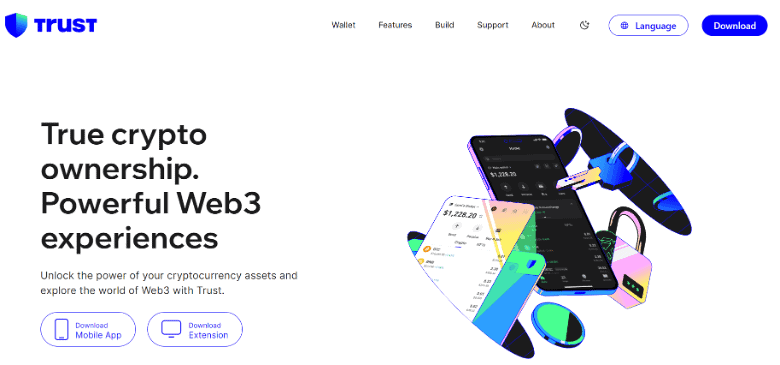
Trust Wallet allows users to trade and exchange cryptocurrencies, collect and trade NFTs, and explore thousands of dApps in the Ethereum and Binance Smart Chain (BNB) ecosystems. All features are accessible from the wallet’s dashboard on mobile devices and desktop browsers.
Trust Wallet Key Features
- dApp Browser: Enables interaction with dApps like Uniswap, Compound, and Aave, and access to NFT marketplaces like OpenSea.
- Staking Rewards: Allows staking of around 23 cryptocurrencies, including Ethereum (ETH), Binance Coin (BNB), TRON (TRX), Tezos (XTZ), Cosmos (ATOM), Osmosis (OSMO), and Kava (KAVA), with varying Annual Percentage Rates (APRs).
- Flexible Purchase Options: Facilitates purchasing cryptocurrencies from third-party platforms such as Mercuryo, MoonPay, and Simplex.
- Custom Token Integration: Simple process for adding custom tokens.
- Seamless Transfers Between Wallets: Quick and secure transfers using various authentication methods.
Trust Wallet Security Features
Trust Wallet utilizes biometric login, an auto-lock timer, encrypted private keys, 12-word recovery phrases, and two-factor authentication (2FA). It’s highly rated on platforms like GetApp and Trust Pilot and can be connected to a hardware wallet like Ledger for enhanced security.
Pros and Cons of Trust Wallet
Pros:
- Supports various blockchain ecosystems with millions of cryptocurrencies and tokens.
- Compatible with thousands of dApps.
- Offers staking for over 23 cryptocurrencies.
- Audited and certified by CertiK, Kudelski Security, and Halborn.
- Compatible with Ledger for increased security.
Cons:
- Educational content and customer support are limited.
- The Android version isn’t updated as often as the iOS version.
Trust Wallet offers a powerful and secure DeFi wallet experience with extensive features and integrations.
Phantom Wallet: Best Wallet for Solana


Phantom is Solana’s most popular self-custody wallet, with millions of active users. It supports Solana, Ethereum, Polygon, and Bitcoin. Phantom is known for its ease of use, allowing users to store, trade, and stake cryptocurrencies on mobile or via Chrome, Firefox, or Brave browser extensions. It supports almost all dApps on the Solana network, making it one of the top Solana DEXs by Total Value Locked (TVL).
Key Features of Phantom Wallet:
- Staking: Earn rewards by staking SOL tokens directly within the wallet.
- Token Swap: Instantly swap tokens with a fixed fee of 0.85% via integration with Raydium.
- Cross-Blockchain Support: Supports Ethereum, Bitcoin, and Polygon through a single interface.
- In-App Token Swap: Seamlessly swap tokens between supported networks.
- NFT Management: Dedicated section to view, display, and track NFT collections, with direct interaction with NFT marketplaces.
- Hardware Wallet Integration: Connects with Ledger for additional security.
Security Features of Phantom Wallet
Phantom is audited by leading cybersecurity companies, with public reports. It offers a $50,000 bug bounty for vulnerabilities. It also automatically detects and hides spam NFTs and URLs. Phantom provides 24/7 customer support globally.
Pros and Cons of Phantom Wallet
Pros:
- User-friendly and easy to install.
- Good customer support and user attention.
- Feature-rich, offering staking, NFT management, and trading.
- Supported by almost all DeFi dApps.
- Offers a high level of security.
Cons:
- No desktop application.
Phantom Wallet stands out in the Solana DeFi world with its ease of use, security, and broad dApp support.
Edge Wallet: Best Wallet for Lending in DeFi


Edge Wallet is a mobile-based non-custodial wallet launched in 2018, available for both iOS and Android. It allows users to store, manage, trade cryptocurrencies, and explore various dApps. Edge aims to provide a user-friendly and secure platform for interacting with a variety of cryptocurrencies and DeFi protocols. A notable feature is the ability to take out Bitcoin-collateralized loans and deposit borrowed dollars directly into a bank account, thanks to integration with the Aave liquidity protocol.
Key Features of Edge Wallet
- Multi-Asset Support: Supports a wide range of cryptocurrencies, including Bitcoin, Ethereum, XRP, Dash, and Dogecoin.
- In-App Cryptocurrency Swapping: Built-in swap function for seamless digital asset exchange.
- Fiat Launcher: Allows users to buy cryptocurrencies with fiat money directly through the wallet.
- Automatic Backup: Enables automatic account and data backup and wallet recovery.
- Password Recovery: Users can set up password recovery using two security questions and an email address.
Edge Wallet’s Security Features
Private keys are stored locally on the user’s device and secured using a hash of the username and password, not shared or stored on Edge servers. While practical for everyday transactions, it’s generally not recommended for storing large amounts of cryptocurrency due to the nature of mobile wallets.
Pros and Cons
Pros:
- Simple and intuitive interface for all user levels.
- Support for a wide range of cryptocurrencies and blockchain networks.
- Streamlines managing and acquiring digital assets.
- Uses strong security measures such as client-side encryption, two-factor authentication, and biometric authentication.
Cons:
- Only available as a mobile app, with no desktop or hardware wallet options.
- May not be ideal for those seeking more secure options for large cryptocurrency holdings.
Edge Wallet is noted for its convenient features and user-friendly interface for everyday use, particularly for DeFi lending.
Coinbase Web3 Wallet: Best DeFi Wallet for Novice Users

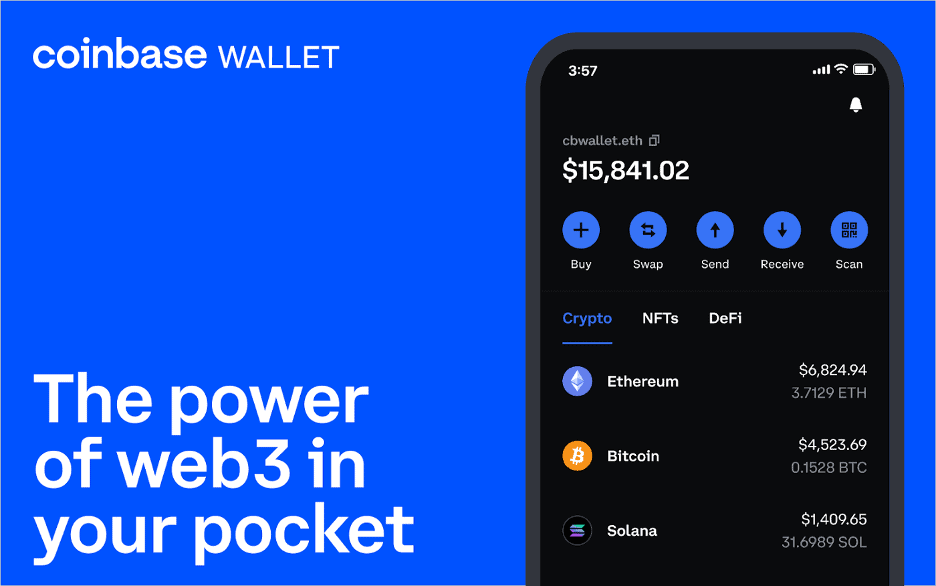
Coinbase Wallet is a secure, non-custodial wallet designed for cryptocurrency storage and management. It supports over 100,000 digital assets and NFTs and provides access to dApps, compatible with networks including Bitcoin, Ethereum, Arbitrum, and Optimism. Unlike MetaMask, Coinbase Wallet is an ideal starting point for beginner users due to its ease of use, simple setup, and wide range of features, also suitable for DeFi enthusiasts.
Key Features of Coinbase Wallet
- DeFi Hub: Explore thousands of dApps from different ecosystems (Ethereum, Solana), interact with DEXs like Raydium, review popular NFTs, use blockchain bridges, and access SocialFi apps.
- Exchange, Trade and Purchase: Swap over 100,000 cryptocurrencies on networks like Polygon, Ethereum, and Solana.
- User-Friendly and Easy Installation: Available as a browser extension (Chrome, Brave) and on iOS and Android mobile devices.
- Privacy: No personal information required; users can use a username to send and receive cryptocurrencies and NFTs.
Coinbase Wallet’s Security Features
Coinbase Wallet adheres to the highest crypto security standards, backed by the Coinbase exchange. As a self-custodial wallet, users store their private keys and receive a 12-word seed phrase. It offers advanced security options like biometric access, passwords, two-factor authentication (2FA), and security locks. Users can also integrate a Ledger hardware wallet for cold storage.
Pros and Cons of Coinbase Wallet
Pros:
- Supports liquid ETH staking in addition to regular staking.
- Designed for ease of use and offers simple installation.
- Available as a browser extension or mobile app for quick and easy setup.
Cons:
- The desktop version may be more convenient than the mobile version for some features.
- Coinbase customer support has faced past criticism.
Coinbase Wallet is easy to set up and use for beginners, offering a solid option in the DeFi world with its wide feature set and high security standards.
Guarda Wallet: Best DeFi Wallet for Token Creation

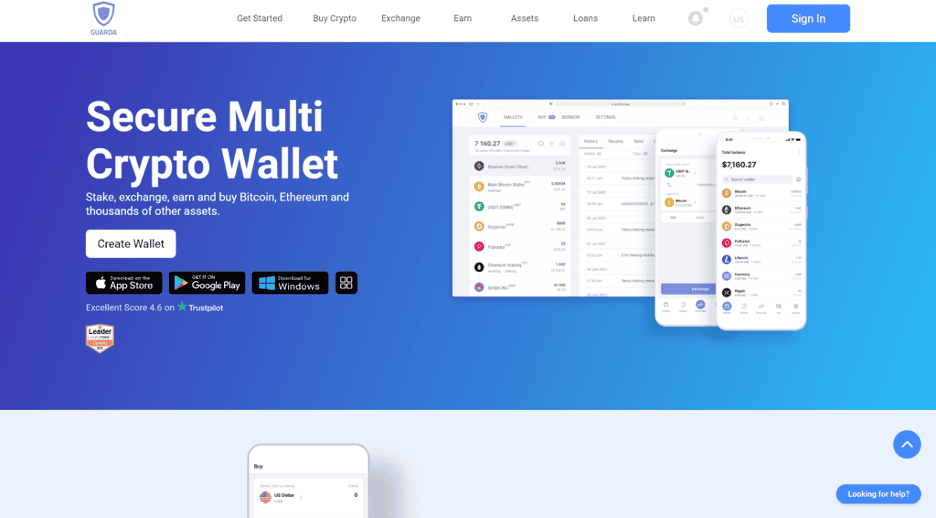
Guarda is a popular non-custodial wallet available on multiple platforms, offering services like sending, receiving, managing, storing, swapping, and staking cryptocurrency assets. It supports major blockchains like Bitcoin, Ethereum, Ripple, and Binance Coin, and over 400,000 tokens in total.
Key Features of Guarda Wallet
- Multi-Platform Support: Available as desktop apps, mobile apps, and browser extensions (Windows, Mac, Linux, iOS, Android).
- Multi-Currency Support: Supports over 50 blockchains and over 400,000 tokens.
- Built-in Swapping: Allows direct cryptocurrency swaps within the wallet.
- Staking Services: Offers staking for cryptocurrencies like Ethereum, Cardano, and Tron.
- Token Creation: Users can create and deploy their own ERC-20 tokens, a significant advantage for businesses or personal projects.
- NFT Support: Ability to store and manage non-fungible tokens (NFTs).
Guarda Wallet’s Security Features
Guarda Wallet maintains high security standards, keeping private keys under user control and protecting data with AES-256 encryption technology. Mobile apps feature biometric authentication (fingerprint, facial recognition). It can be connected to hardware wallets like Ledger for additional security. Guarda Wallet has not reported any security breaches in over five years.
Pros and Cons
Pros:
- Provides access to a wide range of dApps.
- Supports a variety of blockchains and over 400,000 cryptocurrencies.
- Allows creation of ERC-20 tokens.
- User-friendly interface and easy installation.
Cons:
- In-app transaction fees may be a bit high.
- Prepaid Visa card not available in some regions.
Guarda Wallet is a powerful DeFi wallet that simplifies digital asset management with its wide feature set and high security standards. Its token creation capability is a major advantage.
Binance Web3 Wallet: The Best DeFi Wallet for the Binance Ecosystem


Binance Web3 Wallet is a self-custody cryptocurrency wallet developed by Binance. It enables secure and convenient management, storage, and trading of cryptocurrencies, tokens, and NFTs, in addition to interacting with DeFi. It supports many blockchain networks, including Binance Smart Chain, Ethereum, Polygon, and Avalanche, allowing seamless asset management across ecosystems. Integrated with the Binance ecosystem, it can be set up via the Binance app dashboard and used on both mobile and desktop.
Key Features of Binance Web3 Wallet
- Multi-Chain Support: Supports over 38 blockchain networks.
- Token Swaps: Facilitates token swaps between different chains via Binance Bridge and various DEX integrations.
- Yield Farming and Staking: Provides access to various DeFi protocols and staking opportunities.
- dApp Browser: Built-in browser for direct interaction with decentralized applications.
- Secure Key Management: Uses MPC technology to secure funds without requiring a seed phrase.
- Binance Integration: Simplifies asset management by facilitating fund transfers between exchange accounts and the Web3 Wallet.
Binance Web3 Wallet’s Security Features
This wallet uses advanced multi-party computation (MPC) technology for asset security, eliminating the risk of centralized private key storage. It creates three “key shares,” each secured by a recovery password and stored separately on your device, cloud storage, and the Web3 Wallet.
Pros and Cons of Binance Web3 Wallet
Pros:
- Supports numerous blockchain networks and broad asset management capabilities.
- Facilitates fund transfers due to Binance exchange integration.
- Provides direct access to DEXs and DeFi protocols.
- Offers yield farming and staking features.
- Non-custodial with a user-friendly interface and advanced security measures.
Cons:
- May not be ideal for absolute beginners.
Binance Web3 Wallet is an excellent option for users interested in DeFi within the Binance ecosystem, offering extensive network support, powerful integrations, and high security measures.
Crypto.com DeFi Wallet: A Popular Choice Among Exchanges


Crypto.com DeFi Wallet is a non-custodial wallet developed by Crypto.com, designed for seamless interactions with the DeFi ecosystem and various dApps and Web3 projects. It is integrated with the Crypto.com ecosystem, allowing easy transfers between the Crypto.com exchange and the DeFi Wallet, similar to Binance Web3 Wallet.
Key Features of Crypto.com DeFi Wallet
- Multi-Blockchain Support: Compatible with networks such as Ethereum, Cronos, Crypto.org Chain, Solana, and Cosmos.
- Access to DeFi Protocols: Provides access to yield farming, staking, and decentralized exchange (DEX) trading.
- Non-custodial Wallet: Gives full control over private keys and funds.
Security Features of Crypto.com DeFi Wallet
Crypto.com conducts frequent security audits and holds compliance certifications. The app is compatible with hardware wallets like Ledger, allowing users to connect and manage their tokens. For mobile users, it supports biometric authentication (fingerprint and facial recognition).
Pros and Cons of Crypto.com DeFi Wallet
Pros:
- Full control over private keys.
- Support for multiple blockchain networks.
- Access to a wide range of dApps.
Cons:
- May not be suitable for beginners.
- Customer support is somewhat limited.
Crypto.com DeFi Wallet allows users to manage assets, stake, and participate in DeFi protocols across a vast ecosystem, standing out for its full control over private keys and high security standards.
Argent: Best DeFi Wallet For Starknet

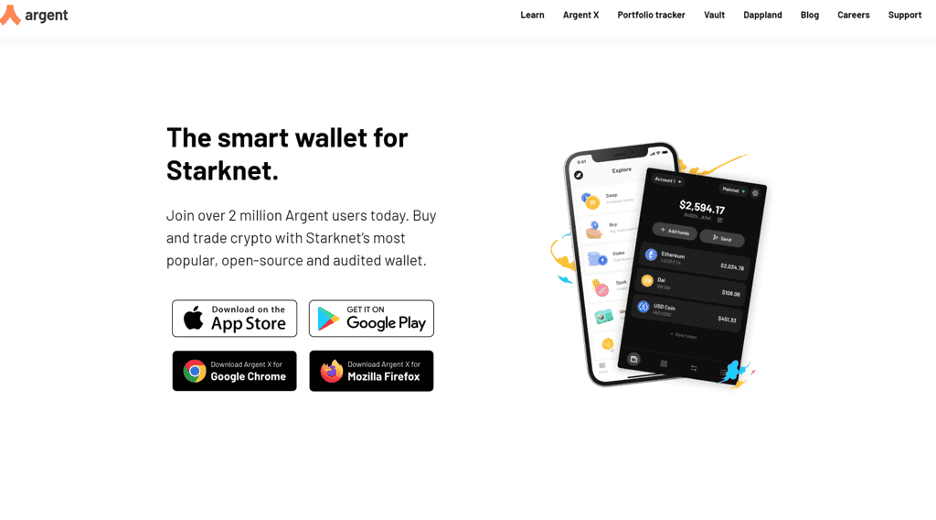
Argent is a mobile non-custodial wallet designed for DeFi and non-fungible token (NFT) transactions on the Ethereum and Starknet networks. Its user-friendly interface simplifies digital asset management and interaction with DeFi applications. This wallet streamlines Layer 1 and Layer 2 network interactions, offering features like gas-free transactions, easy recovery without recovery words, and integrated DeFi services.
Key Features of the Argent Wallet
- Easy Registration: Create a wallet in minutes, with no recovery words or private key required.
- One-Click DeFi Access: Provides access to popular DeFi protocols like Compound, Aave, and Uniswap with a single click.
- Social Recovery: If access is lost, users can appoint trusted people as “guardians” to recover their wallet.
- Gas-Free Transactions: Execute transactions directly without paying gas fees, which are then deducted from the user’s balance.
Security Features of the Argent Wallet
Argent offers advanced security measures such as multi-sig, biometric authentication (fingerprint or facial recognition), and two-factor authentication (2FA). Its “Guardians” feature relies on chosen people and devices to secure and recover the wallet.
Pros and Cons of Argent Wallet
Pros:
- Easy asset management and transactions with simple and intuitive design.
- Extra layer of protection with multi-signature security.
- Possibility to recover the wallet through trusted people (Social Recovery).
- Gas-free transactions reduce direct gas fee payment.
Cons:
- Only supports Ethereum and Starknet, limiting its network compatibility compared to others.
Argent is an excellent option for users interested in DeFi on Starknet, offering a user-friendly experience, strong security features, and gas-free transaction benefits.
Trezor Safe 3: Best Hardware Wallet for DeFi


Trezor, a renowned name in crypto, offers the Trezor Safe 3, which stands out with its advanced security features and extensive cryptocurrency support. It is widely considered one of the best hardware wallets available.
Key Features of Trezor Safe 3
- Enhanced Security:
- EAL6+ Certified Secure Element Chip: Provides advanced security.
- Anonymous Web Browser Tor Support: Supports Tor and anonymizes Bitcoin transactions using Coinjoin.
- Shamir Backup: Compliant with the Shamir backup standard, offering multiple recovery methods for private keys.
- Extensive Cryptocurrency Support:
- Over 8,000 Coins and Tokens: Supports major assets like Bitcoin, Solana, Ethereum, Cardano, Ripple, and Binance Coin, along with ERC-20 and SLP tokens (Cosmos and Avalanche not supported).
- Software Wallet Compatibility: Compatible with software wallets like Exodus, MetaMask, and Yoroi.
- Cross-Platform Compatibility:
- Broad Device Support: Works on Linux, Microsoft, Mac, and mobile devices (iOS and Android) via the Trezor Suite Lite app.
Trezor Safe 3 is an ideal hardware wallet for DeFi users due to its advanced security features, broad cryptocurrency support, and multi-platform compatibility. It is an excellent choice for users seeking to secure private keys and conduct anonymous transactions.
Ledger Nano S Plus: Secure and Comprehensive Crypto Wallet


The Ledger Nano S Plus is a hardware wallet designed for cryptocurrencies and non-fungible tokens (NFTs). Supporting over 5,500 digital assets, it offers a range of security and usability features.
Key Features of Ledger Nano S Plus
- Advanced Security:
- Secure Element Chip: Equipped with a CC EAL5+ certified Secure Element chip, independently certified by the French National Agency for Information Systems Security (ANSSI), highlighting its robustness and security.
- Extensive Crypto and NFT Support:
- Over 5,500 Digital Assets: Supports more than 5,500 cryptocurrencies, tokens, and NFTs, including various token standards like ERC-20, ERC-721, TRC-20, TRC-10, BEP-2, and SLP.
- Ease of Use:
- User-Friendly Interface: Features a dynamic and user-friendly interface, working with over 50 wallets to access dApps and Web3 applications. It allows installation of up to 100 applications.
Security Features
The Ledger Nano S Plus offers various advanced security features to protect digital assets. The Secure Element chip safeguards private keys and is supported by independent certifications.
Pros and Cons
Pros:
- High Security: Provided by the Secure Element chip and independent ANSSI certification.
- Broad Support: Supports over 5,500 digital assets and various token standards.
- Ease of Use: User-friendly interface and multi-wallet support ensure easy usage.
Cons:
- Setup and usage might be a bit complex for absolute beginners.
The Ledger Nano S Plus is a secure and comprehensive hardware wallet solution for managing a wide array of digital assets and interacting with the DeFi ecosystem.
This overview of the top 10 DeFi wallets in 2025 should help users make informed decisions based on their specific needs for security, platform compatibility, and supported features. Do you have any further questions about these wallets or other aspects of DeFi?
-
-

-

-
-

-
-

-

-

-

-

-

